Facts
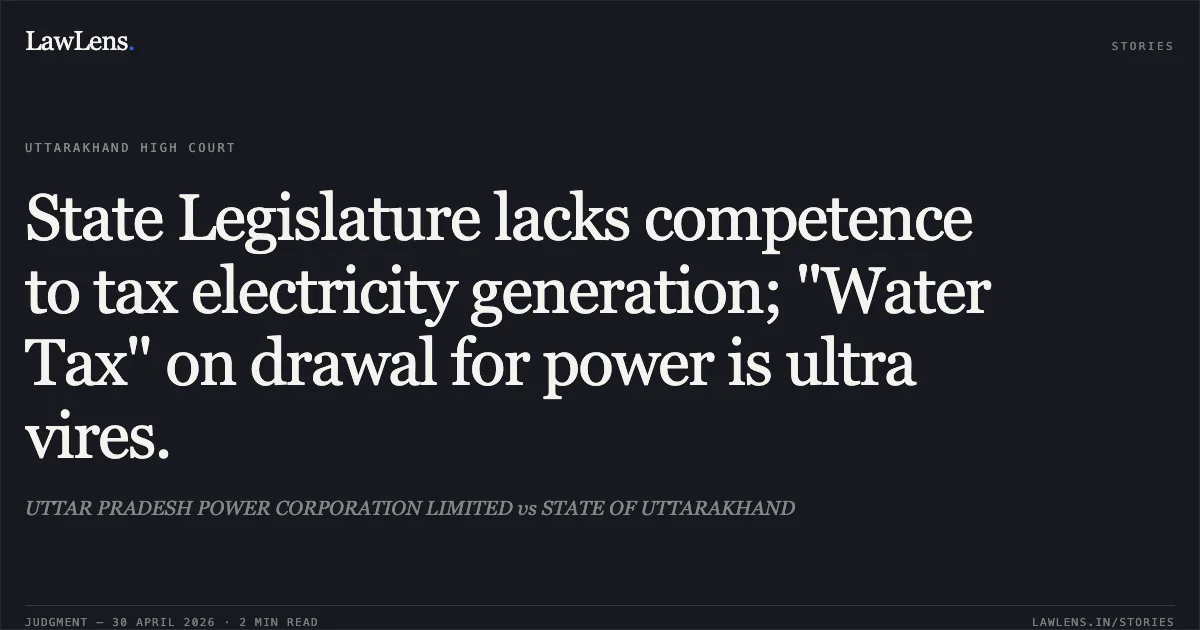
Various hydroelectric power corporations challenged the constitutional validity of "The Uttarakhand Water Tax on Electricity Generation Act, 2012," which imposed a "water tax" on users drawing water for power generation
Source reference: para. 1, 5Appellants argued they had entered into Implementation Agreements with the State, which promised exemptions from such taxes
Source reference: para. 10, 12A Division Bench of the Uttarakhand High Court delivered a split verdict in 2023: the Chief Justice upheld the Act, while Justice Maithani struck it down as ultra vires
Source reference: para. 2The matter was referred to a third judge (Justice Alok Kumar Verma) to resolve the tie
Source reference: para. 2Issues
1. Whether the State Legislature has the competence under List II to impose a tax on water used specifically for electricity generation
Source reference: para. 3, 302. Whether Section 17 of the Act suffers from the vice of excessive delegation by allowing the Government to fix tax rates without legislative guidelines
Source reference: para. 14, 433. Whether the State is barred by the doctrine of promissory estoppel from levying the tax due to prior contractual agreements
Source reference: para. 67, 71Law Applied
The Court applied Article 246 read with the Seventh Schedule of the Constitution, emphasizing that taxing entries are distinct from general regulatory entries (M.P.V. Sundararamier & Co. v. State of A.P.)
Source reference: para. 7, 64It relied on the "Doctrine of Pith and Substance" to determine that the true nature of a tax depends on its taxable event, not its nomenclature (State of W.B. v. Kesoram Industries Ltd.)
Source reference: para. 13, 65Regarding delegation, it applied the principle that fixing tax rates without a policy framework or "ceiling" constitutes abdication of "essential legislative functions"
Source reference: para. 45Concerning promissory estoppel, the Court followed M/s Hero Motocorp Ltd. v. Union of India, which establishes that estoppel cannot be pleaded against the legislature’s exercise of its legislative or taxing powers
Source reference: para. 70Reasoning
The Court analyzed the "charging section" (Section 17) and definitions (Section 2) to conclude that the taxable event was not the mere drawal of water, but the drawal specifically for electricity generation
Source reference: para. 39, 46Consequently, in pith and substance, the levy was a tax on electricity generation, which falls outside the State's competence under List II
Source reference: para. 46, 66Regarding delegation, the Court found that Section 17 conferred "naked" and "unfettered" power upon the Executive to fix and vary rates without any legislative cap or policy guidance, thus violating the rule against excessive delegation
Source reference: para. 45, 46On the point of promissory estoppel, while acknowledging the prior agreements promising tax exemptions, the Court held that a State Government’s contractual promise cannot bind the State Legislature’s sovereign power to enact laws, nor can there be estoppel against a statute
Source reference: para. 69, 72Holding
The Court concurred with the view of Justice Maithani, holding that "The Uttarakhand Water Tax on Electricity Generation Act, 2012" is ultra vires the Constitution due to a lack of legislative competence and excessive delegation
The reference was answered by striking down the Act
Source reference: para. 74The Court rejected the plea of promissory estoppel, holding that the State's taxing power cannot be interdicted by prior executive agreements
Source reference: para. 73Acts & Sections Cited
20 provisions across 1 statute referred to in this judgment. Each provision opens on LawLens.
Uttarakhand water tax and electricity Generation Act
Original Court PDF
UTTAR PRADESH POWER CORPORATION LIMITEDvsSTATE OF UTTARAKHAND
Click to open original judgment
Original judgment, available to read, download and summarize on LawLens.in