Facts
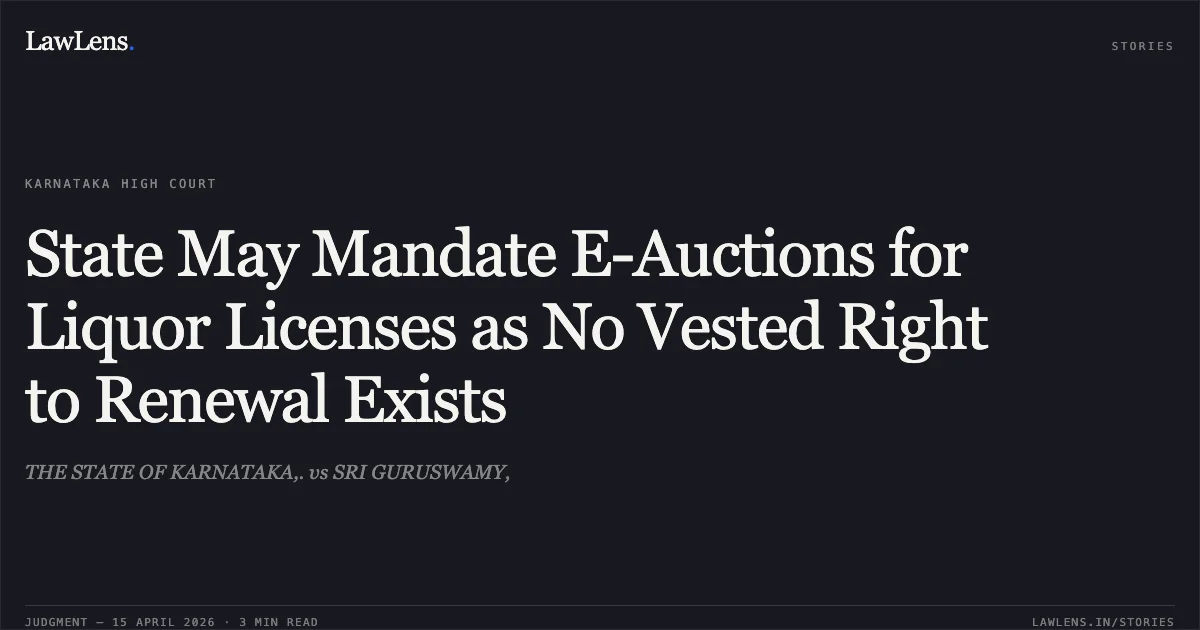
The Respondents, holders of CL-9 (Refreshment Room/Bar) licenses that were either discontinued or not renewed, challenged the Karnataka Excise (Sale of Indian and Foreign Liquors) (Second Amendment) Rules, 2025
Source reference: para 2, 3These "impugned rules" introduced "CL-2A" and "CL-9A" licenses to be granted via "e-auction" and mandated that non-renewed CL-2, CL-9, and CL-11(C) licenses be deemed lapsed, forfeited, and placed into an "auction pool"
Source reference: para 8, 10A learned Single Judge stayed the operation of the amended Rules 5 and 5-A on 25.11.2025, finding prima facie that the introduction of reservation-based eligibility and automatic forfeiture travelled beyond the scope of the Karnataka Excise Act, 1965
Source reference: para 1, 13-14The State appealed this interim stay
Source reference: para 1Issues
Whether the amended Rule 5 and Rule 5-A, providing for e-auctions and forfeiture of lapsed licenses, travel beyond the rule-making power conferred by the Karnataka Excise Act, 1965
Source reference: para 14, 20Whether the proviso to Rule 5, which allows the State to fix reservation norms via notification, constitutes "excessive delegation"
Source reference: para 16.1Whether the amended rules illegally extinguish a "vested right" of renewal for existing or past licensees
Source reference: para 16.2, 59Whether the classification and singling out of CL-2, CL-9, and CL-11(C) licenses for the auction pool is discriminatory under Article 14 of the Constitution
Source reference: para 16.3, 66Law Applied
The Court applied the settled principle that there is no fundamental right to trade in liquor; it is a res extra commercium (State privilege), and the State can determine the terms for parting with this privilege
Source reference: para 46-49It relied on Section 71 of the Karnataka Excise Act, 1965, which empowers the State to make rules regulating the "persons or classes of persons" and the "procedure to be followed" for granting licenses
Source reference: para 32-34The Court followed Arun Tewari v. Zila Mansavi Shikshak Sangh, holding that sub-delegation to the same authority (the State) is not "excessive delegation"
Source reference: para 57-58It applied Bibi Sayeeda v. State of Bihar to distinguish "vested rights" (accrued property) from "mere expectancy" of renewal
Source reference: para 60-61Finally, it upheld the "presumption of constitutionality" for legislative instruments
Source reference: para 68-72Reasoning
The Court reasoned that Section 71(1) and (2)(e) of the Act provide broad powers to the State to regulate who may hold licenses and for what period
Source reference: para 34, 39Since the Act does not grant an indefeasible right to renewal, the Court held that the Rules—which created the right to renew—could also validly limit or extinguish it
Source reference: para 37-38On the issue of "excessive delegation" regarding reservation norms, the Court noted that the State was not delegating power to a subordinate officer but was incorporating its own policy, which is akin to incorporation by reference
Source reference: para 56-57, 65The Court found no violation of Article 14, stating that the State is permitted to create reasonable classifications of licenses and that uniformity in contract terms is not a constitutional requirement
Source reference: para 66-67Critically, the Court observed that the Single Judge failed to apply the "presumption of constitutionality," noting that a stay on legislation requires a "very strong case of invalidity," which the respondents failed to provide
Source reference: para 68, 72-74Holding
The High Court allowed the appeal and set aside the Single Judge’s interim stay
The Court held that the impugned rules are prima facie within the State’s rule-making authority under the Excise Act
Source reference: para 43It concluded that the respondents had no "vested right" to renewal
Source reference: para 63The adoption of reservation norms by the State did not constitute unconstitutional sub-delegation
Source reference: para 58, 65While the Court reserved the respondents' right to argue the validity of Rule 12 (population-based quotas) before the Single Judge, it vacated the interim orders against Rules 5 and 5-A
Source reference: para 75-77Acts & Sections Cited
2 provisions across 2 statutes referred to in this judgment. Each provision opens on LawLens.
KARNATAKA HIGH COURT ACT, 19611
Companies Act, 20131
Original Court PDF
THE STATE OF KARNATAKA,.vsSRI GURUSWAMY,
Click to open original judgment
Original judgment, available to read, download and summarize on LawLens.in