Facts
The petitioner was appointed as a Gagman/Laborer on a daily-wage basis in 1998 within the Public Works Department of Chhattisgarh
Source reference: para. 2Having completed over 25 years of continuous service, she sought regularization of her services based on State Government circulars and judicial precedents
Source reference: para. 2She had previously submitted a representation to Respondent No. 3 on December 10, 2025, which remained pending
Source reference: para. 2The petitioner approached the High Court seeking a mandamus to direct the respondents to consider her case for regularization as a one-time measure with consequential benefits
Source reference: para. 1.1Issues
1. Whether the petitioner, having served for more than 25 years as a daily wager, is entitled to have her services considered for regularization in light of the principles laid down by the Supreme Court
Source reference: para. 2 & 52. Whether the court should direct the State authorities to decide the petitioner's pending representation within a specific timeframe
Source reference: para. 3 & 11Law Applied
Secretary, State of Karnataka v. Umadevi, (2006) 4 SCC 1, which mandated a one-time regularization measure for employees in irregular (not illegal) appointments who have served for over ten years in sanctioned posts
Source reference: para. 5Jaggo v. Union of India (2024) and Bhola Nath v. State of Jharkhand (2026), which deprecated the "pervasive misuse of temporary employment contracts" and "ad-hocism" to evade regular employment obligations
Source reference: para. 7-8State of Chhattisgarh’s Circular dated March 5, 2008, which outlines the procedural framework for regularizing Class III and IV daily-wage employees
Source reference: para. 6Reasoning
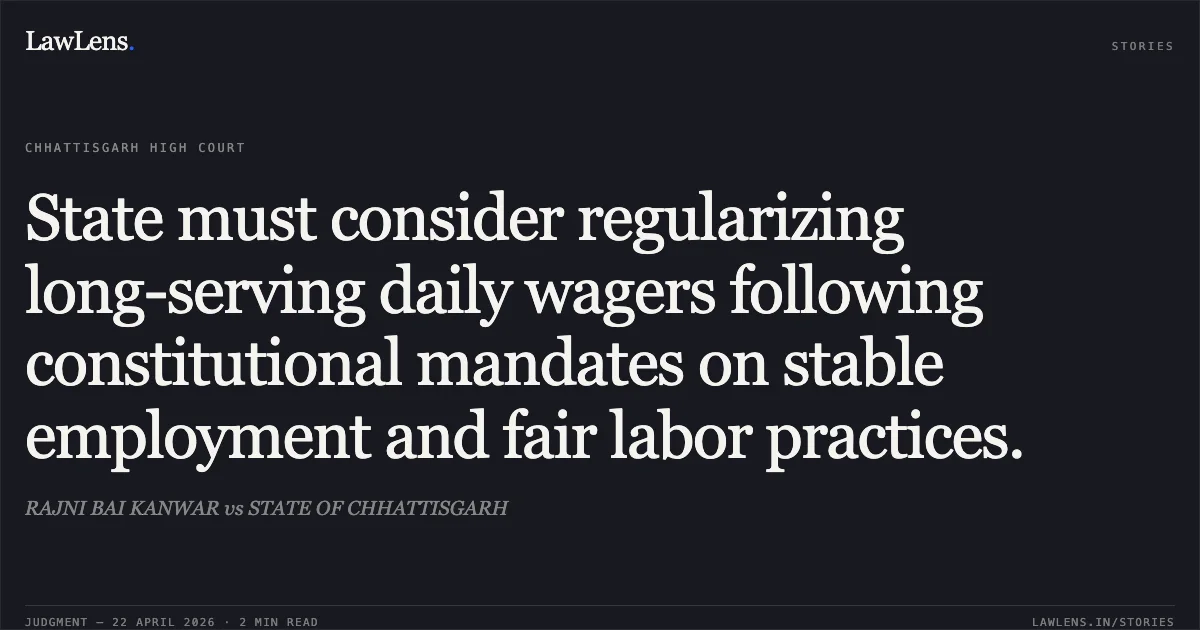
The Court examined the petitioner’s long tenure—exceeding two decades—against the evolving standard of the State as a "constitutional employer" rather than a mere market participant
Source reference: para. 10The Court reasoned that keeping employees in "perpetual uncertainty" despite decades of service contradicts Article 14 and the principle of "equal pay for equal work"
Source reference: para. 9While the petitioner had not initially filed her representation before the highest authorities (Respondents 1 and 2), the Court found that the facts warranted a directed administrative review to ensure the "legitimate rights of workmen" are not trumped by bureaucratic limitations
Source reference: para. 9-11Holding
The Court disposed of the writ petition without adjudicating on the merits, instead permitting the petitioner to submit a fresh, comprehensive representation to Respondents No. 1 and 2
The Court directed the said respondents to consider and decide upon the representation in accordance with the law and the judicial precedents discussed (specifically Umadevi, Jaggo, and Dharam Singh) within a period of six months from the date of receipt
Source reference: para. 11Acts & Sections Cited
3 provisions across 2 statutes referred to in this judgment. Linked provisions open on LawLens.
U.P. Industrial Disputes Act, 19472
Chhattisgarh Lok Seva (Anusuchit Jatiyon, Anusuchit Janjatiyon Aur Anya Pichhade Vargon Ke Liye Arakshan) Adhiniyam, 19941
Original Court PDF
RAJNI BAI KANWARvsSTATE OF CHHATTISGARH
Click to open original judgment
Original judgment, available to read, download and summarize on LawLens.in


