Facts
The petitioners, Assistants working in Ordnance Factories and the Ordnance Factory Board (OFB), filed contempt petitions alleging willful disobedience of a judgment dated 14.10.2014 passed in W.P.(C) 4606/2013
Source reference: para. 1That judgment directed the respondents to grant Assistants in Ordnance Factories historical pay parity with Assistants in CSS/CSSS and Army Headquarters with effect from the same date
Source reference: para. 1Despite the order categorically covering "all similarly placed persons," the respondents failed to extend these benefits to the petitioners
Source reference: paras. 2-3The respondents contested the petitions on grounds of delay/laches and alleged lack of historical pay parity for this specific set of employees
Source reference: paras. 10, 12Issues
1. Whether the respondents are bound to extend the benefits of a prior judicial pronouncement to similarly situated employees who were not original parties to the litigation
Source reference: para. 52. Whether the exception of "laches and delay" applies to fence-sitters in matters involving a continuing cause of action and judgments in rem
Source reference: para. 11Law Applied
The court relied on the principle that when a particular set of employees is granted relief, all identically situated persons must be treated alike under Article 14 of the Constitution to avoid discrimination
Source reference: para. 7Girish Mittal v. Parvati V. Sundaram, establishing that contempt petitions are maintainable by aggrieved parties even if they weren't parties to the original judgment if the directions were general
Source reference: para. 6State of U.P. v. Arvind Kumar Srivastava, distinguishing between judgments in personam and judgments in rem, noting that state instrumentalities should extend benefits to all similarly placed employees without forcing individual litigation
Source reference: para. 7Lt. Col. Suprita Chandel v. Union of India, which held that the government should not penalize employees for not litigating earlier if they are identically situated
Source reference: para. 8Reasoning
The court reasoned that the 14.10.2014 judgment was comprehensive and intended to maintain historical parity across all organizations where employees had identical pay scales, using "Ordnance Factories" as an illustrative rather than exhaustive category
Source reference: para. 9The Court rejected the respondents' plea of "laches," finding that the denial of pay parity constitutes a continuing cause of action and that the petitioners had been diligently pursuing the matter with the authorities
Source reference: para. 11Regarding the respondents' claim that no parity existed, the Court held that the rationale in the original 2014 judgment already negated this argument, specifically finding that historical parity was a recognized fact across these ministerial/secretarial posts
Source reference: paras. 12-13Consequently, the Court determined that the respondents' refusal to apply the policy uniformly was a failure to comply with the overarching terms of the original decree
Source reference: para. 14Holding
The Court held that the respondents must extend the same pay dispensation to the petitioners as provided to other Assistants in Ordnance Factories and the OFB
The Court directed compliance within 12 weeks, with a compliance affidavit to be filed within 8 weeks thereafter. any further non-compliance would be treated as an egregious breach and willful disobedience, entailing fresh action under the Contempt of Courts Act, 1971
Source reference: paras. 17-19Acts & Sections Cited
1 provisions across 1 statute referred to in this judgment. Linked provisions open on LawLens.
Contempt Of Courts Act, 19711
Original Court PDF
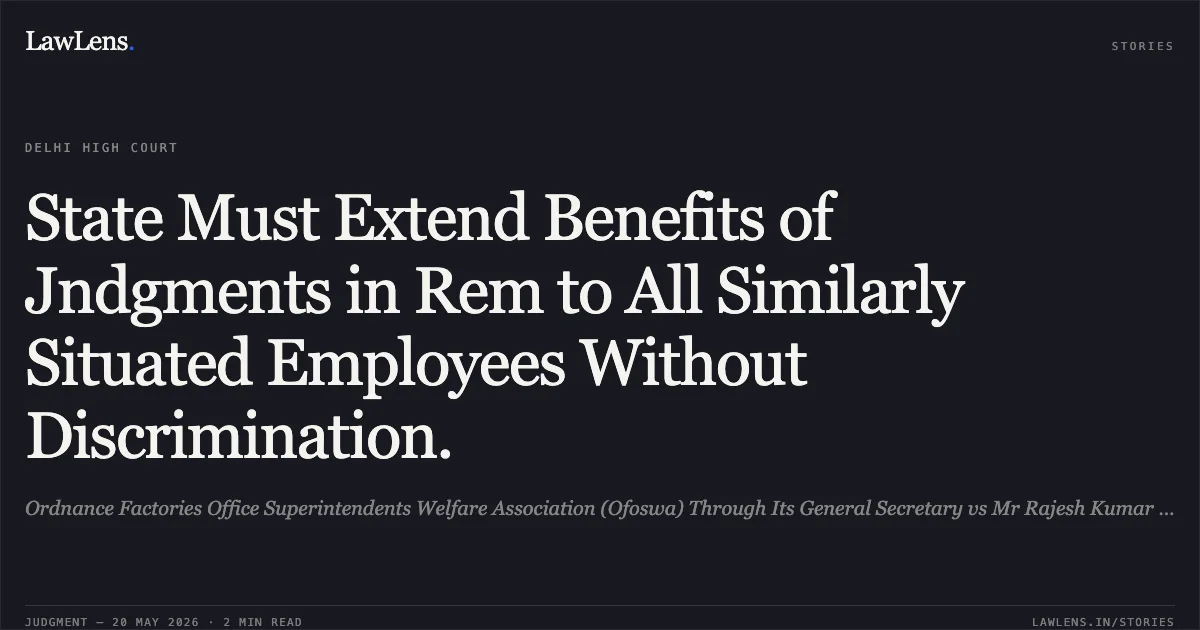
Ordnance Factories Office Superintendents Welfare Association (Ofoswa) Through Its General SecretaryvsMr Rajesh Kumar Singh & Ors.
Click to open original judgment
Original judgment, available to read, download and summarize on LawLens.in