Facts
The petitioner, a registered small-scale industrial unit owned by a Kashmiri Pandit (Sh. K. L. Ambardar), was allotted Shed No. 5 at Bagh-i-Ali Mardan Khan Industrial Area, Srinagar, in 1978.
Source reference: para. 2Following the mass migration of Kashmiri Pandits in 1989 for safety, the petitioner migrated to Jammu, leading to the abandonment of the unit.
Source reference: para. 3-4In 1991, the shed was damaged by fire.
Source reference: para. 5Subsequently, the state re-allotted the site to Respondent No. 6. In a previous round of litigation (OWP No. 488/1996), the High Court directed the state to either provide a similar shed to the petitioner or restore Shed No. 5.
Source reference: para. 6In purported compliance, the respondents offered alternate sheds at Rangret but demanded a new premium and significantly higher rent (Rs. 5,250/- instead of the original Rs. 150/-).
Source reference: para. 8, 11While contempt proceedings regarding the adequacy of this compliance were pending, the respondents issued Order No. IDC/B/2004/73 on 06.04.2004, cancelling the Rangret allotment due to the petitioner’s failure to complete formalities and pay the demanded sums.
Source reference: para. 12Issues
Whether the state acted within its legal and fiduciary obligations by cancelling the allotment of alternate sheds while the petitioner was a registered migrant and contempt proceedings were pending?
Source reference: para. 12, 21Whether the state’s demand for new premiums and higher rents for alternate sheds, necessitated by the state's failure to protect the petitioner's original leasehold, was fair and equitable?
Source reference: para. 21-22Whether the principles of natural justice were violated in cancelling the allotment given the security situation in Kashmir at the relevant time?
Source reference: para. 23Law Applied
The court applied the Principles of Natural Justice, emphasizing that administrative actions must be fair and take into account the specific constraints of the parties involved, such as mass migration due to turmoil.
Source reference: para. 23It invoked the doctrine of State Responsibility and Fiduciary Duty, asserting that the state has a "solemn obligation" to protect and preserve the properties of citizens forced to migrate for safety.
Source reference: para. 21The court utilized the principle of Equity, seeking to restore the petitioner to a position comparable to their original status without allowing the state to benefit from the petitioner's misfortune.
Source reference: para. 22Reasoning
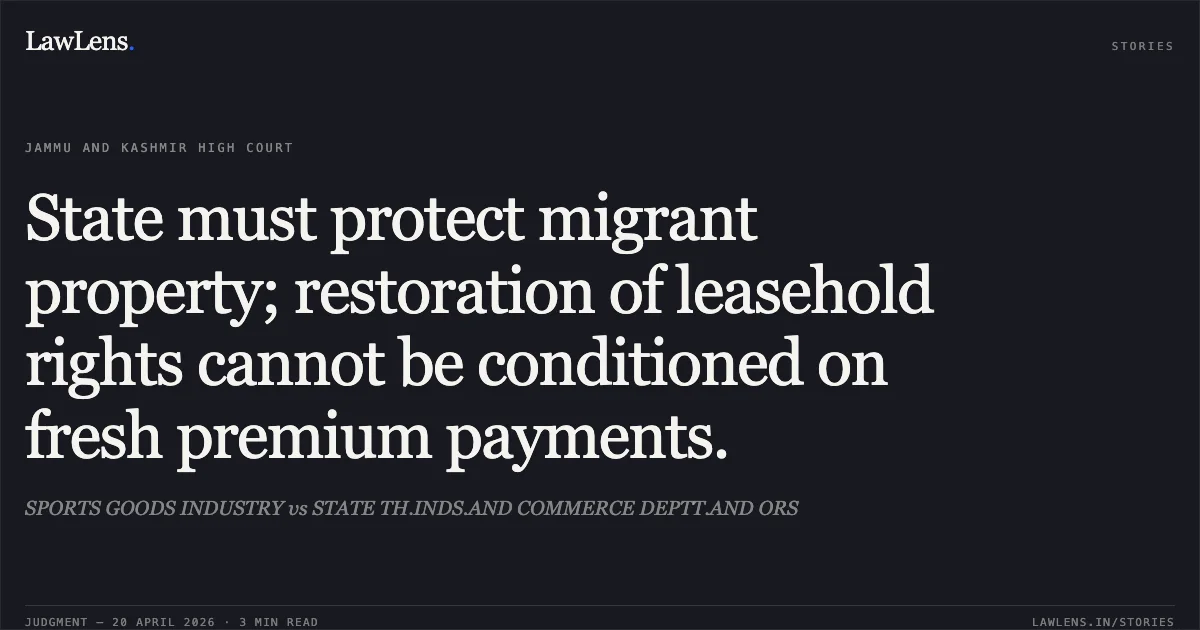
The court observed that the state, instead of acting as a "protector" of the migrant’s property, acted as a "predator" by re-allotting the petitioner’s original shed to a third party during their forced absence.
Source reference: para. 21-22It characterized the state’s offer of alternate sheds at Rangret as a "mirage" and "eyewash" because the state imposed financial terms (new premiums and high rents) as if the petitioner were a new applicant rather than a displaced original allottee.
Source reference: para. 9-11, 21The court reasoned that it was unreasonable for the state to expect the petitioner to restore industrial activity at a time when the safety of the Kashmiri Pandit community was not secured.
Source reference: para. 23By cancelling the allotment while the court was still seized of the matter in contempt proceedings, the respondents ignored the "vested claim and entitlement" of the petitioner and violated the rules of natural justice.
Source reference: para. 23Holding
The court allowed the writ petition and quashed the cancellation order dated 06.04.2004. It held that the state's treatment of the petitioner was unfair and inequitable.
The court directed the official respondents to: (i) allot two sheds at Industrial Estate, Rangret (either the original ones or new ones if unavailable) for the petitioner’s use; (ii) waive any requirement for premium payments; and (iii) charge rent at the prevalent rate prospectively from the date of actual occupation, without insisting on any past arrears.
Source reference: para. 24Original Court PDF
SPORTS GOODS INDUSTRYvsSTATE TH.INDS.AND COMMERCE DEPTT.AND ORS
Click to open original judgment
Original judgment, available to read, download and summarize on LawLens.in