Facts
The petitioners, both of whom are legal adults (aged 19 and 23 respectively), entered into a voluntary inter-caste marriage on March 6, 2026.
Source reference: paras. 2, 5They provided documentation, including a government-issued marriage certificate and Aadhar cards, to verify their age and marital status.
Source reference: para. 2Following the marriage, the petitioners and the husband’s family faced threats of violence and false criminal implication from the wife's family due to community and caste differences.
Source reference: paras. 2, 5Despite submitting representations to the Home Ministry and local police authorities on March 28, 2026, no protective action was taken, prompting the petitioners to seek a writ of mandamus for police protection.
Source reference: paras. 2, 7.1Issues
1. Whether the petitioners are entitled to police protection to safeguard their life and liberty following a valid inter-caste marriage between consenting adults.
Source reference: para. 22. Whether the interference and threats by family members and the community constitute an infringement of the petitioners' constitutional rights and dignity.
Source reference: para. 2Law Applied
Article 21 of the Constitution of India, which guarantees the right to life and personal liberty.
Source reference: no citationLata Singh v. State of U.P. and Another (2006) 5 SCC 475, which established that adults are free to marry any person of their choice and that inter-caste marriages are in the national interest.
Source reference: para. 6Shakti Vahini v. Union of India and Others (2018) 7 SCC 192 regarding the prevention of "honour" crimes and the duty of the state to protect couples from harassment or violence initiated by family members who disapprove of their choice of partner.
Source reference: para. 2Reasoning
The court found that because the petitioners are majors and had legally solemnized their marriage of their own free will, no third party—including family members—had the legal authority to interfere or obstruct their choice.
Source reference: paras. 3, 5The State’s counsel did not dispute the majority or the voluntary nature of the union.
Source reference: para. 3Applying the Lata Singh precedent, the court reasoned that the caste system should not be a barrier to marriage and that the threats of "honour" killings or false criminal cases are "barbaric" acts that demand stern administrative intervention.
Source reference: para. 6The court emphasized that the police have a duty to prevent harassment of such couples and that failure to act on the petitioners' representations necessitated judicial direction to ensure their safety.
Source reference: paras. 6, 7Holding
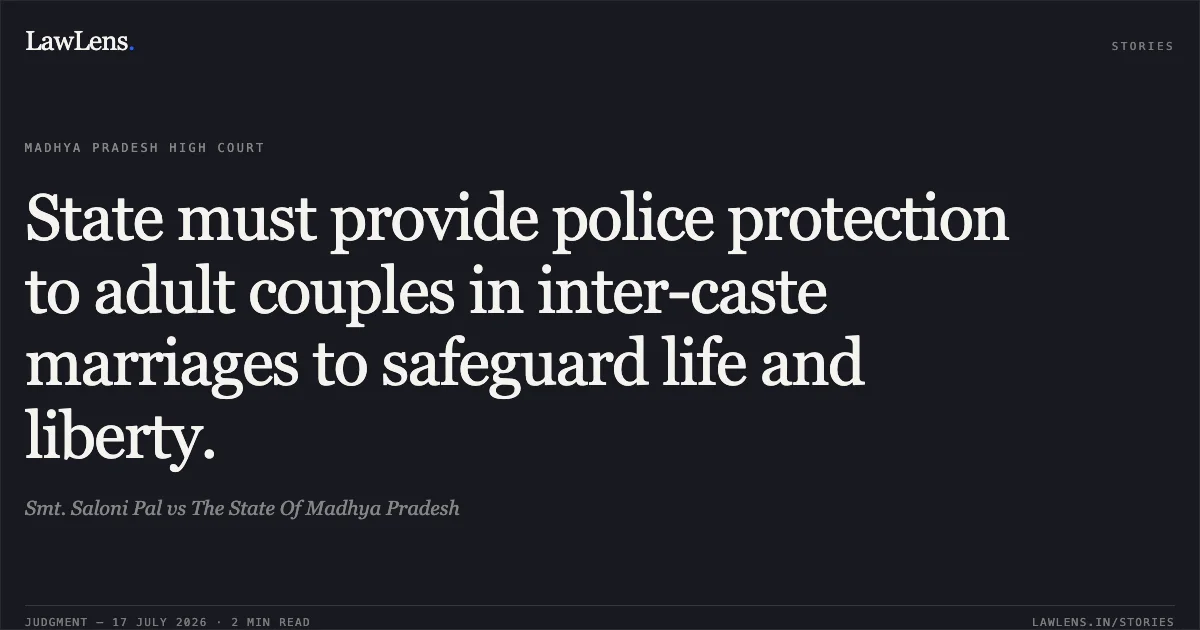
The court allowed the petition, holding that the petitioners have a fundamental right to choose their partners and live without fear of violence.
The court directed the Superintendent of Police, Raisen, to examine the matter and take immediate appropriate steps to provide adequate protection to the petitioners to safeguard their life and liberty.
Source reference: para. 7The petition was disposed of with these directions to ensure the petitioners are not harassed by any person or authority for their marital choice.
Source reference: paras. 7, 8Original Court PDF
Smt. Saloni PalvsThe State Of Madhya Pradesh
Click to open original judgment
Original judgment, available to read, download and summarize on LawLens.in