Facts
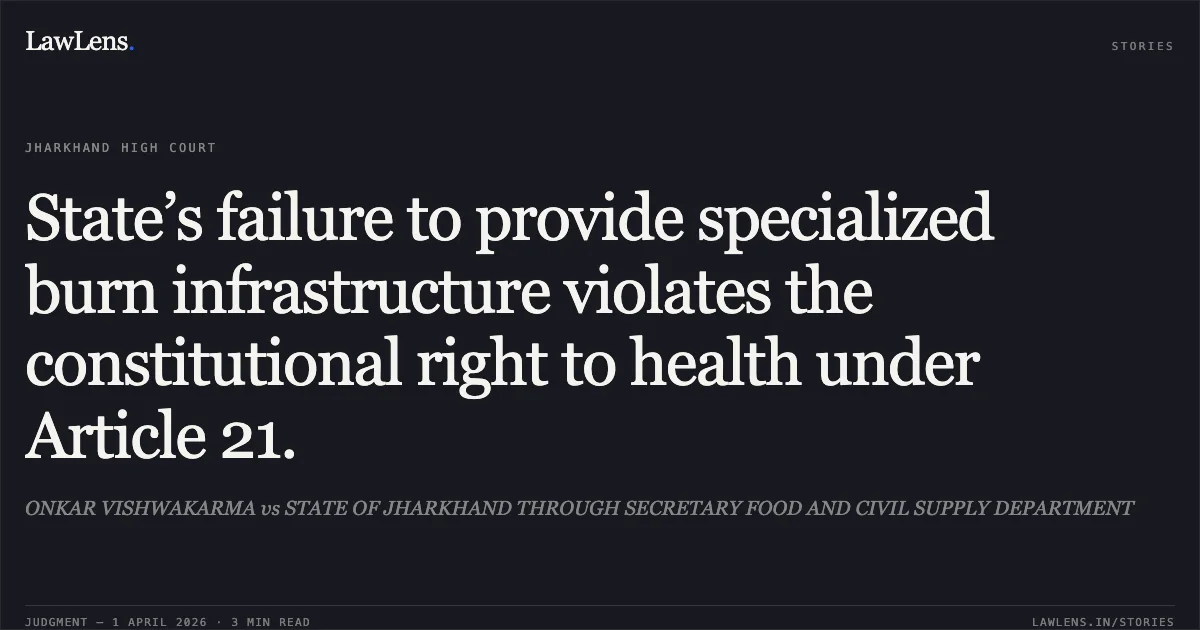
In 2021, an incident in Hazaribagh involving highly inflammable, adulterated kerosene (flash point of 13.5°C against a 35°C safety minimum) supplied through the Public Distribution System led to four deaths and fifteen grievous burn injuries
Source reference: para 3, 6-7The Petitioner filed this Public Interest Litigation (PIL) alleging that victims at Sadar Hospital, Hazaribagh, were denied specialized care due to a lack of dedicated burn units, were treated in general wards, and were forced to purchase essential medicines from the open market
Source reference: para 4, 8-9During proceedings, the State admitted that no specialized wards with modern facilities for burn injuries existed in government hospitals across the entire State of Jharkhand
Source reference: para 23-24The Court subsequently expanded the scope of the PIL to address the systemic deficiency in state-wide specialized healthcare infrastructure
Source reference: para 22, 25Issues
1. Whether the state-wide absence of specialized burn care facilities in government hospitals constitutes a violation of the "Right to Health" and "Right to Life" under Article 21 of the Constitution
Source reference: para 24, 332. Whether the Court can grant specific monetary compensation to victims in a PIL or if such claims must be adjudicated through statutory or civil frameworks
Source reference: para 17-193. Whether the State can plead financial or administrative constraints to justify the non-implementation of essential medical infrastructure
Source reference: para 37, 39Law Applied
The Court primarily relied on the "Right to Health" as an integral part of the "Right to Life" under Article 21 of the Constitution, as established in Consumer Education and Research Centre v. Union of India and Kirloskar Brothers Ltd. v. ESIC
Source reference: para 34-35It applied the principle from Paschim Banga Khet Mazdoor Samity v. State of West Bengal, which mandates that a welfare State cannot use "lack of financial funds" as a defense for failing to provide emergency medical infrastructure
Source reference: para 37, 39Regarding compensation, the Court invoked the doctrine of ‘constitutional tort’ from Nilabati Behera v. State of Orissa
Source reference: para 15referenced the statutory Victim Compensation Scheme under Section 357-A of the CrPC, 1973 (now Section 396 of the Bharatiya Nagarik Suraksha Sanhita, 2023)
Source reference: para 19Reasoning
The Court observed that burn management is a medical super-specialty requiring a "sterile ecosystem" rather than a general ward bed
Source reference: para 39It found the State’s claim of "adequate logistics" inconsistent with a 2021 CAG report, which noted that 20 completed burn units remained non-functional due to a lack of equipment
Source reference: para 26, 29The Court reasoned that since India bears a high global burden of burn mortality, the State's failure to operationalize sanctioned infrastructure represents a breach of its positive mandate to protect life with dignity
Source reference: para 31-33, 38While acknowledging the right to compensation for constitutional torts, the Court determined that calculating specific quantum for 15+ victims required evidentiary assessment unsuitable for a PIL; thus, it directed the use of statutory schemes and the District Legal Services Authority (DLSA) to ensure immediate succor
Source reference: para 17, 21Holding
The Court held that the lack of functional burn units was a systemic failure violating Article 21
It declined to grant specific monetary sums but directed the victims to approach the jurisdictional court/DLSA for compensation under Section 357-A CrPC/Section 396 BNSS
Source reference: para 44(j-l)The State must make dedicated burn units fully functional in all district hospitals and medical colleges within 120 days
Source reference: para 44(a)The State must ensure adequate stocking of medicines and round-the-clock specialist care in these units
Source reference: para 44(c-e)A State Monitoring Committee must be constituted within four weeks to oversee implementation
Source reference: para 44(g-h)Training and capacity-building for medical staff must be completed within 90 days
Source reference: para 44(f)Acts & Sections Cited
1 provisions across 1 statute referred to in this judgment. Each provision opens on LawLens.
Bharatiya Nagarik Suraksha Sanhita, 20231
Original Court PDF
ONKAR VISHWAKARMAvsSTATE OF JHARKHAND THROUGH SECRETARY FOOD AND CIVIL SUPPLY DEPARTMENT
Click to open original judgment
Original judgment, available to read, download and summarize on LawLens.in