Facts
The petitioner, a registered contractor, was awarded a turnkey project by SBPDCL in September 2019 for the construction of power sub-stations and lines in Nalanda and Patna.
Source reference: p. 3While two sites were completed, the Kaladiyara site remained unfinished after five years.
Source reference: p. 4, 14Despite multiple show-cause notices and extensions granted between 2023 and 2024, the petitioner failed to meet completion deadlines.
Source reference: p. 13Consequently, the respondents issued an order on December 31, 2024, terminating the contract, invoking the performance bank guarantee, and blacklisting the petitioner for three years.
Source reference: p. 2, 4The petitioner challenged this order, alleging it was arbitrary, lacking jurisdiction (due to the absence of a blacklisting clause in the contract), and violative of natural justice.
Source reference: p. 5Issues
1. Whether, in the absence of an express provision in the NIT or Agreement, the State or its instrumentalities possess the power to blacklist a contractor.
Source reference: para. 9(i)2. Whether the impugned order dated 31.12.2024 was passed in compliance with the principles of natural justice regarding adequate notice and consideration of the petitioner's reply.
Source reference: para. 9(ii)Law Applied
The Court primarily applied the doctrine of "Inherent Power to Blacklist" derived from the State's executive power under Article 298 of the Constitution of India.
Source reference: para. 13, 15It relied on Kulja Industries Limited v. BSNL, which established that the power to blacklist is inherent in the party allotting the contract and does not require specific statutory or contractual authorization.
Source reference: para. 14It further applied the principles from Patel Engineering Limited v. Union of India and Erusian Equipment & Chemicals Ltd. v. State of W.B., which clarify that while the State has the right to decide its contractual partners, such decisions must be fair, rational, and compliant with Article 14 (Equality) and the principles of natural justice.
Source reference: para. 15Reasoning
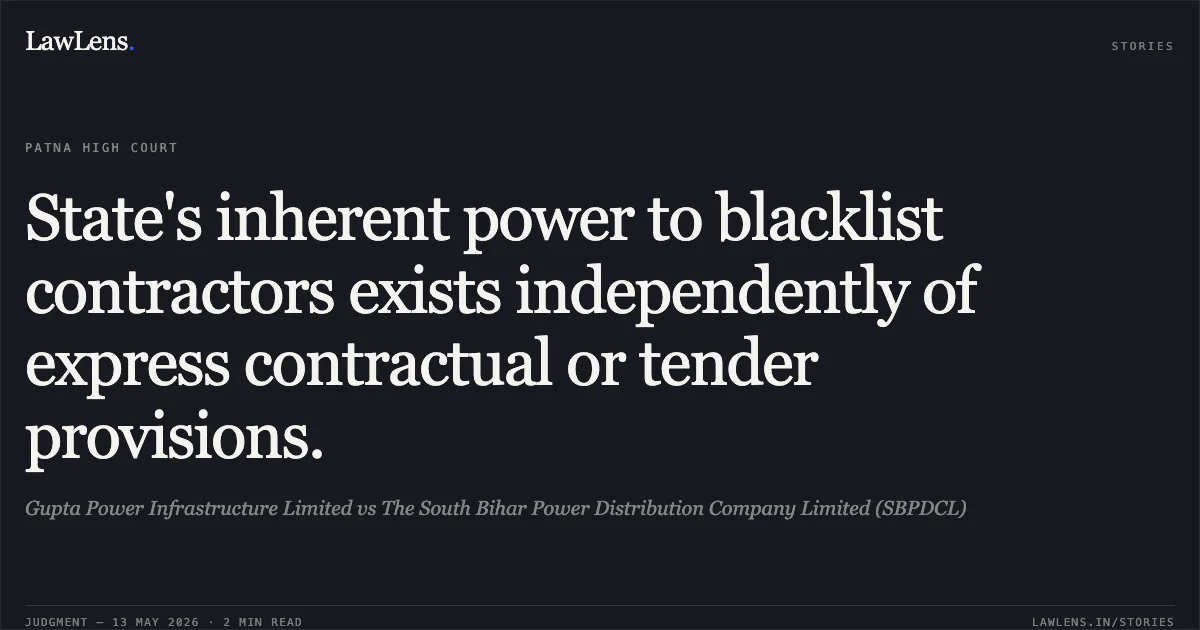
The Court reasoned that the absence of a specific blacklisting clause in the NIT or contract does not denude a State instrumentality of its inherent executive power to refuse to deal with a defaulting contractor.
Source reference: para. 11, 16Applying this to the facts, the Court found that the respondents had issued multiple notices (dated 06.03.2023, 13.05.2024, 10.09.2024, 13.11.2024, and 21.11.2024) specifically warning of termination and blacklisting.
Source reference: para. 18-19The petitioner had even provided written undertakings to complete the work but failed to do so.
Source reference: para. 18The Court observed that the petitioner’s reply dated 23.11.2024 was duly considered but found unsatisfactory given that only two out of three sub-stations were completed in over five years.
Source reference: para. 20Thus, the action was deemed a reasoned decision based on consistent non-performance.
Source reference: para. 20, 22Holding
The Court answered Issue (i) in the affirmative, holding that the power to blacklist is inherent under Article 298 even without a contract clause.
Regarding Issue (ii), it held that the principles of natural justice were fully satisfied through repeated notices and opportunities to be heard.
Source reference: para. 23The writ application was dismissed.
Source reference: para. 25However, the Court granted liberty to the petitioner to pursue legal remedies before appropriate forums regarding the alleged non-payment of dues for work already executed.
Source reference: para. 26Acts & Sections Cited
1 provisions across 1 statute referred to in this judgment. Linked provisions open on LawLens.
Notice Inviting Tender1
Original Court PDF
Gupta Power Infrastructure LimitedvsThe South Bihar Power Distribution Company Limited (SBPDCL)
Click to open original judgment
Original judgment, available to read, download and summarize on LawLens.in