Facts
The first respondent, a Town Inspector, was implicated by the Special Police Establishment (SPE) in a corruption trap case in 2017
Source reference: p. 2Following the grant of sanction for prosecution in 2020, the respondent filed an RTI application seeking details of the decision-making process regarding said sanction
Source reference: p. 2The State Information Commission rejected the request, citing the exemption under Section 8(1)(h) of the Right to Information Act, 2005 (RTI Act)
Source reference: p. 2On appeal, the High Court of Madhya Pradesh directed the supply of information, noting that the investigation was complete
Source reference: p. 3The Appellant (SPE) challenged this before the Supreme Court, relying on a State Government Notification dated 25.08.2011, which purportedly exempted the SPE from the RTI Act under Section 24(4)
Source reference: p. 3Issues
1. Whether the Special Police Establishment (SPE) qualifies as an "intelligence and security organisation" under Section 24(4) of the RTI Act to justify a blanket exemption from the Act
Source reference: p. 5, 142. Whether the State Government’s Notification dated 25.08.2011 was ultra vires Section 24(4) of the RTI Act
Source reference: p. 21, 313. Whether information regarding the grant of sanction could be denied under Section 8(1)(h) after the investigation was complete
Source reference: p. 3, 4Law Applied
Section 24(4) of the RTI Act, 2005, which allows State Governments to exempt "intelligence and security organisations" from the Act’s purview via notification
Source reference: p. 18Section 8(1)(h), which exempts information that would "impede the process of investigation"
Source reference: p. 17Subordinate rules can be struck down if they exceed the limits of the enabling statute or fail to conform to the parent Act as held in Indian Express Newspapers (Bombay) Pvt. Ltd. v. Union of India and State of Tamil Nadu v. P. Krishnamurthy
Source reference: p. 15-16The doctrine from Bharathidasan University v. AICTE, allowing courts to suo motu ignore or invalidate a regulation that is patently outside its statutory banks, even in the absence of a specific prayer
Source reference: p. 11Reasoning
The Court examined whether the SPE’s functions fell within the ambit of "intelligence and security." It noted that the Second Schedule of the RTI Act lists Central organisations like the ED, BSF, and NIA, which handle national security or high-level intelligence.
Source reference: p. 19-20Conversely, the SPE, established under the M.P. Special Police Establishment Act, 1947, is restricted by Notification to investigating specific economic offences and corruption under the PC Act and the IPC.
Source reference: p. 27-28The Court reasoned that "intelligence and security" does not encompass routine anti-corruption investigations into public servants.
Source reference: p. 29Therefore, while Section 24(4) grants the State power to notify exemptions, such power is strictly confined to organisations established for intelligence/security purposes.
Source reference: p. 18Since the SPE’s jurisdiction is limited to matters defined under Section 7 of the M.P. Lokayukt Evam Up-Lokayukt Adhiniyam, 1981, it does not meet the "intelligence and security" criteria.
Source reference: p. 29-30Consequently, the 2011 Notification was found to be an excessive exercise of power.
Source reference: p. 31Holding
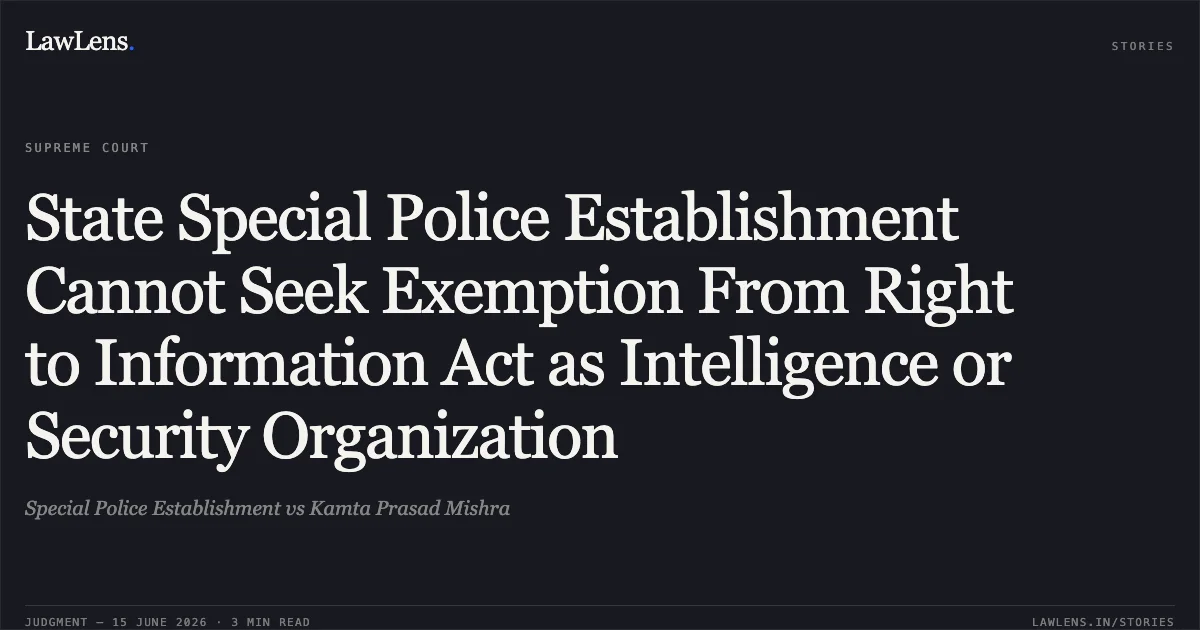
The Court held that the SPE is not an "intelligence and security organisation" for the purposes of Section 24(4).
The Court struck down the Notification dated 25.08.2011 to the extent that it sought to exclude the SPE from the RTI Act, declaring it bad in law and ultra vires the parent Act.
Source reference: p. 31-32The Court dismissed the appeal and upheld the High Court's direction to supply the information.
Source reference: p. 32It clarified that the notification remains operative for the State Bureau of Investigation of Economic Offences, as that was not examined in this case.
Source reference: p. 32Acts & Sections Cited
12 provisions across 4 statutes referred to in this judgment. Each provision opens on LawLens.
Indian Penal Code, 18604
Code of Criminal Procedure, 19731
Lokpal and Lokayuktas Act, 20131
Original Court PDF
Special Police EstablishmentvsKamta Prasad Mishra
Click to open original judgment
Original judgment, available to read, download and summarize on LawLens.in