Facts
The petitioner and Respondent No. 3, Deepa Bakshi, were neighbours.
Source reference: no citationThe petitioner alleged that Deepa Bakshi and her family members were involved in various unlawful activities and that he had previously made police complaints against them.
Source reference: no citationDeepa Bakshi subsequently complained before the Chhattisgarh State Commission for Women, alleging that the petitioner had called her a “tonhi” (witch) and accused her of practising witchcraft.
Source reference: para. 3The petitioner contended that he was not served with prior notice and was only informed telephonically to appear before the Commission on 20 October 2021.
Source reference: paras. 3–5On that date, the Commission considered the complaint and passed an order, including a direction concerning registration of an FIR under the Chhattisgarh Tonhi Pratadna Nivarana Act.
Source reference: paras. 3–5Aggrieved, the petitioner filed the present writ petition seeking quashing of the Commission’s order dated 20 October 2021.
Source reference: paras. 1–2Issues
Whether the Chhattisgarh State Commission for Women exceeded its jurisdiction by directing or recommending registration of an FIR against the petitioner under the Chhattisgarh Tonhi Pratadna Nivarana Act.
Source reference: paras. 4–8Whether the Commission, while exercising its fact-finding and recommendatory powers, could pass an adjudicatory or coercive order without affording the petitioner a proper opportunity of hearing.
Source reference: para. 3; para. 8Law Applied
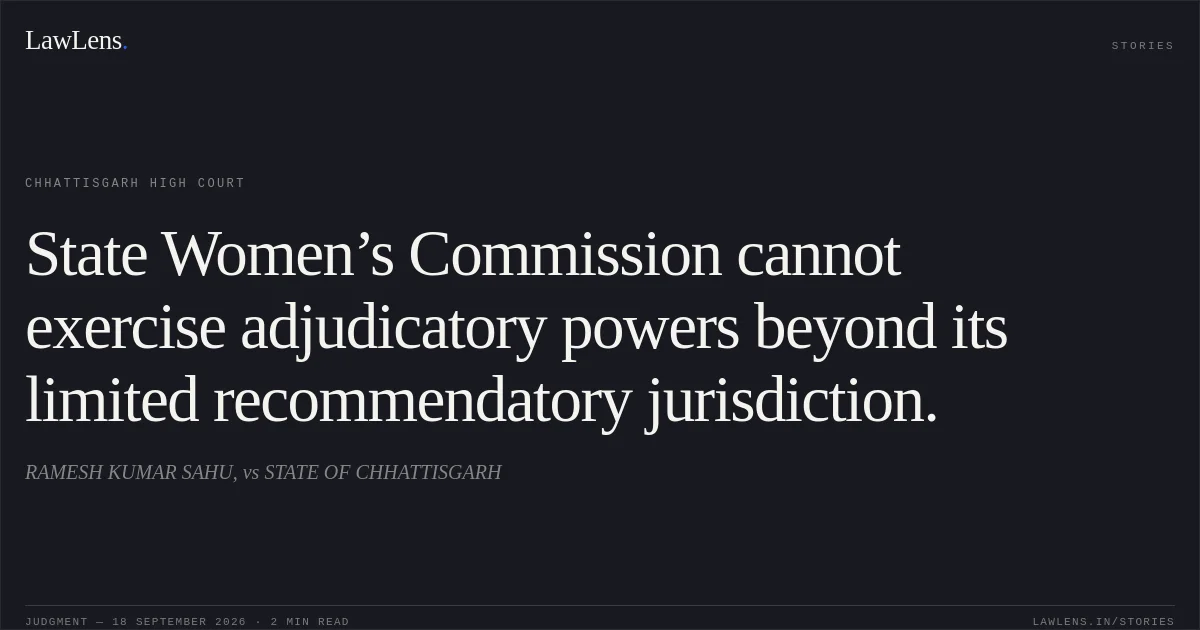
The Court applied the principle that a State Commission for Women possesses limited, primarily fact-finding and recommendatory powers and cannot assume the role of an adjudicatory or prosecuting authority.
Source reference: para. 8Relying on Bhabani Prasad Jena v. Orissa State Commission for Women, (2010) 8 SCC 633, and Mumbai Port Authority v. National Commission for Scheduled Caste, 2026 SCC OnLine 1398, the Court held that such commissions cannot convert their limited jurisdiction into adjudicatory power.
Source reference: para. 8The Court also proceeded on the principles of natural justice, particularly the requirement that an affected person receive a meaningful opportunity of notice and hearing before adverse action is taken.
Source reference: para. 3Reasoning
The Court examined the Commission’s order and the rival submissions regarding its legal effect.
Source reference: paras. 5, 8Although the Commission argued that the impugned order was merely recommendatory and did not directly command registration of an FIR, the Court held that the Commission’s action went beyond its permissible fact-finding and recommendatory jurisdiction.
Source reference: paras. 5, 8The Commission had effectively acted as an adjudicatory authority by accepting the complainant’s allegations and taking consequential action without a proper inquiry or adequate opportunity to the petitioner to defend himself.
Source reference: paras. 3, 8Applying the limits on the Commission’s statutory powers recognised in Bhabani Prasad Jena and Mumbai Port Authority, the Court found the order to be in excess of jurisdiction and manifestly illegal.
Source reference: para. 8Holding
The Court answered the jurisdictional issue in favour of the petitioner and held that the Chhattisgarh State Commission for Women had acted beyond its lawful authority.
The order dated 20 October 2021 was quashed and set aside as manifestly illegal and without jurisdiction.
Source reference: para. 9The writ petition was consequently allowed.
Source reference: para. 10Original Court PDF
RAMESH KUMAR SAHU,vsSTATE OF CHHATTISGARH
Click to open original judgment
Original judgment, available to read, download and summarize on LawLens.in