Facts
The applicant sought the quashing of FIR C.R. No. II-3117 of 2019 registered at DCB Police Station, Ahmedabad.
Source reference: p. 1On November 20, 2019, the police apprehended Accused No. 1 (Mohammed Alikhan) based on secret information and recovered two country-made pistols and cartridges.
Source reference: p. 2During interrogation, Accused No. 1 stated that the weapons were to be delivered to the applicant.
Source reference: p. 2A charge-sheet was subsequently filed, but it failed to include call detail records (CDR) or any independent witness connecting the applicant to the transaction.
Source reference: p. 3The applicant challenged the proceedings under Section 482 of the Cr.P.C., arguing that the implication was based solely on a co-accused's statement.
Source reference: p. 2-3Issues
1. Whether a criminal prosecution can be sustained against an accused person solely on the basis of an inculpatory statement made by a co-accused in the absence of any corroborative evidence or overt act.
Source reference: p. 3-42. Whether the continuation of the trial against the applicant would amount to an abuse of the process of law under Section 482 of the Cr.P.C.
Source reference: p. 3, 8-9Law Applied
The court relied on the principles of the Indian Evidence Act, 1872, specifically Sections 17 and 21 regarding admissions, and Section 30 regarding confessions of a co-accused.
Source reference: p. 5-6It heavily applied the precedent established in P. Krishna Mohan Reddy v. State of Andhra Pradesh (2025), which mandates that a confessional statement of an accused is per se inadmissible against a co-accused at the stage of bail or quashing, and can only be considered during a joint trial as a rule of prudence to lend assurance to other existing evidence.
Source reference: p. 4-7The court also considered the bar under Section 162 of the Cr.P.C. regarding statements made to the police.
Source reference: p. 6Reasoning
The Court observed that the applicant was neither found in possession of illegal firearms nor attributed any specific overt act.
Source reference: p. 3The prosecution (APP) conceded that the charge-sheet lacked call details or direct evidence linking the applicant to the crime.
Source reference: p. 3-4Applying the P. Krishna Mohan Reddy doctrine, the Court reasoned that a statement recorded under Section 161 of the Cr.P.C. which is inculpatory/confessional is hit by the rigors of Section 25 of the Evidence Act and cannot be used to implicate another co-accused as substantive evidence.
Source reference: p. 5Since the only material against the applicant was the statement of Accused No. 1, which has no legal "credibility" or "sanction" for truthfulness in this context, the Court determined that the prosecution's case lacked a legal foundation.
Source reference: p. 6-7Consequently, forcing the applicant to face trial would be an "exercise in futility".
Source reference: p. 3Holding
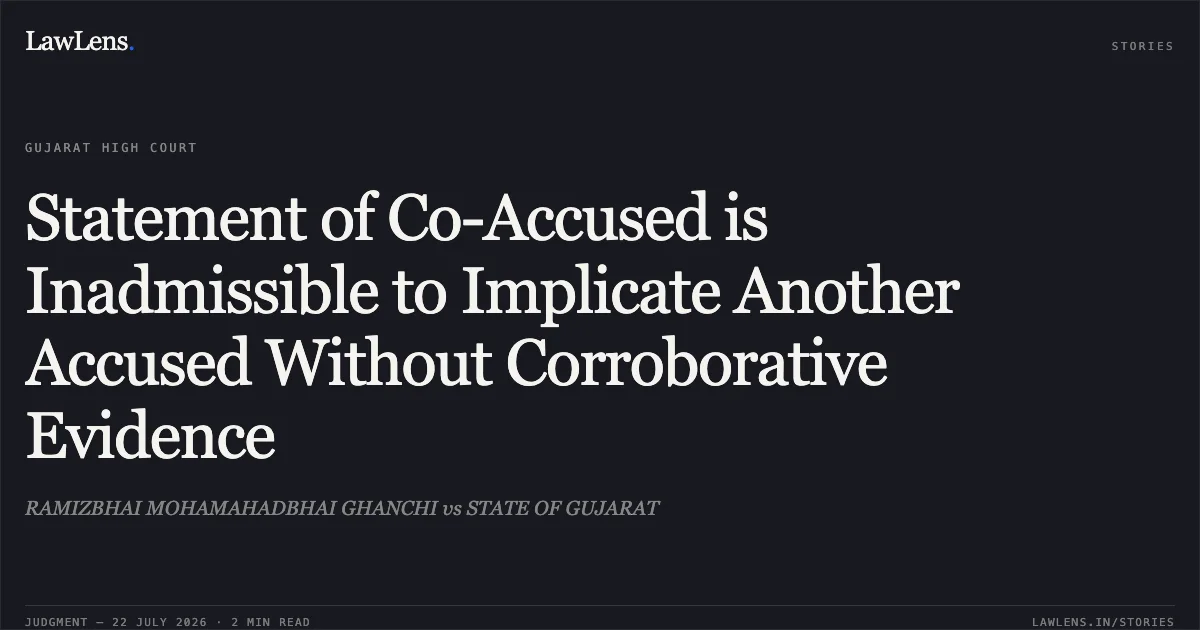
The Court answered the issues in favor of the applicant, holding that an admission or confession by a co-accused cannot form the sole basis for prosecution without corroborative material.
The Court allowed the application and quashed FIR C.R. No. II-3117 of 2019 and all consequential proceedings qua the applicant.
Source reference: p. 8-9It clarified that the trial against the other accused persons shall proceed uninfluenced by this judgment.
Source reference: p. 9Acts & Sections Cited
7 provisions across 2 statutes referred to in this judgment. Each provision opens on LawLens.
Code of Criminal Procedure, 19734
Arms Act, 19593
Original Court PDF
RAMIZBHAI MOHAMAHADBHAI GHANCHIvsSTATE OF GUJARAT
Click to open original judgment
Original judgment, available to read, download and summarize on LawLens.in


