Facts
On August 15, 2020, police intercepted a Bolero car near Panjrapol cross-roads, Ahmedabad, and seized 161 bottles of Indian Made Foreign Liquor
Source reference: p. 2An FIR was registered under Sections 65(e), 116-B, 98(2), and 81 of the Prohibition Act
Source reference: p. 2The applicant was not named in the FIR but was subsequently arraigned as an accused in the charge-sheet solely based on the confessional statement of a co-accused who was caught at the scene
Source reference: p. 2, 4No recovery was made from the applicant, and no call data records were produced to establish a link between the applicant and the co-accused
Source reference: p. 3Issues
1. Whether a criminal prosecution can be sustained against an individual when the only evidence connecting them to the crime is the inculpatory statement of a co-accused
Source reference: p. 4 / para. 52. Whether the continuation of proceedings against the applicant constitutes an abuse of the process of law in the absence of independent corroborative evidence
Source reference: p. 8 / para. 6Law Applied
Section 482 of the Criminal Procedure Code regarding the inherent powers of the High Court to quash proceedings to prevent abuse of process
Source reference: p. 1Sections 25 and 26 (inadmissibility of confessions to police) and Section 30 (consideration of proved confessions against co-accused) of the Indian Evidence Act
Source reference: p. 5P. Krishna Mohan Reddy v. State of Andhra Pradesh (2025), which established that a confessional statement of an accused is per se inadmissible against a co-accused at the stage of bail or investigation and can only be used as a rule of prudence during trial if specific stringent conditions are met
Source reference: p. 5-7Reasoning
The court reasoned that the applicant’s implication rested entirely on the "iota of evidence" provided by a co-accused's statement
Source reference: p. 3Applying the P. Krishna Mohan Reddy precedent, the court noted that such inculpatory statements cannot be taken into consideration against a co-accused under Section 17 read with Section 21 of the Evidence Act
Source reference: p. 6, 8The court observed that the investigation failed to produce any corroborative material, such as call detail records (CDR) or recovery of goods, to prove the applicant had "called for" or "aided" the crime
Source reference: p. 4, 8Consequently, the court found that since the primary evidence was legally inadmissible, the chances of conviction were "bleak," rendering the continuation of the trial a futile exercise and an abuse of the judicial process
Source reference: p. 8-9Holding
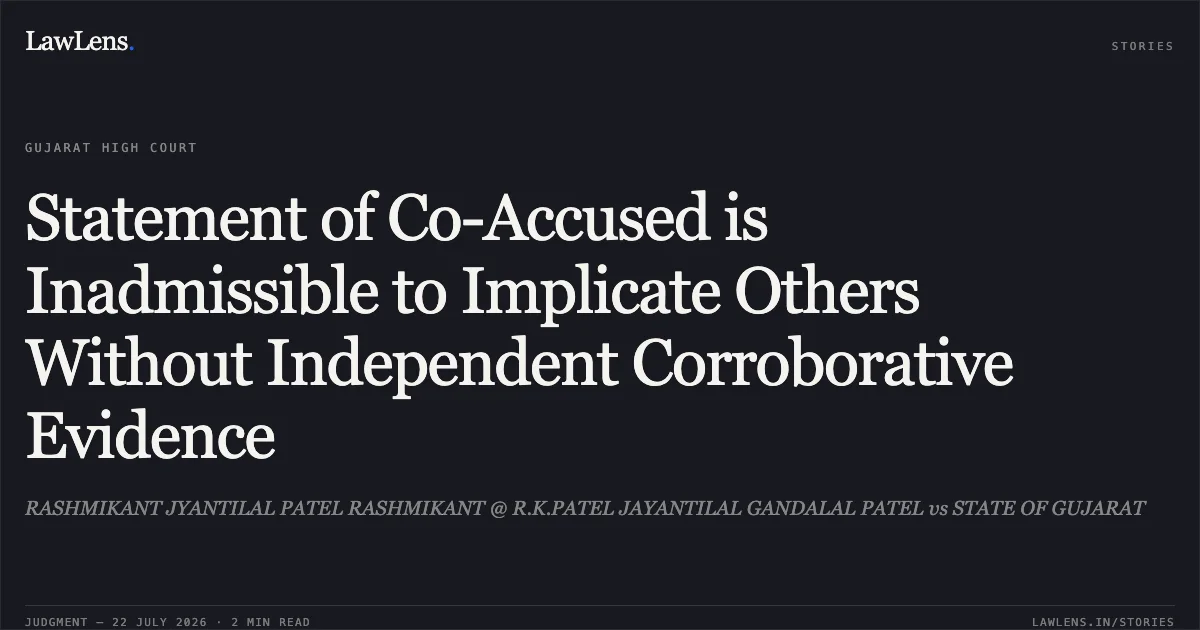
The court answered the issues in the affirmative, holding that prosecution cannot be sustained solely on a co-accused’s statement without independent material
The High Court allowed the application and quashed FIR C.R. No. 11191014200515 of 2020 and all consequential proceedings qua the applicant, clarifying that the trial against other accused persons shall proceed uninfluenced by this judgment
Source reference: p. 9Acts & Sections Cited
7 provisions across 2 statutes referred to in this judgment. Each provision opens on LawLens.
Code of Criminal Procedure, 19734
Gujarat Prohibition Act, 1949.3
Original Court PDF
RASHMIKANT JYANTILAL PATEL RASHMIKANT @ R.K.PATEL JAYANTILAL GANDALAL PATELvsSTATE OF GUJARAT
Click to open original judgment
Original judgment, available to read, download and summarize on LawLens.in