Facts
Following the reorganisation of Bihar and the creation of Jharkhand, disputes arose over employment-related liabilities of workers of five State-owned corporations.
Source reference: para. 2–4, 8After considering a committee report, the Court’s order of 29 May 2026 settled the apportionment and payment of principal dues, leaving open issues concerning residual claims, daily-wage workers’ entitlements, and interest on delayed payments.
Source reference: para. 2–4, 8The States reported that dues had been paid to 2,074 of 2,274 verified employees/workmen, while approximately 200 cases remained pending because claimants were untraceable or documentation was incomplete.
Source reference: para. 5–6, 33Issues
1. Whether the claims of untraceable or unverified employees/workmen, or their legal heirs, should be closed, and on what terms.
Source reference: para. 8(i), 33–352. Whether daily-wage employees/workmen were entitled to additional monetary relief, and whether compensation was payable in cases of death in service.
Source reference: para. 8(ii), 36–423. Whether interest was payable on delayed provident-fund dues and on salary, wages, and other monetary dues, and, if so, at what rate and for what period.
Source reference: para. 8(iii), 43–58Law Applied
Section 7-Q of the Employees’ Provident Funds and Miscellaneous Provisions Act, 1952 requires simple interest at 12% per annum, or a higher rate specified in the Scheme, on amounts due under the Act from the date they become due until actual payment.
Source reference: para. 44In Arcot Textile Mills Ltd. v. Regional Provident Fund Commissioner, (2013) 16 SCC 1, the Court recognised Section 7-Q interest as a statutory consequence of delayed provident-fund payment and as compensation serving the Act’s social-welfare purpose.
Source reference: para. 45The Court also relied on Central Bank of India v. Ravindra, (2002) 1 SCC 367, for the principle that interest compensates a person deprived of the use of money lawfully due.
Source reference: para. 51–52For non-EPF dues, where no uniform statutory rate applied, interest was to be determined as reasonable compensation, having regard to the nature and duration of the delay and the resulting prejudice, rather than as a punitive levy.
Source reference: para. 49, 54The relief was confined to the particular facts of this case and was not stated to establish a general rule for other cases.
Source reference: para. 60Reasoning
The Court found that reasonable tracing efforts had been made, so indefinite administrative searches were unnecessary; however, closure could not extinguish the underlying entitlements, and claimants were to retain a 12-month opportunity to approach the relevant Nodal Officer.
Source reference: para. 34–35It held that applying a uniform rate of Rs.42.50 per day over several decades did not fairly reflect the passage of time and applicable wage structures. To avoid further protracted individual recalculations while balancing the equities, it ordered a one-time payment rather than remitting the wage computations for fresh determination.
Source reference: para. 39–42On interest, the Court applied Section 7-Q to qualifying EPF dues and found that the extraordinary delay in payment of other lawful monetary entitlements warranted reasonable compensatory interest. It rejected the contention that the separate corporate personality of the defunct corporations, by itself, could deprive workers of relief in the circumstances of this case.
Source reference: para. 43–48, 50–57Holding
The Court disposed of the petition and directed the States to complete outstanding implementation; allow untraced or unverified claimants 12 months to seek verification and payment; and publish updated claim and payment information within four weeks, with periodic updates.
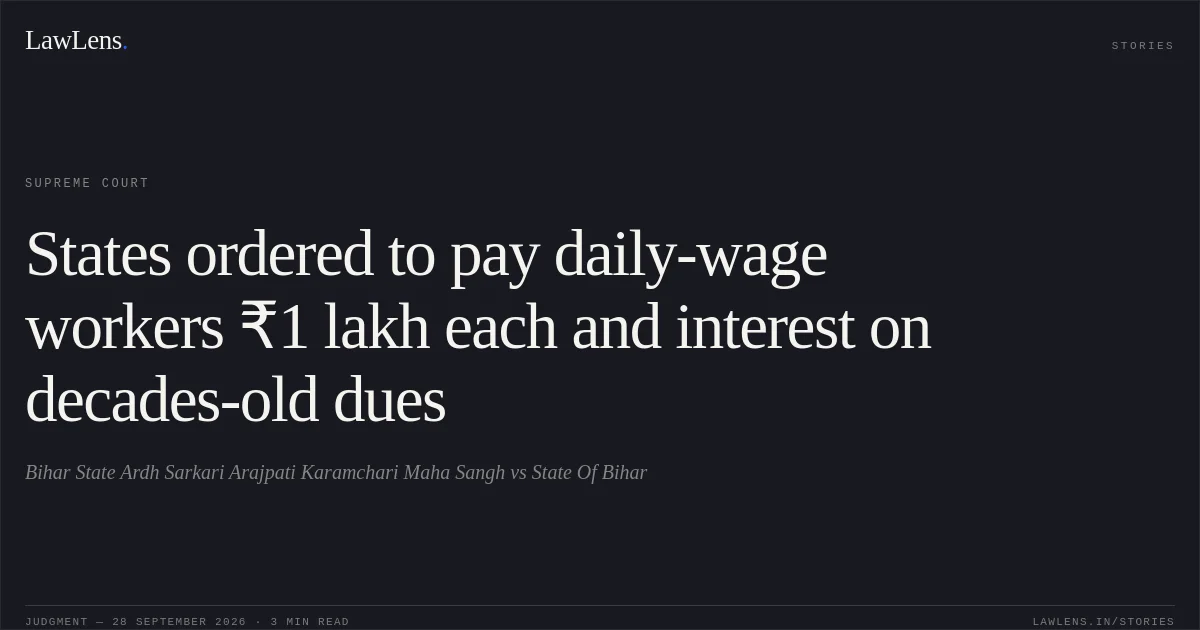
Bihar and Jharkhand were directed to pay each concerned daily-wage employee/workman a one-time Rs.1,00,000 in addition to amounts already determined.
Source reference: para. 59(d)The States were also directed to ensure simple interest at 12% per annum on delayed EPF dues governed by Section 7-Q and at 6% per annum on delayed salary, wages, and other non-EPF monetary dues, from the dates those amounts became due until actual payment; interest was to be computed and disbursed within three months.
Source reference: para. 57–59(e)The respective States’ liability remains governed by the mechanism approved in the order of 29 May 2026.
Source reference: para. 59(f)Acts & Sections Cited
1 provisions across 1 statute referred to in this judgment. Each provision opens on LawLens.
Code of Civil Procedure, 19081
Original Court PDF
Bihar State Ardh Sarkari Arajpati Karamchari Maha SanghvsState Of Bihar
Click to open original judgment
Original judgment, available to read, download and summarize on LawLens.in