Facts
The Petitioners, a married couple, approached Respondent No. 5 (Hospital) for Assisted Reproductive Technology (ART) services following the death of their son.
Source reference: para. 2At the commencement of treatment, both petitioners were within the age limits prescribed by Section 21(g) of the ART Act, 2021.
Source reference: para. 3On March 7, 2026, six embryos were created and cryopreserved; one transfer was attempted but failed.
Source reference: para. 3, 12The Petitioners sought to utilize the remaining five embryos for a Frozen Embryo Transfer (FET) procedure.
Source reference: para. 1However, the Hospital and the Gynaecologist (Respondent No. 6) refused to proceed because Petitioner No. 1 (the wife) had since crossed the upper age limit of 50 years.
Source reference: para. 4As of the hearing, the wife was 50 years and 2 months old, and the husband was 54 years old.
Source reference: para. 13Issues
1. Whether the age restriction prescribed under Section 21(g) of the ART Act, 2021, operates to prevent the continuation (utilization of existing embryos) of a medical process that was lawfully initiated when the parties were within the statutory age limits.
Source reference: para. 8Law Applied
Section 21(g) of the Assisted Reproductive Technology (Regulation) Act, 2021, which limits ART services to women between ages 21–50 and men between 21–55.
Source reference: para. 8, 10Definition of a "commissioning couple" under Section 2(e).
Source reference: para. 9Article 21 of the Constitution of India, establishing that reproductive autonomy and decisional privacy are fundamental rights.
Source reference: para. 5, 11, 16The purposive interpretation of the ART Act found in Sarabjit Kaur v. State of Punjab and Shyamoli Saha v. State of West Bengal, which held that statutory age limits should not be applied mechanically to defeat ongoing reproductive processes involving already created embryos.
Source reference: para. 5, 17, 18, 19Reasoning
The Court reasoned that a distinction must be drawn between the initiation of a fresh IVF cycle and the continuation of an ongoing procedure using pre-existing cryopreserved embryos.
Source reference: para. 12, 14The Court noted that the Petitioners undisputedly fulfilled the eligibility criteria when the embryos were retrieved and created.
Source reference: para. 12The Court observed that Section 21(g) prescribes age eligibility for a "woman" and a "man" individually, and the legislature consciously avoided a composite "combined age" for a commissioning couple.
Source reference: para. 17, 19By analyzing Sections 21(a), 2(e), and 21(h), the Court found that the statutory requirements focus on the status of the couple at the time they "approach" the clinic and "avail" the technology.
Source reference: para. 20-21Applying a purposive and constitutional interpretation, the Court held that since the embryos are an integral facet of the petitioners' reproductive autonomy under Article 21, and since no specific medical risk beyond general policy concerns was presented, the law should not be used as an insurmountable barrier to conclude a process lawfully begun.
Source reference: para. 15, 25, 27Holding
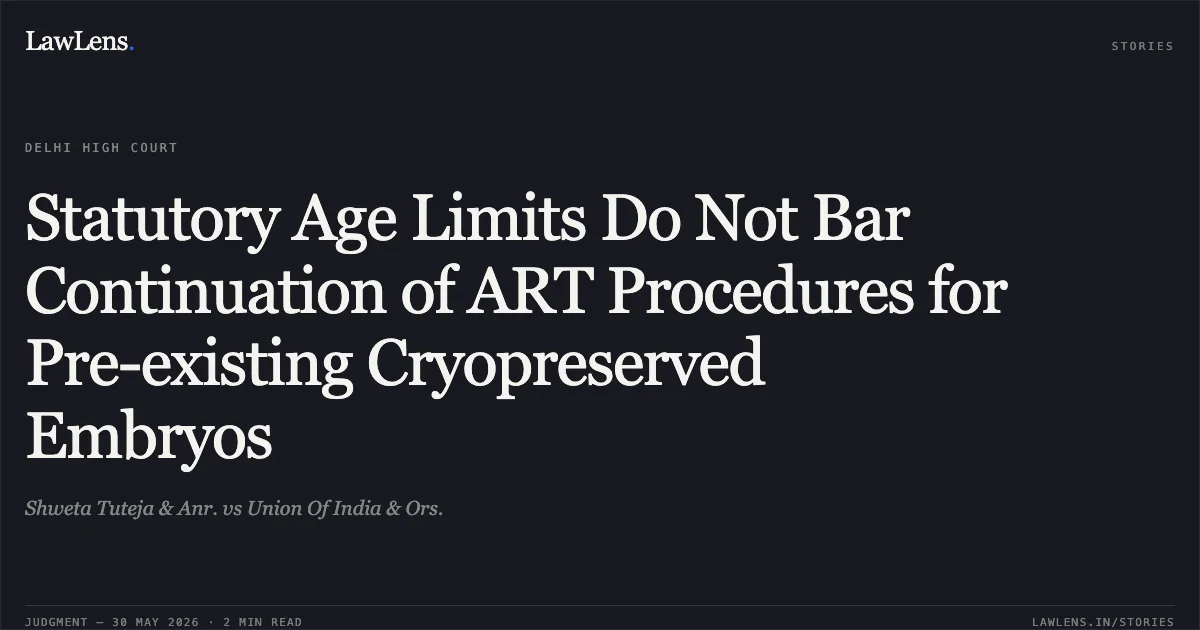
The Court answered the issue in the negative, holding that the age limit in Section 21(g) does not prohibit the utilization of embryos created while the petitioners were of permissible age.
The High Court allowed the petition and directed that the Petitioners be permitted to undergo the Frozen Embryo Transfer (FET) of their remaining five cryopreserved embryos at Respondent No. 5 hospital, adhering to all medical safeguards.
Source reference: para. 29No order as to costs was made.
Source reference: para. 31Acts & Sections Cited
2 provisions across 1 statute referred to in this judgment. Each provision opens on LawLens.
Assisted Reproductive Technology (Regulation) Act, 20212
Original Court PDF
Shweta Tuteja & Anr.vsUnion Of India & Ors.
Click to open original judgment
Original judgment, available to read, download and summarize on LawLens.in