Facts
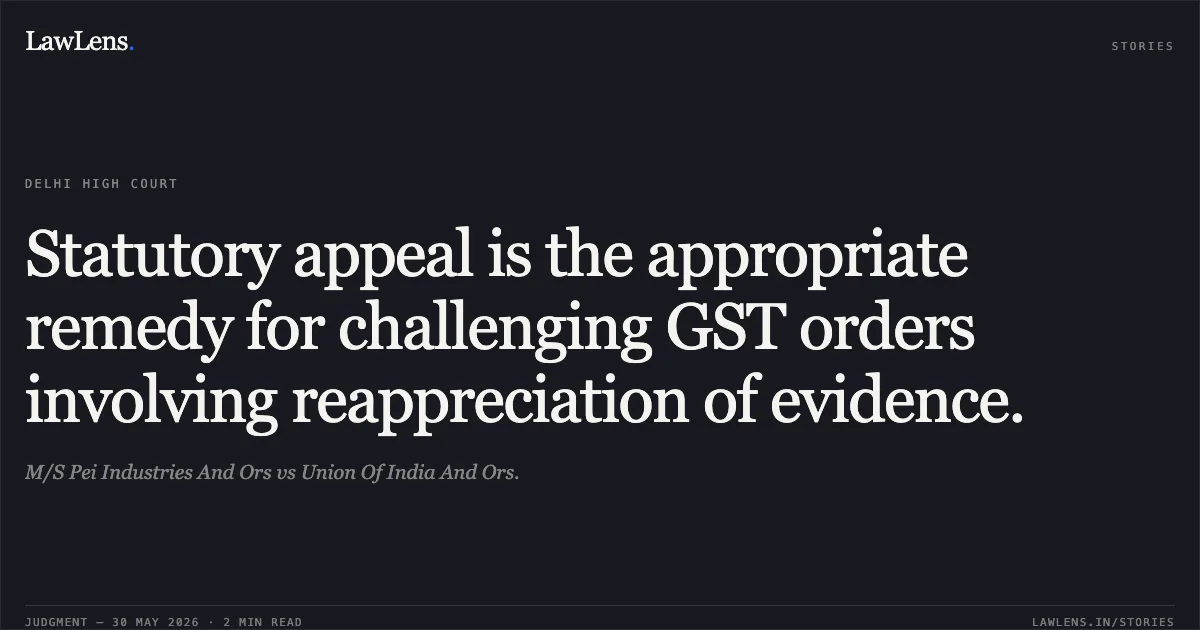
The Petitioners challenged the Order in Original dated March 30, 2026, issued by the Central GST Authorities under Section 74 of the CGST Act
Source reference: p. 3The Petitioners contended that the proceedings were barred under Section 6(2)(b) of the Act because State GST Authorities had already closed proceedings on the same set of documents under Section 73
Source reference: p. 3They further alleged violations of Article 14, claiming the Central Authorities refused to accept the same evidence that led to their exoneration by State authorities and failed to provide adequate opportunity for personal hearing or production of additional documents
Source reference: p. 3The Respondents raised a preliminary objection regarding the maintainability of the writ petition, citing the availability of an alternative statutory remedy (appeal)
Source reference: p. 4Issues
1. Whether a writ petition is maintainable against an Order in Original when an alternative statutory remedy of appeal is available under the Act
Source reference: p. 5/62. Whether the closure of proceedings under Section 73 by State GST Authorities automatically precludes the Central GST Authorities from initiating proceedings under Section 74 based on similar material
Source reference: p. 53. Whether the requirement of a statutory pre-deposit for an appeal justifies the exercise of writ jurisdiction
Source reference: p. 6Law Applied
Section 6(2)(b) of the CGST Act, 2017, which prevents multiple proceedings on the same subject matter, and Sections 73 and 74, which govern the determination of tax not paid or short-paid for reasons other than fraud and by reason of fraud/misstatement respectively
Source reference: p. 3-5The Court followed the established principle of administrative law that High Courts should refrain from exercising writ jurisdiction under Article 226 of the Constitution when an efficacious alternative statutory remedy exists
Source reference: p. 6The powers of the Appellate Authority include the capacity to re-appreciate evidence and permit additional evidence
Source reference: p. 5-6Reasoning
The Court reasoned that Sections 73 and 74 of the Act operate in "altogether different arenas" and on different legal considerations; thus, an exoneration under the former does not automatically bar proceedings under the latter
Source reference: p. 5The Court found that the Petitioner’s grievances regarding "inappropriate appreciation of evidence" or the denial of opportunities to produce additional documents are factual disputes
Source reference: p. 5It held that the Appellate Authority is the competent forum to re-appreciate the entire evidentiary record and, if necessary, allow the production of new material
Source reference: p. 5-6The Court specifically rejected the Petitioner's argument that the financial burden of a statutory pre-deposit constitutes a valid ground to bypass the appellate process and invoke writ jurisdiction
Source reference: p. 6Holding
The Court held that the petition was not maintainable due to the existence of a statutory bar created by the available remedy of appeal
The Court answered that the Central GST Authorities are not inherently barred from proceeding under Section 74 simply because State authorities closed a Section 73 inquiry
Source reference: p. 5Consequently, the writ petition and all pending applications were dismissed, relegating the Petitioner to the statutory appellate process to be decided on its own merits
Source reference: p. 6Acts & Sections Cited
3 provisions across 1 statute referred to in this judgment. Each provision opens on LawLens.
Central Goods and Services Tax Act, 20173
Original Court PDF
M/S Pei Industries And OrsvsUnion Of India And Ors.
Click to open original judgment
Original judgment, available to read, download and summarize on LawLens.in