Facts
The petitioner, proprietor of Maa Parwati/Ma Parbati Rice Mill, challenged two confiscation orders passed by the District Magistrate, Buxar under Section 6A(1)(a) of the Essential Commodities Act, 1955.
Source reference: p. 2In CWJC No. 8167 of 2023, the order dated 24 September 2021 concerned the seizure of 468 bags of rice allegedly purchased from Vyapar Mandal PACS for open-market sale after being declared sub-standard for public distribution.
Source reference: p. 2In CWJC No. 13676 of 2023, the order dated 29 October 2021 concerned the seizure of 155 quintals and 75 kilograms of rice, which the petitioner claimed to have purchased from Lakshmi Rice Mill under bills dated 25 March 2019.
Source reference: p. 3Since both petitions involved identical issues, they were heard and decided by a common order.
Source reference: p. 1The respondents contended that the petitioner had an efficacious statutory appeal under Section 6C of the Essential Commodities Act.
Source reference: p. 3Issues
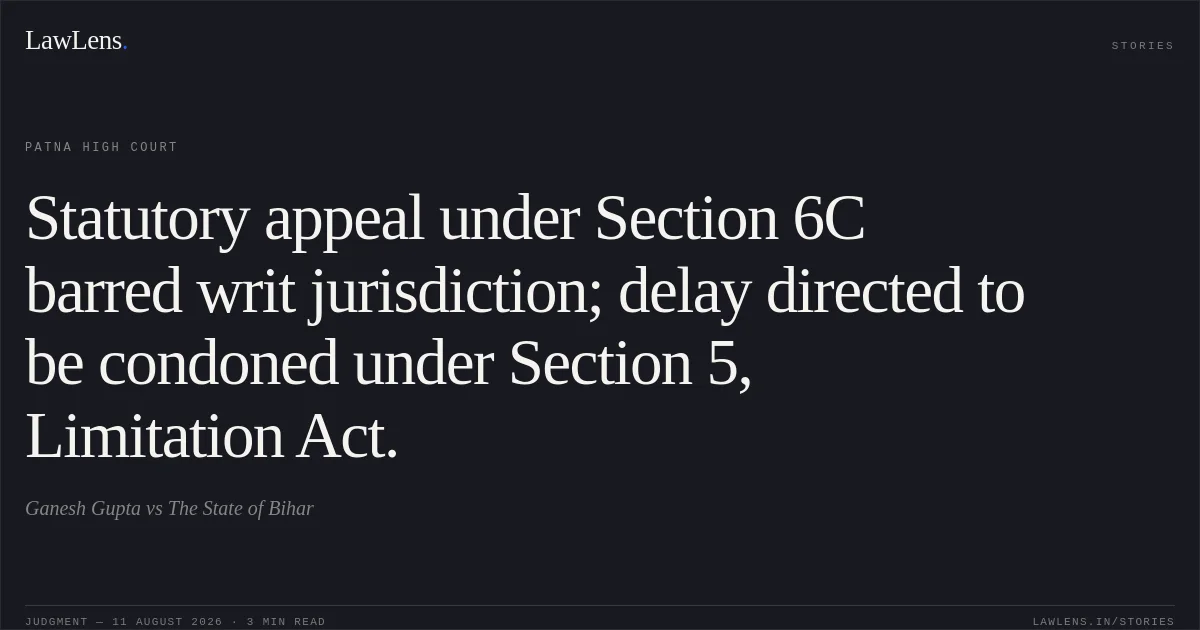
Whether the writ petitions challenging the confiscation orders under Section 6A of the Essential Commodities Act were maintainable when the petitioner had an alternative statutory remedy of appeal under Section 6C.
Source reference: pp. 3–5Whether the High Court could determine, in proceedings under Article 226 of the Constitution, the petitioner’s contention that the seizure was legally justified and that the police had found the case to be a mistake of fact.
Source reference: p. 5Whether the delay in filing the statutory appeals could be condoned under Section 5 of the Limitation Act.
Source reference: pp. 5–6Law Applied
Section 6C of the Essential Commodities Act, 1955 provides a statutory appeal to a judicial authority against an order of confiscation under Section 6A; the appellate authority may confirm, modify, or annul the confiscation order after hearing the aggrieved person.
Source reference: pp. 3–5Where an effective alternative statutory remedy exists, the High Court ordinarily declines to exercise its writ jurisdiction under Article 226, particularly where disputed factual questions require determination by the competent appellate authority.
Source reference: p. 5The Court further directed that the delay in filing the appeals be considered under Section 5 of the Limitation Act.
Source reference: p. 5Reasoning
The petitioner’s challenge was directed against confiscation orders passed under Section 6A, for which Section 6C expressly provided an appellate remedy.
Source reference: pp. 2–5The Court held that the petitioner’s assertions regarding the lawful purchase, quality, and possession of the rice, as well as the police conclusion that the case was a mistake of fact, involved factual matters that could not appropriately be adjudicated in the writ jurisdiction under Article 226.
Source reference: p. 5Although the limitation period for filing the statutory appeals had expired, that circumstance did not justify bypassing the appellate remedy; instead, the competent authority was directed to consider condonation of delay under Section 5 of the Limitation Act.
Source reference: pp. 5–6Holding
The High Court declined to examine the merits of the confiscation orders in writ proceedings and disposed of both writ petitions on the ground of the available alternative remedy under Section 6C of the Essential Commodities Act.
The petitioner was directed to file appeals before the concerned authority within four weeks from receipt of the order.
Source reference: p. 6The appellate authority was directed to condone and consider the delay in accordance with Section 5 of the Limitation Act and to dispose of the appeals within three months from the date of filing.
Source reference: p. 6All interlocutory applications, if any, were also disposed of.
Source reference: p. 6Acts & Sections Cited
3 provisions across 2 statutes referred to in this judgment. Each provision opens on LawLens.
Limitation Act, 19631
Original Court PDF
Ganesh GuptavsThe State of Bihar
Click to open original judgment
Original judgment, available to read, download and summarize on LawLens.in