Facts
The Petitioner Trust occupied land under a 90-year lease granted in 1923 for charitable purposes
Source reference: para 3In 2009, the Municipal Corporation Dhamtari (Respondent No. 2) cancelled the lease alleging a breach of conditions regarding sub-letting
Source reference: para 4Following a previous writ petition (WPC No. 3422 of 2010), the High Court directed the Corporation in 2024 to consider the Trust's renewal application
Source reference: para 4On June 13, 2025, the Corporation rejected the renewal application and subsequently demolished the Trust's structure
Source reference: para 5The Petitioner filed a statutory appeal and stay application under the Chhattisgarh Municipal Corporation Act, 1956, on June 23, 2025
Source reference: para 5While these remained pending for over six months, the Respondent issued a new Notice Inviting Tender (NIT) on February 27, 2026, to develop the land under a Public-Private Partnership (PPP) model
Source reference: para 5The Petitioner moved the High Court to quash the NIT and expedite the pending appeal
Source reference: para 2Issues
1. Whether the Court should quash the NIT dated 27.02.2026 issued by the Municipal Corporation during the pendency of the statutory appeal
Source reference: para 2.12. Whether a mandamus should be issued to the Appellate Committee to decide the pending appeal and stay application under the Chhattisgarh Municipal Corporation Act, 1956, in a time-bound manner
Source reference: para 2.2, 2.3Law Applied
The Court primarily considered the statutory appellate framework under Section 403 (Appeals) and Section 404 (Stay of execution of orders) of the Chhattisgarh Municipal Corporation Act, 1956
Source reference: para 5, 8These provisions establish the right of an aggrieved party to challenge Corporation orders before an Appellate Committee and seek interim relief to suspend the operation of the impugned order
Source reference: para 6Reasoning
The Court observed that the Petitioner had already invoked the prescribed statutory remedy by filing an appeal and a stay application, which had remained unaddressed for approximately nine months
Source reference: para 5The Court highlighted the prejudice caused by the Respondent's issuance of a fresh NIT for the subject land while the legality of the lease rejection was still being adjudicated by the Appellate Committee
Source reference: para 8Upon receiving confirmation from the Respondent’s counsel that the Appellate Committee was currently functional, the Court determined that the most efficient relief was to compel the Committee to exercise its jurisdiction
Source reference: para 7The Court emphasized that the Petitioner had approached the High Court before the expiry of the NIT deadline, necessitating urgent judicial intervention to ensure the statutory appeal was not rendered infructuous by the tender process
Source reference: para 8Holding
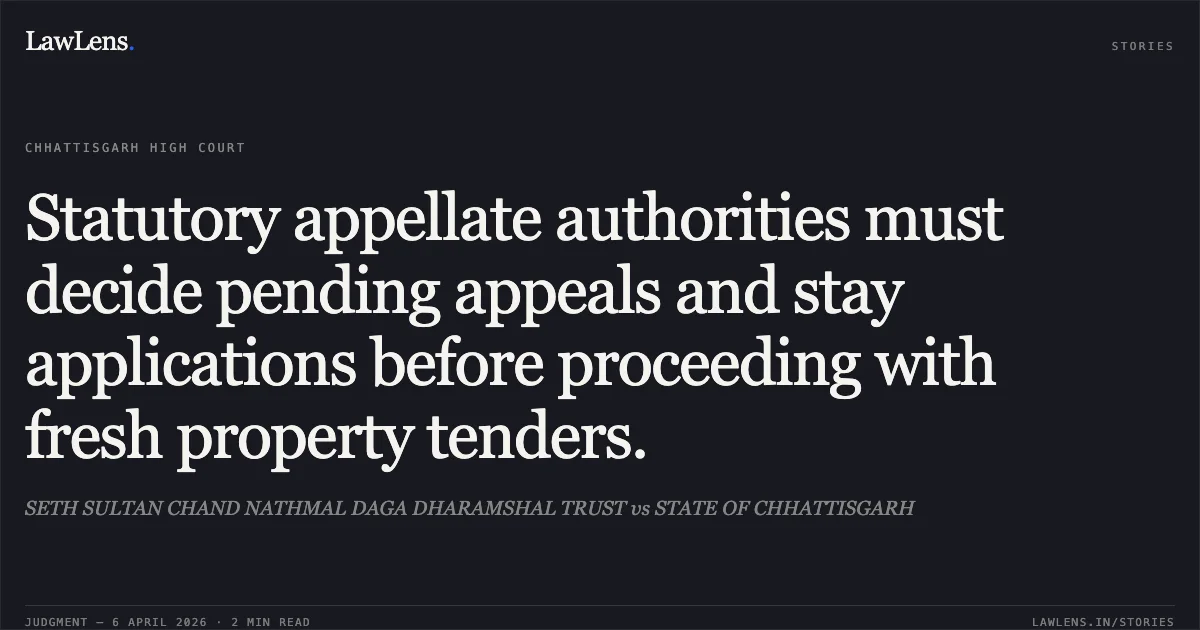
The High Court declined to quash the NIT at this stage but directed the Appellate Committee of the Respondent Corporation to decide the Petitioner's appeal (under Section 403) and stay application (under Section 404) within one week from the receipt of the certified copy of the order
The Court noted that this expedited timeline was necessary as the NIT's last date had already expired and the land's status was in flux
Source reference: para 8The petition was disposed of with these directions
Source reference: para 9Acts & Sections Cited
2 provisions across 1 statute referred to in this judgment. Linked provisions open on LawLens.
Municipal Corporation Act, 19562
Original Court PDF
SETH SULTAN CHAND NATHMAL DAGA DHARAMSHAL TRUSTvsSTATE OF CHHATTISGARH
Click to open original judgment
Original judgment, available to read, download and summarize on LawLens.in