Facts
The Appellant, while serving as a Lower Division Clerk (LDC) in the Slum Department of the Delhi Development Authority (DDA) in 1986, was accused of demanding and accepting a bribe of ₹100 from the complainant (PW2)
Source reference: p. 2The gratification was allegedly required to incorporate "No. IV Jawalapuri" on PW2's possession slip for a plot
Source reference: p. 2Following a complaint, the CBI conducted a trap operation on 18.07.1986, during which tainted currency notes were recovered from the Appellant's pant pocket, and his hand-wash tested positive for phenolphthalein
Source reference: p. 9-10The Trial Court, on 30.06.2003, convicted the Appellant under Section 161 of the IPC and Section 5(2) read with 5(1)(d) of the Prevention of Corruption Act, 1947, sentencing him to one year of rigorous imprisonment and a fine
Source reference: p. 4-5The Appellant challenged this conviction on grounds of witness contradictions and lack of authority to perform the requested act
Source reference: p. 5-6Issues
1. Whether the prosecution successfully established the foundational facts of demand, acceptance, and recovery of illegal gratification to sustain a conviction
Source reference: p. 72. Whether the Appellant was entitled to the benefit of doubt due to minor inconsistencies in witness testimonies and his alleged lack of competence to alter the possession slip
Source reference: p. 12, 143. Whether the sentence imposed by the Trial Court required modification in light of mitigating circumstances
Source reference: p. 15Law Applied
The Court applied Section 161 of the IPC (bribery) and Sections 5(1)(d) and 5(2) of the Prevention of Corruption Act, 1947 (criminal misconduct by a public servant).
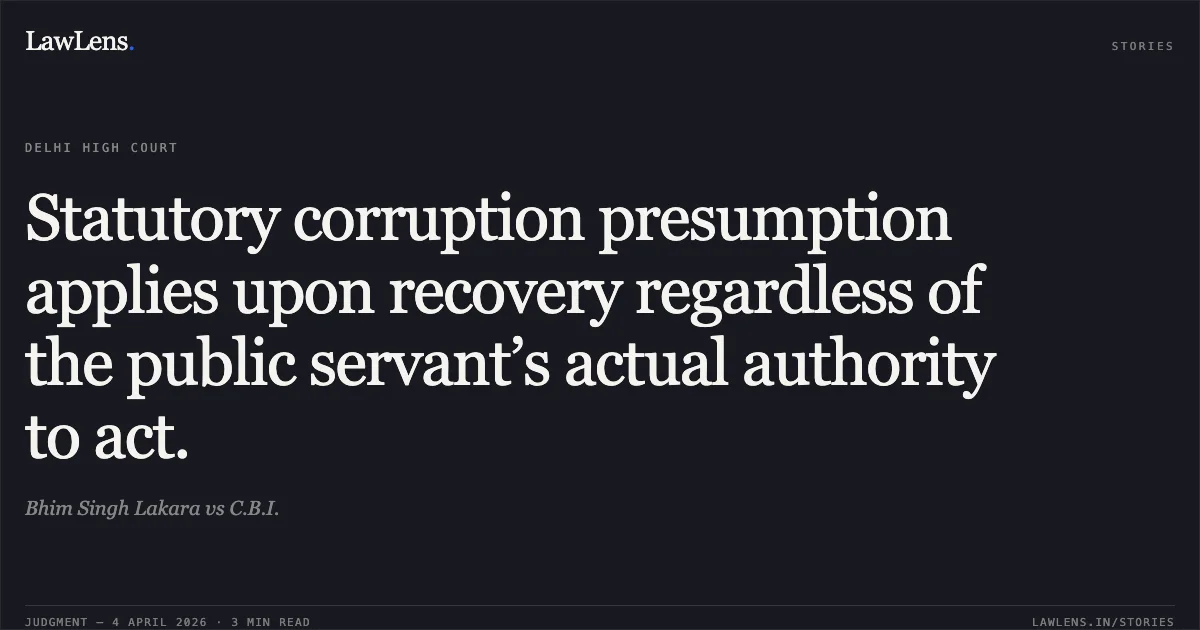
Source reference: no citationIt heavily relied on the statutory presumption under Section 4 of the PC Act, which mandates that once the acceptance of gratification is proved, it shall be presumed to be a motive or reward for an official act unless the contrary is proved
Source reference: p. 13Furthermore, the Court cited M. Narsinga Rao v. State of A.P. (2001), which holds that the recovery of tainted currency without a plausible explanation constitutes a strong incriminating circumstance
Source reference: p. 14Reasoning
The Court found that the testimonies of the complainant (PW2), the shadow witness (PW3), and the recovery witness (PW5) consistently proved the demand, acceptance, and subsequent recovery of the tainted money
Source reference: p. 10-11Although the defense pointed out discrepancies regarding who gave the signal to the raiding party and which specific official recovered the notes, the Court dismissed these as minor procedural inconsistencies that did not affect the core of the prosecution’s case
Source reference: p. 12-13Applying Section 4 of the PC Act, the Court noted that once acceptance was established, the burden shifted to the Appellant to rebut the presumption of guilt, which he failed to do beyond a mere denial
Source reference: p. 14Additionally, the Court ruled that the Appellant’s legal competence to make the entry on the slip was irrelevant; the offense is complete if a public servant demands and accepts gratification for an act they induce the complainant to believe they can perform
Source reference: p. 14-15Holding
The Court upheld the conviction, finding no infirmity in the Trial Court’s judgment regarding the Appellant's guilt
the Court noted mitigating factors: the incident occurred in 1986 (40 years prior), the bribe amount was nominal (₹100), and the Appellant had no prior criminal record
Source reference: p. 15-16Consequently, while maintaining the conviction, the Court partially allowed the appeal by reducing the substantive sentence of rigorous imprisonment from one year to six months
Source reference: p. 16Acts & Sections Cited
4 provisions across 2 statutes referred to in this judgment. Each provision opens on LawLens.
Code of Criminal Procedure, 19733
Indian Penal Code, 18601
Original Court PDF
Bhim Singh LakaravsC.B.I.
Click to open original judgment
Original judgment, available to read, download and summarize on LawLens.in