Facts
In July 2022, the NIA registered a case following the seizure of 102.784 kg of heroin
Source reference: p. 2Investigation revealed that funds from drug sales were routed through the bank account of ‘Sandhu Tour and Travel’, owned by the Petitioner, a suspected Hawala operator
Source reference: p. 3On 20.10.2022, NIA searched the Petitioner’s premises and seized ₹1,34,12,000/- in cash
Source reference: p. 3On 08.11.2023, a freezing order was passed under Section 68F(1) of the NDPS Act, which was confirmed by the Competent Authority on 07.12.2023
Source reference: p. 3-4The Petitioner challenged this before the Appellate Tribunal with a 250-day delay, which the Tribunal dismissed on 05.11.2024 for lack of jurisdiction to condone delay beyond the statutory limit of 60 days
Source reference: p. 4Issues
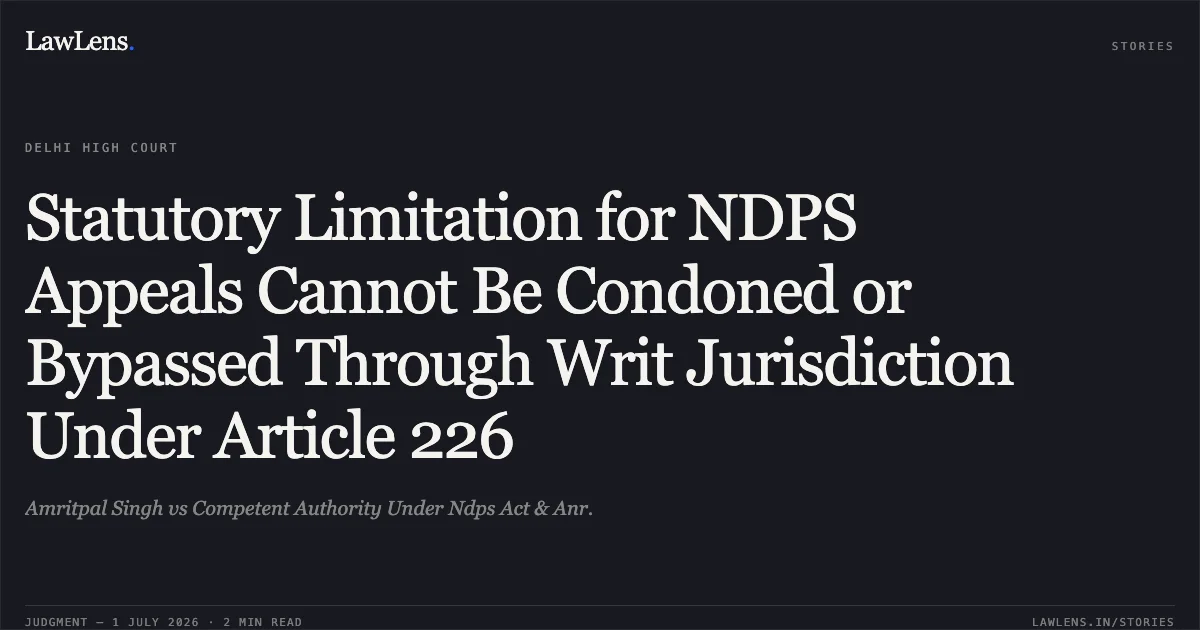
1. Whether the High Court can exercise its writ jurisdiction under Article 226 to condone a statutory delay in filing an appeal that exceeds the maximum limit prescribed under Section 68-O of the NDPS Act.
Source reference: p. 6-72. Whether the freezing order and subsequent confirmation are void ab initio due to non-compliance with the 48-hour reporting mandate under the proviso to Section 68F of the NDPS Act.
Source reference: p. 5Law Applied
The court primarily applied Section 68-O of the NDPS Act, which mandates that an appeal must be filed within 45 days, with an extension limited to a maximum of 60 days upon showing sufficient cause
Source reference: p. 10It relied on the principle that "an appeal is a creature of statute," as established in Durga Shankar Mehta v. Thakur Raghuraj Singh
Source reference: p. 11Article 226 cannot be used to circumvent or revive a statutory remedy extinguished by limitation (Omaxe Buildhome Limited v. Union of India)
Source reference: p. 11-12Radha Krishan Industries v. State of H.P. regarding the exhaustion of alternative remedies
Source reference: p. 8-9Reasoning
The Court reasoned that the NDPS Act provides a specific, time-bound appellate mechanism under Section 68-O, leaving the Tribunal with no discretion to condone a 250-day delay
Source reference: p. 10It rejected the Petitioner's plea for writ intervention, holding that a litigant who disables themselves from a statutory remedy through their own negligence cannot seek to resurrect that right via Article 226
Source reference: p. 13Regarding the procedural challenge to the initial seizure, the Court noted that while Section 68F requires swift reporting, the NIA initially seized the cash under Section 102 of the CrPC during a UAPA investigation, only invoking NDPS provisions after financial nexus was established
Source reference: p. 16The Court found that any initial procedural irregularities were cured because the Petitioner was subsequently given a full hearing during the confirmation proceedings but failed to provide any documentary evidence to prove the legitimate source of the cash
Source reference: p. 18Holding
The Court held that the Appellate Tribunal was correct in dismissing the appeal as it lacked the power to condone delay beyond 60 days
The Court dismissed the petition, holding that it cannot exercise extraordinary jurisdiction to bypass statutory limitation periods
Source reference: p. 20It further concluded that since the Petitioner failed to approach the Court with promptitude and failed to explain the source of the funds during confirmation proceedings, no relief was warranted
Source reference: p. 15, 18Final Order: Petition dismissed
Source reference: p. 20Acts & Sections Cited
8 provisions across 5 statutes referred to in this judgment. Each provision opens on LawLens.
Narcotic Drugs and Psychotropic Substances Act, 19852
Unlawful Activities (Prevention) Act, 19673
Code of Criminal Procedure, 19731
Central Excise Act, 19441
Electricity Act, 20031
Original Court PDF
Amritpal SinghvsCompetent Authority Under Ndps Act & Anr.
Click to open original judgment
Original judgment, available to read, download and summarize on LawLens.in