Facts
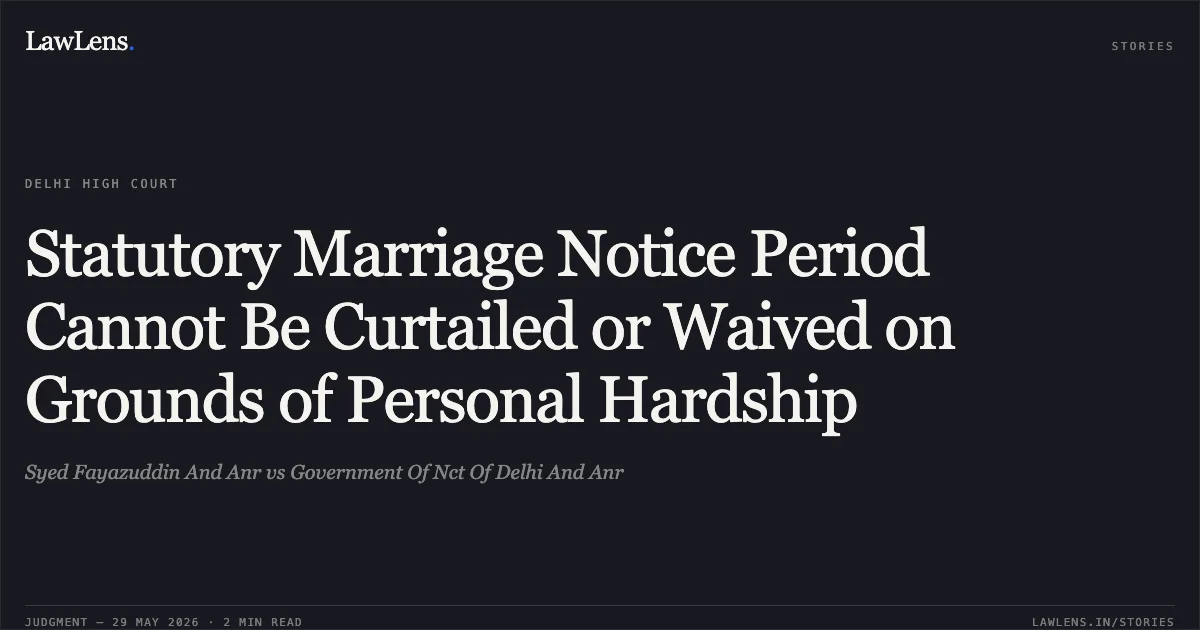
The petitioners filed a notice of intended marriage on 11.05.2026 under Section 5 of the Special Marriage Act, 1954 ["the Act"] before the Marriage Officer, Kalkaji.
Source reference: para. 2The statutory 30-day waiting period was set to expire on 19.06.2026.
Source reference: para. 2The petitioners approached the High Court seeking a Writ of Mandamus to exempt or relax this notice period because Petitioner No. 1 secured employment abroad and was required to relocate by 10.06.2026.
Source reference: para. 1, 3They argued that the waiting period would cause grave hardship and relied on precedents regarding privacy and marriage procedures.
Source reference: para. 3-4Issues
1. Whether the High Court, in the exercise of its writ jurisdiction under Article 226, can direct a waiver or curtailment of the mandatory 30-day statutory waiting period prescribed under the Special Marriage Act, 1954.
Source reference: para. 5, 7Law Applied
Section 16 of the Special Marriage Act, 1954, mandates that a marriage certificate can only be entered after the lapse of thirty days from the publication of notice.
Source reference: para. 7The principle established in Nazir Ahmad v. King-Emperor, and recently in Union Bank of India v. Rajat Infrastructure (P) Ltd., that when a statute requires a thing to be done in a particular manner, it must be done in that manner or not at all.
Source reference: para. 8The doctrine of dura lex sed lex (the law is hard, but it is the law), citing Popat Bahiru Govardhane v. Land Acquisition Officer and Martin Burn Ltd. v. Corpn. of Calcutta, asserting that courts cannot ignore statutory mandates to relieve individual hardship.
Source reference: para. 10The limits of judicial interpretation as held in Rohitash Kumar v. Om Prakash Sharma, noting courts cannot add or subtract words from a statute.
Source reference: para. 12Reasoning
The Court distinguished the petitioners' cited precedents, Pranav Kumar Mishra and Safiya Sultana, noting those cases dealt with privacy and address verification rather than the waiver of the statutory waiting period.
Source reference: para. 5-6The Court reasoned that the 30-day period is not merely procedural but a conscious legislative framework engrafted by Parliament.
Source reference: para. 9The Court held that issuing a mandamus to bypass this period would compel authorities to act in contravention of the law, potentially leading to the "destruction of rule of law".
Source reference: para. 9The Court observed that while the petitioners' hardship was genuine, the legislature is presumed to be aware of such inconveniences, and the judiciary cannot "alter the fabric" of the Act or "iron out creases" to the extent of rewriting the law.
Source reference: para. 11-12Holding
The Court answered the issue in the negative, holding that there is no justifiable ground to permit the waiver or curtailment of the statutory 30-day period.
A writ of mandamus cannot be issued to direct an authority to act contrary to express legislative mandates; consequently, the High Court dismissed the writ petition as devoid of merit.
Source reference: para. 9, 13, 14Acts & Sections Cited
5 provisions across 1 statute referred to in this judgment. Each provision opens on LawLens.
Special Marriage Act, 19545
Original Court PDF
Syed Fayazuddin And AnrvsGovernment Of Nct Of Delhi And Anr
Click to open original judgment
Original judgment, available to read, download and summarize on LawLens.in