Facts
The respondent (landlord) filed an application under Section 10 of the U.P. Regulation of Urban Premises Tenancy Act, 2021 ("Act No. 16 of 2021") for the enhancement of rent
Source reference: para. 3On 24.11.2025, the Rent Authority revised the rent payable by the petitioner (tenant)
Source reference: para. 4The petitioner challenged this before the Rent Tribunal in Rent Appeal No. 07 of 2026.
Source reference: para. 4By an order dated 02.01.2026, the Tribunal noted that the petitioner had deposited 50% of the arrears due but directed the petitioner to continue depositing 50% of the revised monthly rent (Rs. 22,500/- out of Rs. 45,000/-) during the pendency of the appeal as a condition for interim protection
Source reference: para. 4The petitioner challenged this direction under Article 227, contending that the proviso to Section 35(1) of the Act only requires a one-time deposit of 50% of the amount due as of the date the appeal is filed
Source reference: para. 5Issues
1. Whether the requirement of pre-deposit under the proviso to Section 35(1) of the U.P. Act No. 16 of 2021 is confined to a one-time deposit calculated up to the date of filing, or whether it extends to a continuing obligation for recurring liabilities accruing during the pendency of the appeal
Source reference: para. 6Law Applied
proviso to Section 35(1) of the U.P. Act No. 16 of 2021, which stipulates that "no appeal shall lie unless the appellant has deposited fifty per cent of the entire payable amount under the impugned order"
Source reference: para. 7the right of appeal is a statutory creation and can be conditional, as established in Anant Mills Co. Ltd. v. State of Gujarat and Vijay Prakash D. Mehta v. Collector of Customs
Source reference: para. 10pre-deposit requirements in fiscal or rent statutes are mandatory and intended to safeguard the successful party, citing M/s Tecnimont Pvt. Ltd. v. State of Punjab and Prathama U.P. Gramin Bank v. Union of India
Source reference: para. 10, para. 12S. Sundaram Pillai v. V.R. Pattabiraman that a proviso can operate as a substantive restriction on a right
Source reference: para. 13Reasoning
The Court observed that the expression "entire amount payable under the impugned order" is of wide amplitude and must be construed contextually based on the nature of the liability
Source reference: para. 14In rent matters, the liability is recurring and continuous; therefore, the "amount payable" is dynamic rather than static
Source reference: para. 15-16The Court reasoned that if the deposit were "frozen" at the date of filing, it would defeat the legislative intent of safeguarding the landlord's interests during the appeal and allow the tenant to avoid statutory obligations while enjoying the benefit of the litigation's pendency
Source reference: para. 17, 21The Court emphasized that the statutory mandate is not exhausted by a one-time initial deposit but subsists as a "subsisting and dynamic requirement" as long as the liability continues to accrue
Source reference: para. 23.4, 23.13The Tribunal's direction for periodic deposits was held to be a regulatory measure and an equitable arrangement for interim protection, rather than an execution of the final order
Source reference: para. 23.9, 25Holding
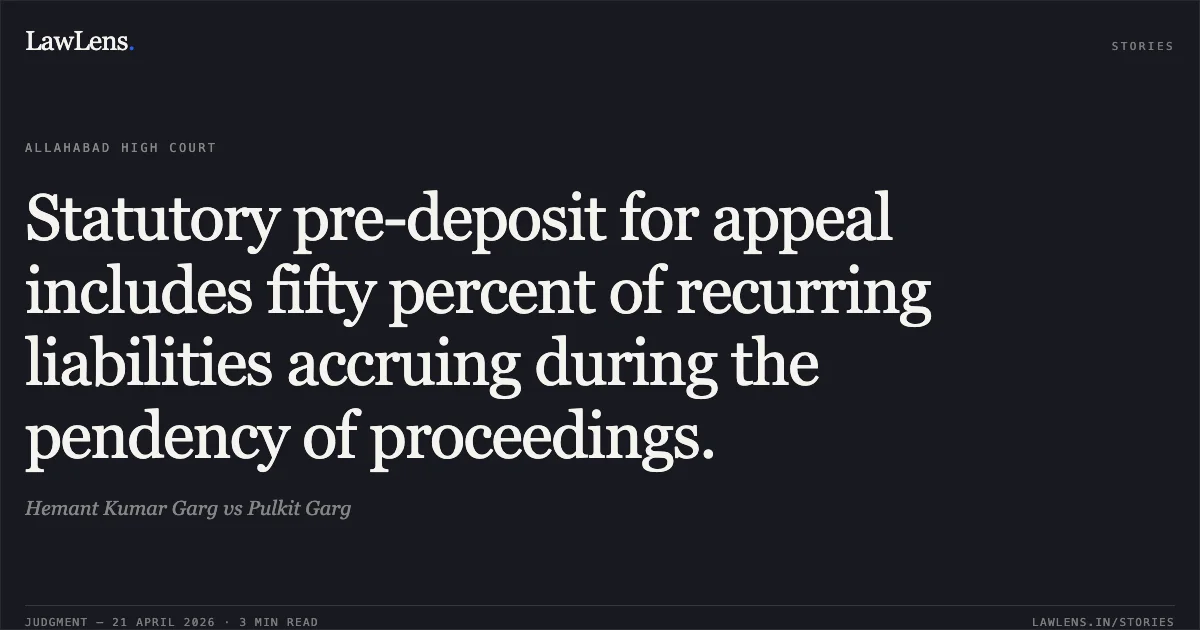
The Court dismissed the petition, holding that the pre-deposit requirement under Section 35(1) for recurring liabilities is continuous in operation throughout the pendency of the appeal
The Rent Tribunal's direction to deposit 50% of the revised monthly rent was held to be a valid, logical extension of the statutory mandate intended to balance the parties' interests
Source reference: para. 24-25The Court concluded that non-compliance with such a continuing deposit requirement justifies the vacating of interim protection or dismissal of the appeal
Source reference: para. 23.11Acts & Sections Cited
2 provisions across 1 statute referred to in this judgment. Linked provisions open on LawLens.
U.P. Regulation of Urban Premises Tenancy Act, 20212
Original Court PDF
Hemant Kumar GargvsPulkit Garg
Click to open original judgment
Original judgment, available to read, download and summarize on LawLens.in