Facts
On August 26, 1996, the D.B. Marg Police received information regarding a brothel operating at Rele Building, Mumbai.
Source reference: para. 3, 17A raid was conducted post-midnight (August 27, 1996) by a police team and two panchas, where the Applicant was found in a room with two minor girls.
Source reference: para. 3, 17The Applicant was charged under the Immoral Traffic (Prevention) Act, 1956 (PITA) and the Juvenile Justice Act, 1986.
Source reference: no citationThe Metropolitan Magistrate convicted the Applicant under Section 6 of PITA, sentencing her to two years RI and a fine.
Source reference: para. 2This conviction was upheld by the Additional Sessions Judge in 2003.
Source reference: para. 2The Applicant filed this revision challenging the concurrent findings, alleging material contradictions in witness testimony, lack of an ossification test, and procedural lapses in the raid.
Source reference: para. 7.1–7.9Issues
1. Whether there were material contradictions regarding the date of the raid and delay in filing the FIR sufficient to vitiate the prosecution’s case
Source reference: para. 17-182. Whether the absence of a formal "ossification test" invalidated the medical officer's finding regarding the victims' minority
Source reference: para. 21-233. Whether the statutory presumption under Section 6(2) of PITA was applicable and remained unrebutted by the Applicant
Source reference: para. 19, 25Law Applied
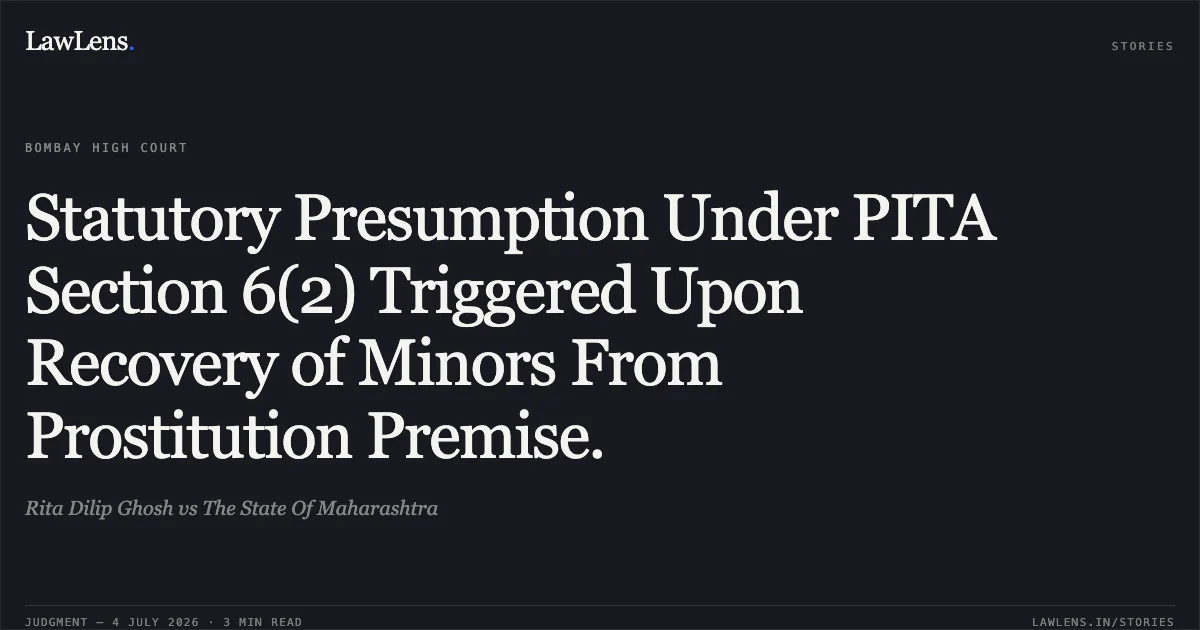
Section 6 of the Immoral Traffic (Prevention) Act, 1956, specifically the statutory presumption under Section 6(2), which presumes a person has committed an offence if found with a child in a brothel unless the contrary is proved.
Source reference: para. 19Section 15 of PITA regarding the powers of a Special Police Officer.
Source reference: para. 27The principles in Vinod Katara v. State of Uttar Pradesh, which defines the ossification test as a determination based on the fusion of bones via X-ray and notes it is relevant but not solely conclusive.
Source reference: para. 22Standard for revisional jurisdiction from K. Chinnaswamy Reddy v. State of Andhra Pradesh, limiting interference to cases of glaring procedural defects or manifest errors of law.
Source reference: para. 35Reasoning
The Court found no merit in the alleged contradictions regarding dates; the discrepancy between August 26 and 27 was logically explained by the raid occurring post-midnight.
Source reference: para. 17The delay in FIR was deemed well-explained by the necessity of medical examinations and Juvenile Board formalities.
Source reference: para. 18The Court rejected the argument against the age verification process, noting that PW-4 (Medical Officer) had clinically examined the girls and relied on X-rays, which fundamentally constitutes an ossification test.
Source reference: para. 23Even with a two-year margin of error, the victims remained minors.
Source reference: para. 24Since the victims were found in the Applicant's custody in a brothel—a fact corroborated by independent panch witness PW-1—the statutory presumption under Section 6(2) of PITA was triggered.
Source reference: para. 25The Applicant failed to lead any evidence to rebut this presumption.
Source reference: para. 25The Court noted that minor discrepancies in testimony are not fatal in trafficking cases given the trauma and fear associated with such heinous crimes.
Source reference: para. 11Holding
The Court answered the issues in the negative, holding that the prosecution proved the guilt beyond reasonable doubt and the Applicant failed to rebut the statutory presumption.
The Court held that the concurrent findings of the lower courts did not suffer from any manifest error of law or flagrant miscarriage of justice.
Source reference: para. 35, 37The Revision Application was dismissed, the conviction and sentence were confirmed, and the Trial Court was directed to secure the Applicant's presence to serve the remainder of the sentence.
Source reference: para. 37-38Acts & Sections Cited
7 provisions across 4 statutes referred to in this judgment. Each provision opens on LawLens.
Immoral Traffic (Prevention) Act, 19562
Code of Criminal Procedure, 19731
Indian Penal Code, 18602
Narcotic Drugs and Psychotropic Substances Act, 19852
Original Court PDF
Rita Dilip GhoshvsThe State Of Maharashtra
Click to open original judgment
Original judgment, available to read, download and summarize on LawLens.in