Facts
Kamlaben, the deceased, was married to the respondent approximately three years before the incident and resided with him and his family in Ahmedabad.
Source reference: paras. 1–2.5, pp. 1–3The prosecution alleged that the respondent subjected her to cruelty, demanded money from her parental family, consumed liquor, played cards, and quarrelled with her.
Source reference: paras. 1–2.5, pp. 1–3On 29 March 2007, Kamlaben sustained fatal burn injuries while allegedly preparing tea on a primus stove.
Source reference: paras. 1–2.5, pp. 1–3She was taken to L.G. Hospital, where she died.
Source reference: paras. 1–2.5, pp. 1–3Her father subsequently lodged an FIR under Sections 498-A and 306 of the IPC.
Source reference: paras. 1–2.5, pp. 1–3The Trial Court acquitted the respondent in Sessions Case No. 137 of 2010, finding that the prosecution had failed to establish cruelty, harassment, dowry demand, or abetment of suicide beyond reasonable doubt.
Source reference: paras. 1–2.5, pp. 1–3The State challenged the acquittal under Section 378(1)(3) of the CrPC.
Source reference: paras. 1–2.5, pp. 1–3The High Court noted that the deceased’s family members were present during the post-mortem and cremation but did not immediately raise suspicion; an accidental-death entry had also been recorded before registration of the FIR.
Source reference: paras. 8, 11, pp. 7–9The deceased’s statement to the Investigating Officer and the dying declaration at Exhibit 38 attributed the burn injuries to an accident and did not implicate the respondent.
Source reference: paras. 12–14, pp. 9–10Issues
Whether the Trial Court committed an error in acquitting the respondent.
Source reference: para. 7, p. 6Whether the Trial Court misappreciated the oral and documentary evidence or committed an error of law or fact.
Source reference: para. 7, p. 6Whether the impugned judgment of acquittal was illegal or perverse so as to warrant appellate interference.
Source reference: para. 7, p. 6Whether the prosecution established the foundational facts necessary to invoke the presumptions under Sections 113A and 113B of the Indian Evidence Act.
Source reference: paras. 15–16, p. 10Whether the prosecution proved the offences under Sections 498-A and 306 of the IPC beyond reasonable doubt.
Source reference: paras. 16, 19, pp. 10–11Law Applied
The Court applied Section 498-A IPC, under which “cruelty” includes wilful conduct likely to drive a woman to suicide or cause grave injury, and harassment connected with an unlawful demand for property or valuable security.
Source reference: para. 22, pp. 12–13Section 306 IPC requires proof that the accused abetted the commission of suicide, read with Section 107 IPC, which defines abetment through instigation, conspiracy, or intentional aid.
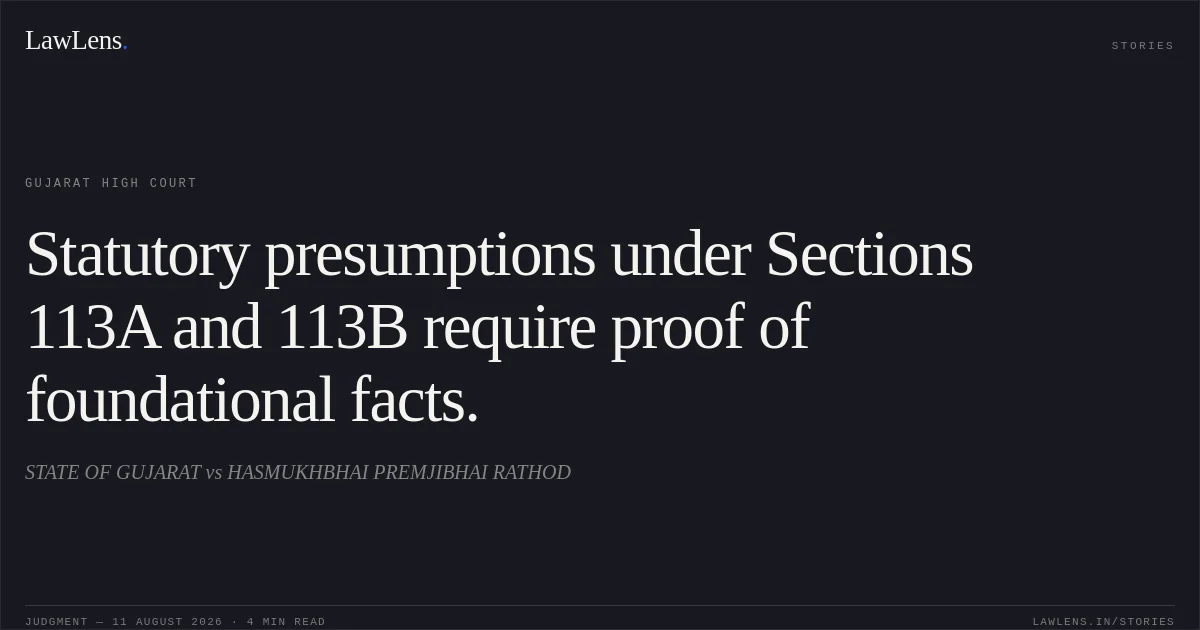
Source reference: para. 22, pp. 12–13Section 113A of the Evidence Act permits a presumption of abetment of suicide by a husband or his relative where a married woman commits suicide within seven years of marriage and was subjected to cruelty; the requisite foundational facts must first be established.
Source reference: paras. 15, 23, pp. 10, 13–14The Court also referred to Sections 113A and 113B, observing that statutory presumptions cannot be invoked in the absence of cogent material establishing cruelty, harassment, dowry demand, or other necessary circumstances.
Source reference: paras. 15, 23, pp. 10, 13–14On appeals against acquittal, the appellate court may reappreciate the evidence, but the accused carries a double presumption of innocence, and an acquittal should not be disturbed where two reasonable views are possible.
Source reference: paras. 25–28, pp. 14–17The Court relied principally on Chandrappa v. State of Karnataka, (2007) 4 SCC 415, as reaffirmed in Rajesh Prasad v. State of Bihar, [2022] 3 SCC 471, Babu Sahebagouda Rudragoudar v. State of Karnataka, (2024) 8 SCC 149, and Ramesh v. State of Karnataka, [2024] 9 SCC 169.
Source reference: paras. 25–28, pp. 14–17Reasoning
The High Court found that the prosecution evidence did not reliably establish the alleged cruelty or harassment.
Source reference: paras. 10, 19, pp. 7–8, 11The allegations regarding monetary demands, liquor consumption, card-playing, quarrelling, and non-earning were either unsupported by the material witnesses or affected by material contradictions.
Source reference: paras. 10, 19, pp. 7–8, 11The deceased’s own statement and dying declaration described the incident as accidental and did not implicate the respondent; the scene-of-offence panchnama further corroborated the accidental version.
Source reference: paras. 12–14, pp. 9–10Although the death occurred within seven years of marriage, that circumstance alone did not justify invoking Sections 113A or 113B because the foundational facts of cruelty, dowry harassment, or abetment were not proved.
Source reference: para. 15, p. 10The inconsistency between the FIR, the deceased’s statement, and the dying declaration further weakened the prosecution case.
Source reference: para. 16, p. 10Applying the restrictive principles governing appeals against acquittal, the Court held that the Trial Court’s view was reasonable, supported by the evidence, and neither perverse nor legally infirm.
Source reference: paras. 20–21, 25–30, pp. 11, 14–18Holding
The High Court answered the issues against the State.
It held that the prosecution failed to prove the offences under Sections 498-A and 306 IPC beyond reasonable doubt and failed to establish the foundational facts necessary for statutory presumptions under Sections 113A and 113B of the Evidence Act.
Source reference: paras. 15–16, 19, 29–30, pp. 10–11, 17–18Finding no illegality, perversity, or manifest error in the Trial Court’s acquittal, the Court dismissed the State’s appeal and confirmed the judgment and order of acquittal.
Source reference: para. 31, p. 18The respondent’s bail bond was cancelled, and the record and proceedings were directed to be returned to the Trial Court.
Source reference: para. 31, p. 18Acts & Sections Cited
4 provisions across 2 statutes referred to in this judgment. Each provision opens on LawLens.
Code of Criminal Procedure, 19732
Indian Penal Code, 18602
Original Court PDF
STATE OF GUJARATvsHASMUKHBHAI PREMJIBHAI RATHOD
Click to open original judgment
Original judgment, available to read, download and summarize on LawLens.in