Facts
The Appellant is the Secretary of a Sangha representing depositors of Sri Guru Raghavendra Sahakara Bank Niyamitha (the Bank).
Source reference: no citationFollowing a detection of financial irregularities amounting to over ₹1,500 crores, the RBI imposed "All Inclusive Directions" on 10.01.2020, freezing the bank's activities.
Source reference: para. 17, 18Under the Deposit Insurance and Credit Guarantee Corporation (Amendment) Act, 2021, the Corporation (DICGC) became liable to make interim payments to depositors up to ₹5,00,000.
Source reference: para. 29The DICGC disbursed approximately ₹712 crores to over 22,234 claimants and subsequently issued a demand on 03.01.2022 requiring the Bank to repay this amount in five annual installments.
Source reference: para. 30-31The Appellant challenged the constitutionality of Sections 18A(5), 21(3), and 21(4) of the DICGC Act, arguing that granting the Corporation priority in recovery over the remaining dues of depositors is arbitrary and violates Articles 14 and 300-A.
Source reference: para. 1, 41A Single Judge dismissed the Writ Petition on 01.09.2025, leading to this appeal.
Source reference: para. 42Issues
1. Whether Sections 18A(5), 21(3), and 21(4) of the DICGC Act, 1961, as amended, are constitutionally valid or if they are "manifestly arbitrary" under Article 14 for granting the Corporation priority in recovery.
Source reference: para. 53, 562. Whether the Amendment Act was beyond the legislative competence of Parliament under Entry 47 of List-I of the Seventh Schedule.
Source reference: para. 49, 66Law Applied
Deposit Insurance and Credit Guarantee Corporation Act, 1961 (as amended by Act 30 of 2021), specifically Section 18A regarding interim payments and Section 21 regarding the statutory obligation of banks to repay the Corporation.
Source reference: para. 57The principle of "manifest arbitrariness" as defined in Shayara Bano v. Union of India, which invalidates legislation done capriciously or without adequate determining principles.
Source reference: para. 56The principle recognized in DICGC v. Ragupathi Ragavan, which recognized the "laudable object" of the Act to protect small depositors.
Source reference: para. 54The grounds for challenging plenary legislation under Article 14 as established in Indian Express Newspapers (Bombay) (P) Ltd. v. Union of India.
Source reference: para. 56, 61Reasoning
The Court rejected the Appellant's argument that the DICGC's right to recovery must be confined to the common law principle of subrogation.
Source reference: para. 63It reasoned that the priority accorded to the Corporation is a statutory prescription designed to replenish public funds so the Corporation can continue to fulfill its obligations to the broader banking industry and other small depositors.
Source reference: para. 62-63The Court found no "manifest arbitrariness" because the priority has a clear nexus with the legislative object of fostering financial stability and protecting the maximum number of depositors.
Source reference: para. 63Regarding legislative competence, the Court held that Parliament's power under Article 246 is not strictly limited by the narrow definitions of "insurance" as a contract but extends to statutory protections for depositors in the public interest.
Source reference: para. 66The claim that ad valorem premiums on deposits exceeding ₹5 Lakhs were arbitrary was dismissed, as statutory exactions need not be perfectly commensurate with specific payouts, and such matters of policy and reserve-maintenance are outside the scope of judicial review.
Source reference: para. 56, 67Holding
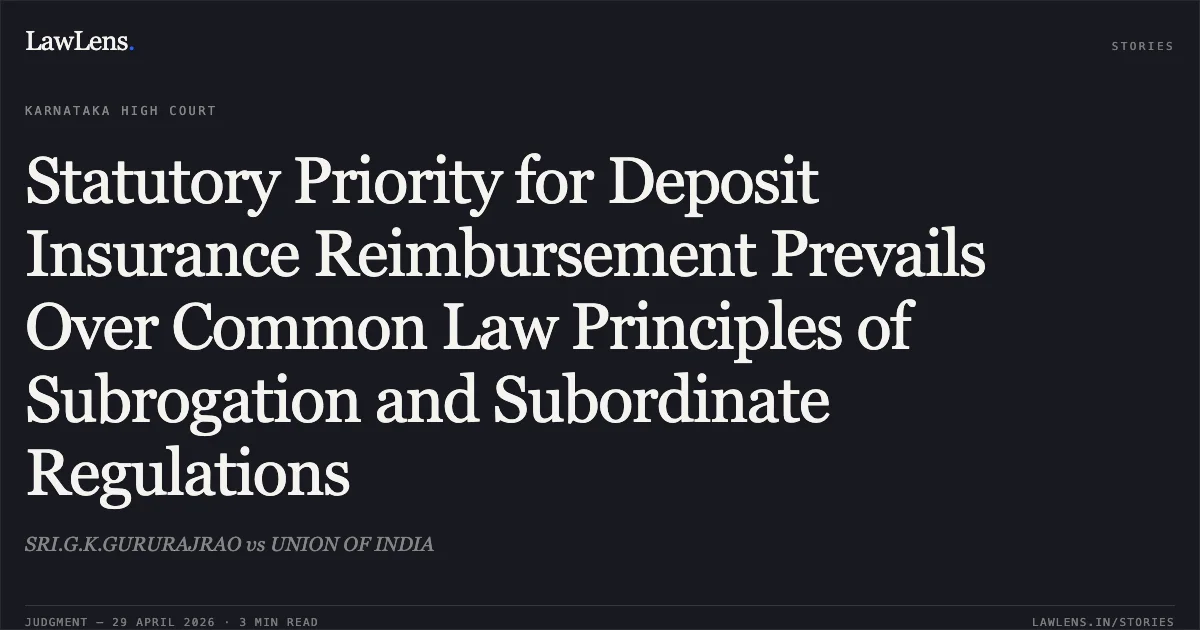
The Court answered both issues in the negative, upholding the constitutional validity of the impugned provisions.
It held that the priority of discovery granted to the DICGC is not arbitrary but is a necessary mechanism for public interest and banking stability.
Source reference: para. 63The Court found the legislation to be within the pith and substance of Parliament's powers.
Source reference: para. 66The Writ Appeal was dismissed, affirming the Single Judge's order and denying any relief to the Appellant.
Source reference: para. 68Acts & Sections Cited
11 provisions across 4 statutes referred to in this judgment. Each provision opens on LawLens.
Deposit Insurance and Credit Guarantee Corporation Act, 19617
Banking Regulation Act, 19492
KARNATAKA CO-OPERATIVE SOCIETIES ACT, 1959.1
KARNATAKA HIGH COURT ACT, 19611
Original Court PDF
SRI.G.K.GURURAJRAOvsUNION OF INDIA
Click to open original judgment
Original judgment, available to read, download and summarize on LawLens.in