Facts
The petitioner is a tenant of a shop in Bijnor, originally under an erstwhile owner before the respondent-landlord purchased the premises.
Source reference: para. 3In 2014, the respondent filed a release application (P.A. Case No. 1 of 2014) under Section 21(1)(a) of the U.P. Act No. 13 of 1972, seeking the shop for his son’s business.
Source reference: para. 4The petitioner contested the need and raised a jurisdictional objection, claiming the mandatory six-month notice required by the first proviso to Section 21(1)(a) was not satisfied, as notice was issued on 02.12.2013 and the suit filed on 15.01.2014.
Source reference: para. 5, 8The Prescribed Authority allowed the release in 2022, holding the need bona fide and finding the notice objection waived by the tenant’s conduct.
Source reference: para. 6This was affirmed by the Appellate Court on 16.01.2026.
Source reference: para. 2, 7Issues
1. Whether the release application was liable to be held premature and without jurisdiction due to non-compliance with the six-month prior notice requirement under the first proviso to Section 21(1)(a) of U.P. Act No. 13 of 1972.
Source reference: para. 14.12. Whether the petitioner-tenant, through prolonged participation and contesting on merits for seven years before raising the notice objection in a written statement, waived his right to challenge the maintainability of the proceedings.
Source reference: para. 14.2Law Applied
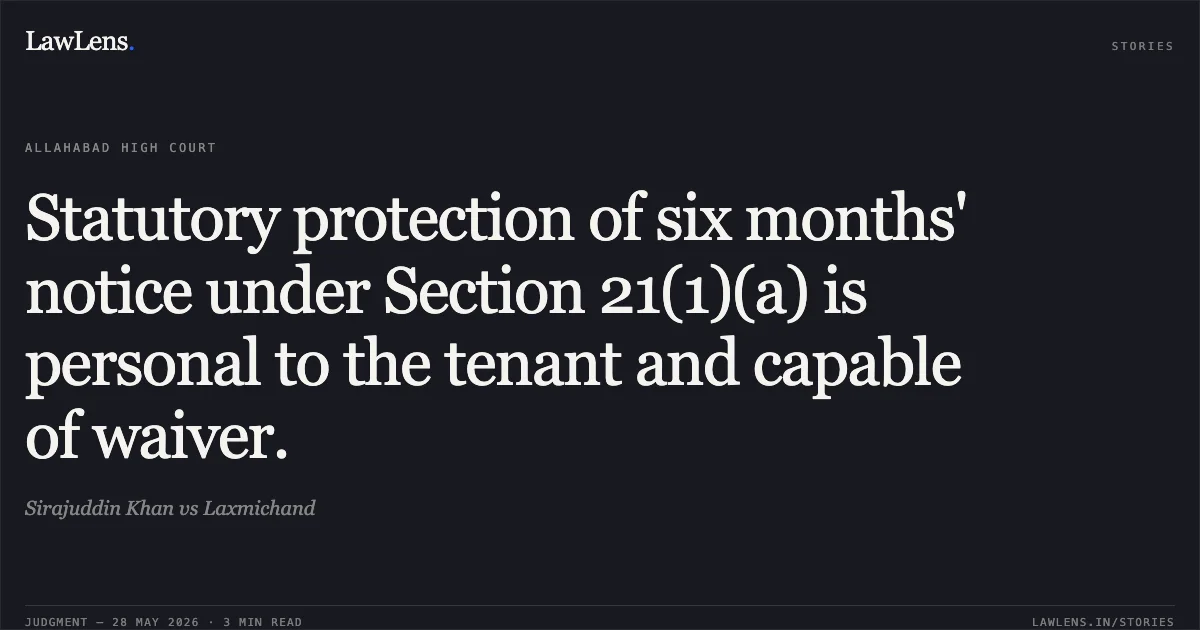
Section 21(1)(a) of the U.P. Urban Buildings (Regulation of Letting, Rent and Eviction) Act, 1972, which mandates a three-year waiting period post-purchase and a six-month prior notice to the tenant before filing a release application.
Source reference: para. 15The Supreme Court precedent Martin & Harris Ltd. v. Additional District Judge (1998), which established that while the six-month notice is mandatory, it is a procedural safeguard for the personal benefit of the tenant and is thus capable of being waived.
Source reference: para. 26The Latin maxim quilibet potest renunciare juri pro se introducto (anyone may waive a right introduced for their own benefit), as supported by Krishan Lal v. State of Jammu & Kashmir and Vellayan Chettiar v. Govt. of Madras.
Source reference: para. 27-29Reasoning
The court reasoned that the six-month notice requirement does not affect the inherent jurisdiction of the authority but serves as a procedural protection for the tenant.
Source reference: para. 21-22Applying Martin & Harris Ltd., the court observed that if a tenant participates in proceedings on merits without timely pressing the notice objection, they lose the right to challenge the suit as premature.
Source reference: para. 26, 34In this case, the petitioner entered appearance in 2014, filed interrogatories, and sought numerous adjournments for seven years before finally raising the notice plea in a written statement in 2021.
Source reference: para. 43-44The court held that such "prolonged participation" and "conscious inaction" constituted a waiver by conduct.
Source reference: para. 45, 47It emphasized that the law does not allow a party to keep a technical objection in reserve only to revive it at a belated stage after testing the merits of the case.
Source reference: para. 39Holding
The High Court dismissed the petition, holding that the notice objection stood waived due to the petitioner’s seven-year delay in raising it and active participation in the trial.
The court affirmed the lower courts' findings that the landlord’s requirement was bona fide and the hardship weighed in his favor, noting that concurrent findings of fact do not warrant interference under the limited supervisory jurisdiction of Article 227 unless patently perverse.
Source reference: para. 52-55The impugned judgments of the Prescribed Authority and the Appellate Court were upheld.
Source reference: para. 54Acts & Sections Cited
1 provisions across 1 statute referred to in this judgment. Each provision opens on LawLens.
Code of Civil Procedure, 19081
Original Court PDF
Sirajuddin KhanvsLaxmichand
Click to open original judgment
Original judgment, available to read, download and summarize on LawLens.in