Facts
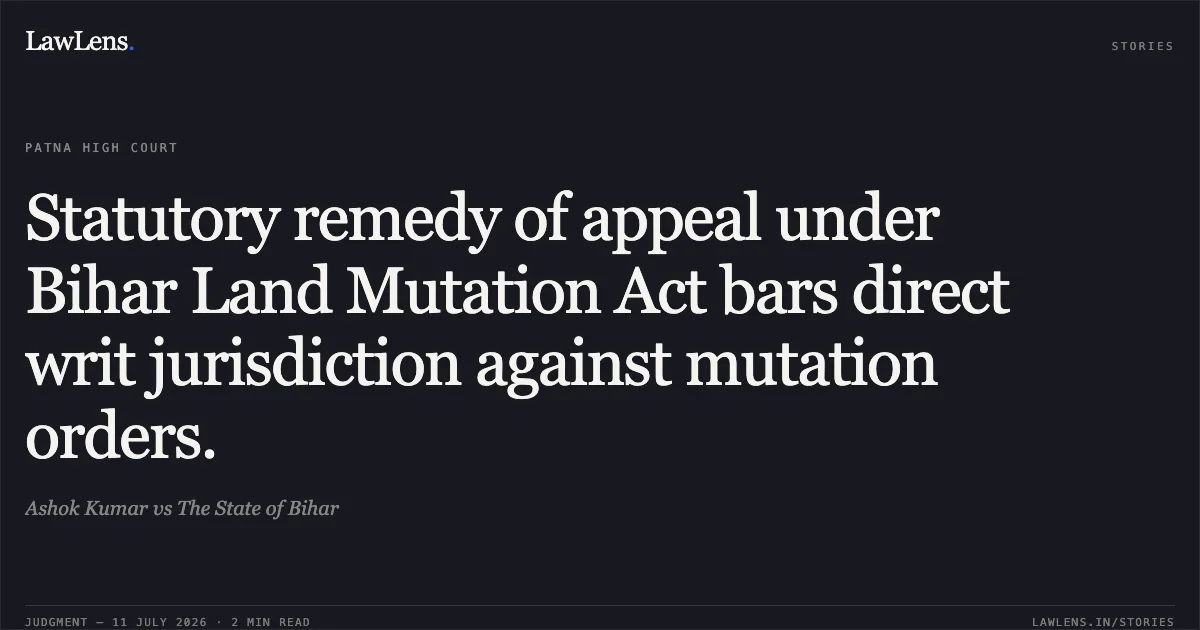
The petitioner, Ashok Kumar, filed a writ petition under Article 226 of the Constitution of India challenging an order dated 19.05.2026 passed by the Circle Officer, Gayaji, in Mutation Case No. 8967R27/2025-26.
Source reference: para. 2The Circle Officer had rejected the petitioner's application for the mutation of land.
Source reference: para. 2During the proceedings, the State raised a preliminary objection regarding the maintainability of the writ petition, arguing that the petitioner had bypassed a specific statutory remedy available under the Bihar Land Mutation Act, 2011.
Source reference: para. 3Issues
1. Whether a writ petition is maintainable against an order of the Circle Officer when a statutory alternative remedy of appeal exists under the Bihar Land Mutation Act, 2011?
Source reference: para. 4-5Law Applied
Section 7 of the Bihar Land Mutation Act, 2011, which provides a statutory right of appeal to the Deputy Collector Land Reforms (DCLR) for any party aggrieved by an order of the Circle Officer regarding land mutation.
Source reference: para. 4Section 7(1) mandates that such an appeal be filed within 30 days, while Section 7(2) allows the DCLR to condone delays for sufficient reasons.
Source reference: para. 4The court followed the judicial principle of "alternative remedy," which restricts the exercise of extraordinary writ jurisdiction under Article 226 when an efficacious statutory forum is available.
Source reference: para. 5Reasoning
The Court observed that Section 6 of the Bihar Land Mutation Act, 2011, defines the procedure for the Circle Officer to dispose of mutation cases, and Chapter VI of the same Act provides a comprehensive mechanism for appellate review.
Source reference: para. 4The Court found merit in the State's submission that the petitioner should have approached the DCLR instead of the High Court.
Source reference: para. 4Consequently, the Court permitted the petitioner to withdraw the writ petition to seek the correct statutory remedy.
Source reference: para. 5To ensure the petitioner was not prejudiced by the time spent in the High Court, the Court directed that any question of limitation should be viewed leniently, acknowledging the period the petitioner spent pursuing the matter under Article 226.
Source reference: para. 6Holding
The Court disposed of the writ petition, granting the petitioner liberty to file an appeal before the D.C.L.R., Gayaji, within two weeks.
The D.C.L.R. was directed to accept the appeal, condone any delay caused by the High Court proceedings, and decide the case on its merits within six weeks after hearing all concerned parties.
Source reference: para. 5-6All pending interlocutory applications were also disposed of.
Source reference: para. 8Acts & Sections Cited
2 provisions across 1 statute referred to in this judgment. Each provision opens on LawLens.
Original Court PDF
Ashok KumarvsThe State of Bihar
Click to open original judgment
Original judgment, available to read, download and summarize on LawLens.in