01Facts
Petitioner No. 1, an agricultural labourer, purchased agricultural land at Village Zamrala through a registered sale deed in 1973; the related revenue entry was mutated and certified. Following a family arrangement, the names of his sons, Petitioner Nos. 2 to 4, were subsequently entered in the revenue record.
pp. 2–4 · ¶ 3.1–3.2In 2000, Petitioner Nos. 2 to 4 purchased another parcel of agricultural land from Respondent Nos. 3 and 4 through a registered sale deed, pursuant to which Revenue Entry No. 1142 was mutated and certified.
pp. 2–4 · ¶ 3.1–3.2In 2012, Respondent No. 3 complained that the petitioners were not agriculturists and had purchased agricultural land without prior permission. Proceedings were initiated under Sections 54 and 75 of the Saurashtra Gharkhed Tenancy Settlement and Agricultural Lands Ordinance, 1949.
pp. 3–4 · ¶ 3.3–3.4The Collector, after considering the material, withdrew the proceedings on 13 November 2014, finding no statutory breach.
pp. 3–4 · ¶ 3.3–3.4On Respondent No. 3’s revision application, the Special Secretary, Revenue Department (Appeals and Revision) set aside the Collector’s order and remanded the matter for fresh consideration by order dated 13 October 2017, principally because sufficient documentary evidence of Petitioner No. 1’s agricultural-labourer status had allegedly not been produced.
pp. 4–5, 12–13 · ¶ 3.5, 7.2–7.3The petitioners challenged the remand order under Articles 226 and 227 of the Constitution.
p. 1 · ¶ 202Issues
i.Whether proceedings concerning the alleged invalidity of the agricultural-land transactions could be initiated or remanded for fresh consideration after an unexplained delay of approximately 39 years from the 1973 transaction, despite the absence of a prescribed limitation period.
pp. 20–21 · ¶ 20–21ii.Whether the SSRD was justified in setting aside the Collector’s order and remanding the matter for fresh inquiry into the petitioners’ agriculturist status without first addressing the issue of unreasonable delay.
p. 22 · ¶ 22iii.Whether the registered transactions and certified revenue entries, which had remained undisturbed for several decades, could be reopened at the instance of one of the sellers.
p. 22 · ¶ 2203Law Applied
The Court applied Sections 54 and 75 of the Saurashtra Gharkhed Tenancy Settlement and Agricultural Lands Ordinance, 1949, governing the validity and consequences of transfers of agricultural land.
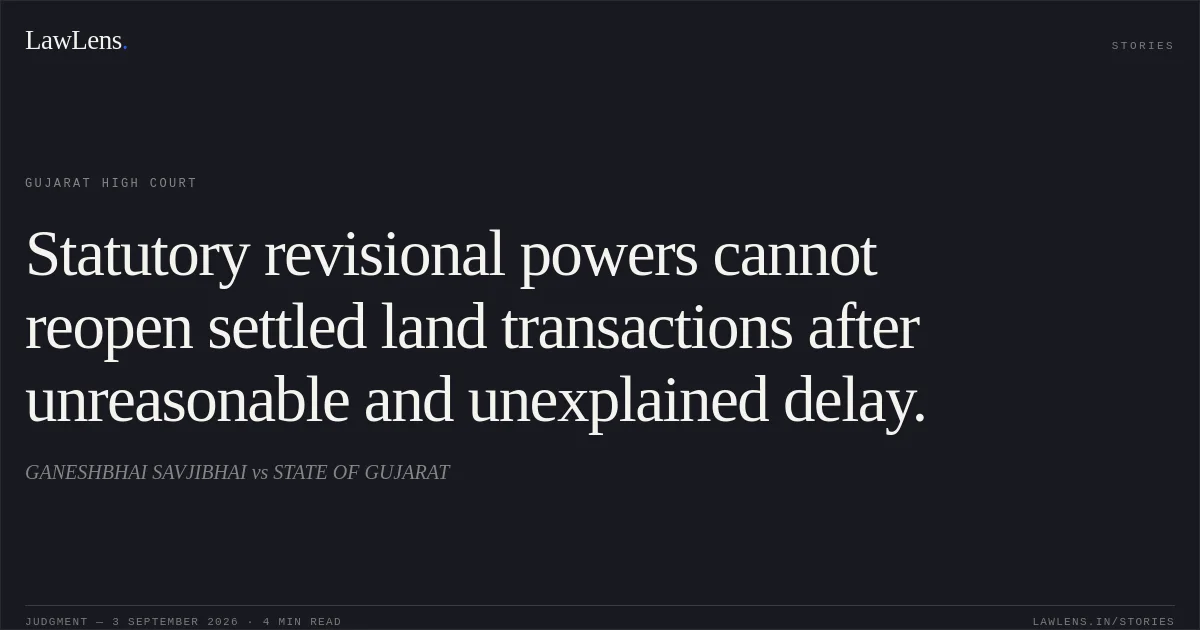
pp. 16–18 · ¶ 12–16It held that even where a statute does not prescribe a limitation period for the exercise of suo motu or revisional power, that power must be exercised within a reasonable period and cannot be used to unsettle long-standing transactions after unexplained and inordinate delay.
pp. 16–18 · ¶ 12–16The Court relied on State of Gujarat v. Patel Raghav Natha, (1969) 2 SCC 187; Mohamad Kavi Mohamad Amin v. Fatmabai Ibrahim, (1997) 6 SCC 71; Santoshkumar Shivgonda Patil v. Balasaheb Tukaram Shevale, (2009) 9 SCC 353; and Chandulal Gordhandas Ranodriya v. State of Gujarat, 2013 (2) GLR 1788, which establish that statutory powers without a specified limitation period must nevertheless be exercised within a reasonable time.
pp. 16–18 · ¶ 12–16It also relied on Joint Collector, Ranga Reddy District v. D. Narsing Rao, (2015) 3 SCC 695, holding that unexplained and inordinate delay in exercising revisional power is arbitrary, contrary to the rule of law, and may itself amount to a fraud upon the statute.
pp. 14–16 · ¶ 9–10Provisions in the judgment · 3 · Linked ones open on LawLens
Saurashtra Gharkhed, Tenancy Settlement and Agricultural Lands Ordinance, 1949 Section 54Section 75Section 43
04Reasoning
The Court found that the 1973 registered sale deed had been followed by mutation and certification of the relevant revenue entry, and that the petitioners’ asserted rights had thereafter remained reflected in the revenue record for a considerable period.
pp. 18–21 · ¶ 17–21The subsequent 2000 registered sale deed and corresponding certified revenue entry were also left unchallenged until 2012.
pp. 18–21 · ¶ 17–21Applying the reasonable-time doctrine, the Court held that reopening the transaction after approximately 39 years, without any satisfactory explanation for the delay, was impermissible.
pp. 18–21 · ¶ 17–21The absence of a statutory limitation period did not authorise the revenue authorities to exercise their power indefinitely or unsettle crystallised rights.
pp. 18–21 · ¶ 17–21The SSRD therefore erred in remanding the matter for further evidence regarding the petitioners’ agriculturist status without first determining whether such an inquiry could legally be undertaken after such prolonged delay.
p. 22 · ¶ 22The Court also noted that Respondent No. 3 had been a party to the subsequent registered sale transaction, had not challenged the sale deed before a civil court, and could not seek to reopen the transaction before the revenue authorities after such an extended period.
p. 22 · ¶ 2205Holding
The Court held that initiation and continuation of the proceedings after approximately 39 years was not within a reasonable period and that the SSRD’s remand order was legally unsustainable.
p. 23 · ¶ 24The petition was allowed; the SSRD’s order dated 13 October 2017 in Revision Application No. MVV/GRKH/BTD/3/2015 was quashed and set aside, and the Collector’s order dated 13 November 2014 withdrawing the proceedings under Sections 54 and 75 of the Ordinance was confirmed and restored.
p. 23 · ¶ 24Rule was made absolute to that extent.
p. 23 · ¶ 24Original Court PDF
GANESHBHAI SAVJIBHAIvsSTATE OF GUJARAT
Click to open original judgment
Original judgment, available to read, download and summarize on LawLens.in