Facts
Pursuant to a 2011 Supreme Court order in W.P. (C) No. 562/2009 aimed at liquidating iron ore stocks in Karnataka, a Monitoring Committee was formed to conduct e-auctions.
Source reference: p.2Respondent No. 1 was the successful bidder in Auction No. 41 (14-15) for iron ore fines on June 27, 2014.
Source reference: p.8-9Per the tender agreement, the Respondent paid the sale price, taxes, and royalty at the then-applicable rate of 10%.
Source reference: p.9Clause 9 of the agreement also required a deposit of Rs. 50/tonne to meet future "variances in royalty".
Source reference: p.12On September 1, 2014, the Central Government amended the Second Schedule of the MMDR Act, increasing the royalty from 10% to 15%.
Source reference: p.10The Respondent shifted the ore in batches, some after the amendment date.
Source reference: p.12The Appellant subsequently deducted the 5% difference in royalty from the Respondent’s security deposit.
Source reference: p.13The High Court of Karnataka set aside this deduction, holding that royalty was frozen at the date the bid was accepted.
Source reference: p.16Issues
1. Whether the State could, on account of a subsequent change in law, charge a royalty rate higher than what was stipulated in the tender agreement.
Source reference: p.2 / para. 32. Whether the liability to pay royalty under Section 9 of the MMDR Act crystallizes at the time of the auction or at the time of removal/dispatch of the mineral.
Source reference: p.13 / para. 3.6Law Applied
The Court primarily applied Section 9 of the Mines and Minerals (Development and Regulation) Act, 1957, which mandates that the holder of a mining lease must pay royalty in respect of any mineral "removed or consumed" at the rate specified in the Second Schedule "for the time being".
Source reference: p.17-18It integrated the principle from Mineral Area Development Authority v. SAIL (2024), establishing that royalty is a statutory payment made for the privilege of removing minerals and is generally determined by the quantity removed.
Source reference: p.21-22Section 3(aa) of the MMDR Act defines "dispatch" as the removal of minerals from the leased area, which is the triggering event for royalty liability.
Source reference: p.24Reasoning
The Court reasoned that for Section 9 to apply, three conditions must be met: the existence of a mining lease, the removal or consumption of minerals, and a party covered by the statute.
Source reference: p.19While the Respondent argued the contract "froze" the royalty at 10%, the Court held that royalty is a statutory import, not a matter of contractual equity.
Source reference: p.16, 23Applying Mineral Area Development Authority, the Court concluded that royalty is legally linked to "dispatch" or "removal".
Source reference: p.24Since the minerals were moved/dispatched after the September 1, 2014 amendment, the statutory rate "for the time being" was 15%.
Source reference: p.24The Court clarified that the word "applicable" in previous judicial orders referred to the rate at the time of removal, not at the time of the auction.
Source reference: p.24Consequently, any contractual clause attempting to limit liability must yield to the statutory amendment of the Second Schedule.
Source reference: p.23-24Holding
The Supreme Court allowed the appeal and set aside the High Court's judgment.
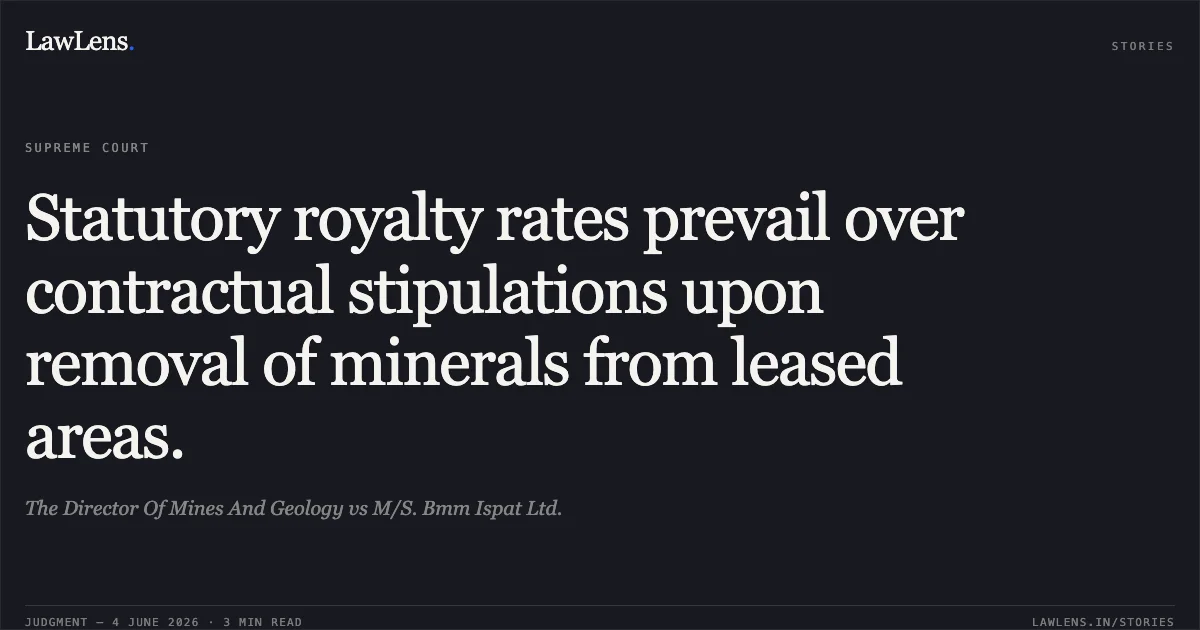
It held that the Appellant was legally justified in deducting the additional 5% royalty from the security deposit because the statutory liability for royalty crystallizes upon the removal of the mineral, not the acceptance of the bid.
Source reference: p.24The Court noted that the Respondents chose to move the minerals after the rate was enhanced and thus cannot escape the statutory obligation.
Source reference: p.25All pending applications were disposed of.
Source reference: p.25Acts & Sections Cited
9 provisions across 6 statutes referred to in this judgment. Each provision opens on LawLens.
Transfer of Property Act, 18821
Sale of Goods Act, 19302
Indian Easements Act, 18821
General Clauses Act, 18971
Registration Act, 19081
Original Court PDF
The Director Of Mines And GeologyvsM/S. Bmm Ispat Ltd.
Click to open original judgment
Original judgment, available to read, download and summarize on LawLens.in