Facts
The Telangana Government, via G.O.Ms.No. 6 dated 14.03.2024, appointed a Commission of Inquiry headed by Justice Pinaki Chandra Ghose to investigate alleged financial irregularities and negligence in the construction of the Medigadda, Annaram, and Sundilla barrages of the Kaleshwaram Project
Source reference: p. 4, 44The petitioners—the former Chief Minister (KCR), former Irrigation Minister (THR), and two senior IAS officers (SKJ and SS)—challenged the G.O. as ultra vires and sought to set aside the Commission's Report dated 31.07.2025
Source reference: p. 6-7They contended that the Commission rendered defamatory findings against them without issuing mandatory notices under Sections 8B and 8C of the Commissions of Inquiry Act, 1952, despite summoning them only as witnesses
Source reference: p. 13, 16, 18, 20Issues
1. Whether the constitution of the Commission of Inquiry under Section 3 of the Act vide G.O.Ms.No.6 is arbitrary, illegal, or ultra vires the Constitution and the Act of 1952?
Source reference: p. 43, para 38(i)2. Whether the findings rendered by the Commission are prejudicial to the conduct and reputation of the petitioners without following the statutory safeguard provided under Sections 8B and 8C of the Act, and thereby in violation of the principles of natural justice?
Source reference: p. 43, para 38(ii)Law Applied
Section 3 of the Commissions of Inquiry Act, 1952, which empowers the Government to appoint a commission on matters of public importance
Source reference: p. 43the "Dominant Purpose Test" from P.V. Jagannath Rao v. State of Orissa to determine the validity of the Commission's appointment
Source reference: p. 54Section 8B (mandatory notice to persons likely to be prejudicially affected) and Section 8C (right to cross-examine and legal representation), noting these were inducted to safeguard the right to reputation under Article 21 of the Constitution, as established in Kiran Bedi v. Committee of Inquiry and State of Bihar v. Lal Krishna Advani
Source reference: p. 78-79, 81-82, 85-87Reasoning
Regarding Issue 1, the court found the G.O. valid because the sinking of barrage piers was a matter of definite public importance, and the "dominant purpose" was to identify systemic lapses rather than target individuals; the use of the term "Judicial Inquiry" did not shift its statutory nature
Source reference: p. 52, 55-56Regarding Issue 2, the court analyzed the summons issued to the petitioners. It found that while petitioners were called as witnesses (Section 4/5), the Commission eventually recorded scathing findings—such as "intent to siphon public funds" and "malicious suppression of reports"—which directly impeached their conduct and reputation
Source reference: p. 64, 66, 72The court reasoned that since Section 8B is a mandatory statutory embodiment of audi alteram partem, the Commission's failure to issue specific notices detailing incriminating material or allowing cross-examination under Section 8C rendered the prejudicial findings legally unsustainable, regardless of the petitioners' voluntary appearance as witnesses
Source reference: p. 91-93, 100Holding
The court upheld the constitution of the Commission/G.O.Ms.No.6
It held that the findings in the Report dated 31.07.2025 which prejudicially affect the conduct and reputation of the petitioners are inoperative due to the violation of Section 8B and principles of natural justice. The court directed that no action shall be taken against the petitioners based specifically on those prejudicial findings
Source reference: p. 100-101, para 78(ii)Acts & Sections Cited
14 provisions across 2 statutes referred to in this judgment. Each provision opens on LawLens.
Indian Penal Code, 18608
Original Court PDF
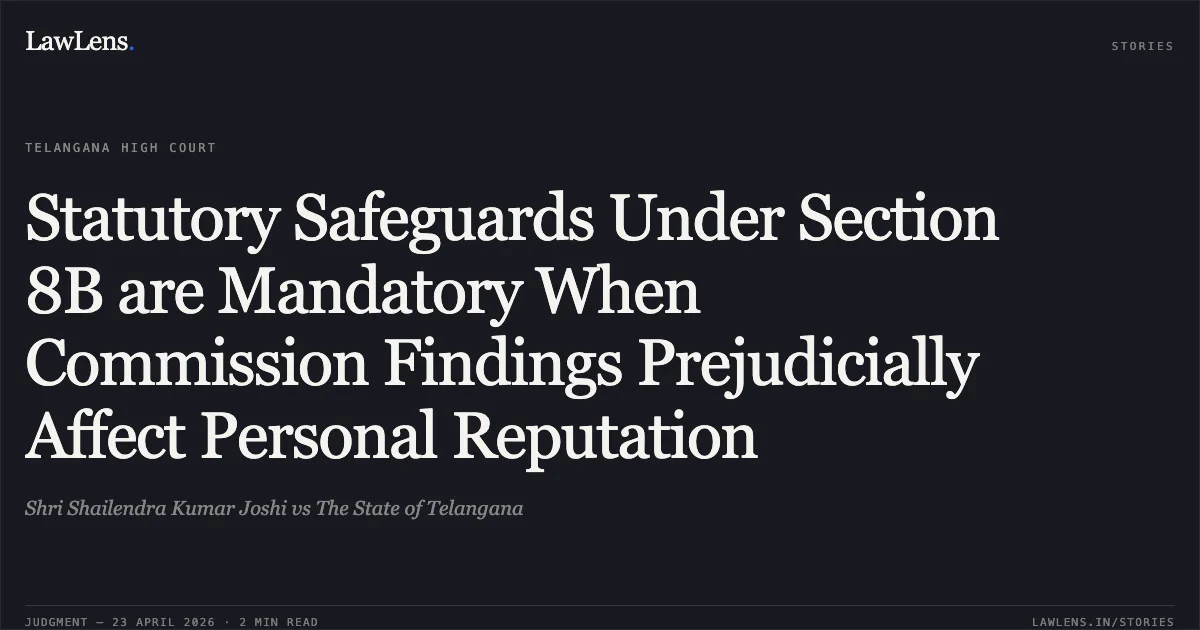
Shri Shailendra Kumar JoshivsThe State of Telangana
Click to open original judgment
Original judgment, available to read, download and summarize on LawLens.in