Facts
The appellant and respondent, followers of different faiths, solemnized their marriage under the Special Marriage Act, 1954 (SMA) on 25.08.2025
Source reference: p. 2Following the marriage, the appellant’s father suffered a severe health crisis (liver failure) upon learning of the union, and the family severed ties
Source reference: p. 2the respondent hid the marriage from her family to avoid similar disownment
Source reference: p. 2The marriage was never consummated, and no cohabitation occurred
Source reference: p. 2The parties filed a petition for divorce by mutual consent along with an application to waive the one-year mandatory waiting period under Section 29 and the six-month cooling-off period under Section 28(2) of the Act
Source reference: p. 2The Family Court dismissed the application on 15.10.2025, ruling that the case did not disclose "exceptional hardship"
Source reference: p. 3Issues
1. Whether the statutory one-year period for presenting a divorce petition under Section 29 of the Special Marriage Act can be waived in cases of "exceptional hardship"
Source reference: p. 4 / para. 10-112. Whether the specific circumstances of familial estrangement and lack of consummation in this case constitute "exceptional hardship"
Source reference: p. 7 / para. 16Law Applied
The Court applied Section 29 of the Special Marriage Act, 1954, which restricts divorce petitions within the first year of marriage unless "exceptional hardship" to the petitioner or "exceptional depravity" by the respondent is shown
Source reference: p. 4Section 28 of the SMA regarding the six-month cooling-off period
Source reference: p. 4Sections 28 and 29 of the SMA are pari materia to Sections 13B and 14 of the HMA
Source reference: p. 6Full Bench decision in Shiksha Kumari v. Santosh Kumar (2025), which established that the one-year separation period can be waived if the court is satisfied of exceptional hardship
Source reference: p. 5-6Supreme Court precedents in Amardeep Singh v. Harveen Kaur (2017) and Amit Kumar v. Suman Beniwal (2021), which held that statutory waiting periods are directory, not mandatory, when continuation of the marriage serves no purpose
Source reference: p. 3, 9Reasoning
The High Court found that the Family Court adopted a "hyper-technical" and "restrictive" approach by insisting on efforts toward cohabitation for a marriage that was "unworkable from inception"
Source reference: p. 3, 7The Court reasoned that since the marriage was purely notional—lacking cohabitation, consummation, or social recognition—enforcing the statutory waiting period would only prolong the parties' agony
Source reference: p. 7The Court determined that the appellant’s familial displacement, his father’s medical crisis, and the respondent’s fear of similar consequences collectively met the threshold of "exceptional hardship"
Source reference: p. 7judicial discretion must be exercised to waive timelines when the legislative intent of stability is outweighed by unavoidable mental and social distress
Source reference: p. 8Holding
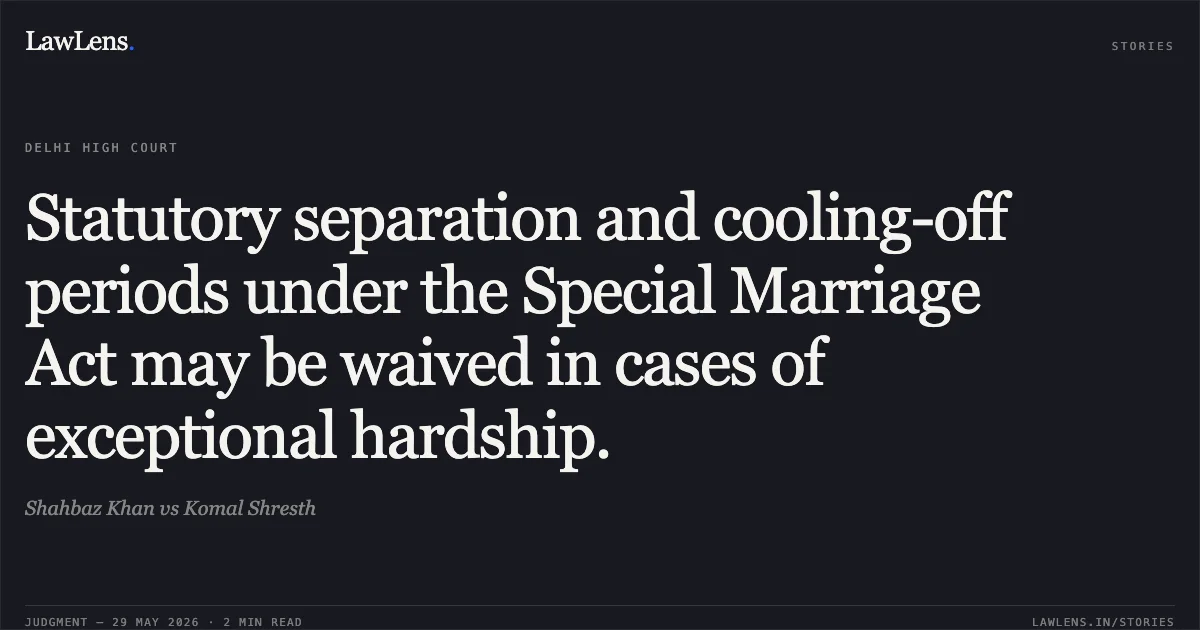
The High Court allowed the appeal and set aside the Family Court’s judgment dated 15.10.2025. The Court answered the issues in the affirmative, holding that the statutory one-year period under Section 29 of the SMA is waivable in exceptional circumstances
The application for waiver was allowed, the divorce petition under Section 28(1) was revived, and the matter was remanded to the Family Court for expedited disposal without insisting on the one-year separation period. The Court further directed the Family Court to consider waiving the six-month cooling-off period
Source reference: p. 8-9Acts & Sections Cited
4 provisions across 3 statutes referred to in this judgment. Each provision opens on LawLens.
Special Marriage Act, 19542
Family Courts Act, 19841
Hindu Marriage Act, 19551
Original Court PDF
Shahbaz KhanvsKomal Shresth
Click to open original judgment
Original judgment, available to read, download and summarize on LawLens.in