Facts
The petitioner, a registered company, filed its income tax returns for Assessment Year (AY) 2018-19
Source reference: para 4.1Subsequently, the petitioner underwent Corporate Insolvency Resolution Process (CIRP) under the Insolvency and Bankruptcy Code, 2016 (IBC).
Source reference: no citationA Resolution Plan for the petitioner was approved by the National Company Law Tribunal (NCLT) on 05.10.2021
Source reference: para 4.5This plan specifically provided for the waiver and extinguishment of all assessed or unassessed tax liabilities for the period prior to the approval date
Source reference: para 4.5, 7Despite this, the Respondent (Income Tax Department) issued a notice under Section 148 and an order under Section 148A(d) of the Income Tax Act, 1961, dated 30.03.2022, seeking to reopen the assessment for AY 2018-19
Source reference: para 4.6, 4.7Issues
1. Whether the Income Tax Department can initiate reassessment proceedings under Section 148 of the Income Tax Act for a period prior to the approval of a Resolution Plan under the IBC
Source reference: para 52. Whether the approval of a Resolution Plan under Section 31 of the IBC results in the absolute extinguishment of past statutory dues not specifically provided for in the plan
Source reference: para 5.1Law Applied
Section 31 of the Insolvency and Bankruptcy Code, 2016, which stipulates that an approved Resolution Plan is binding on all stakeholders, including the Central and State Governments
Source reference: para 9"Clean Slate" doctrine established in Committee of Creditors of Essar Steel India Ltd. v. Satishkumar Gupta, which prevents a successful resolution applicant from being faced with "undecided" or "pop-up" claims after the plan's approval
Source reference: para 8The precedent from Ghanshyam Mishra and Sons Pvt. Ltd. v. Edelweiss Asset Reconstruction Company Ltd., which clarifies that the 2019 Amendment to Section 31 is declaratory/retrospective and that all dues (including statutory dues) not part of the Resolution Plan stand extinguished
Source reference: para 9Reasoning
The court analyzed the approved Resolution Plan, specifically Clause 3.15, which deemed all prior tax liabilities "waived and extinguished"
Source reference: para 6.1, 7The court applied the principle that once the NCLT approves a Resolution Plan, it becomes a binding contract that terminates all pending or potential claims against the corporate debtor for the pre-insolvency period
Source reference: para 9The court reasoned that allowing the Income Tax Department to continue reassessment for AY 2018-19 would violate Section 31 of the IBC and the "Clean Slate" principle, as the resolution applicant must start on a fresh slate without the threat of unforeseen liabilities
Source reference: para 8, 10Since the tax liabilities were legally extinguished on 05.10.2021, the subsequent issuance of the Section 148 notice on 30.03.2022 was void of legal basis
Source reference: para 10Holding
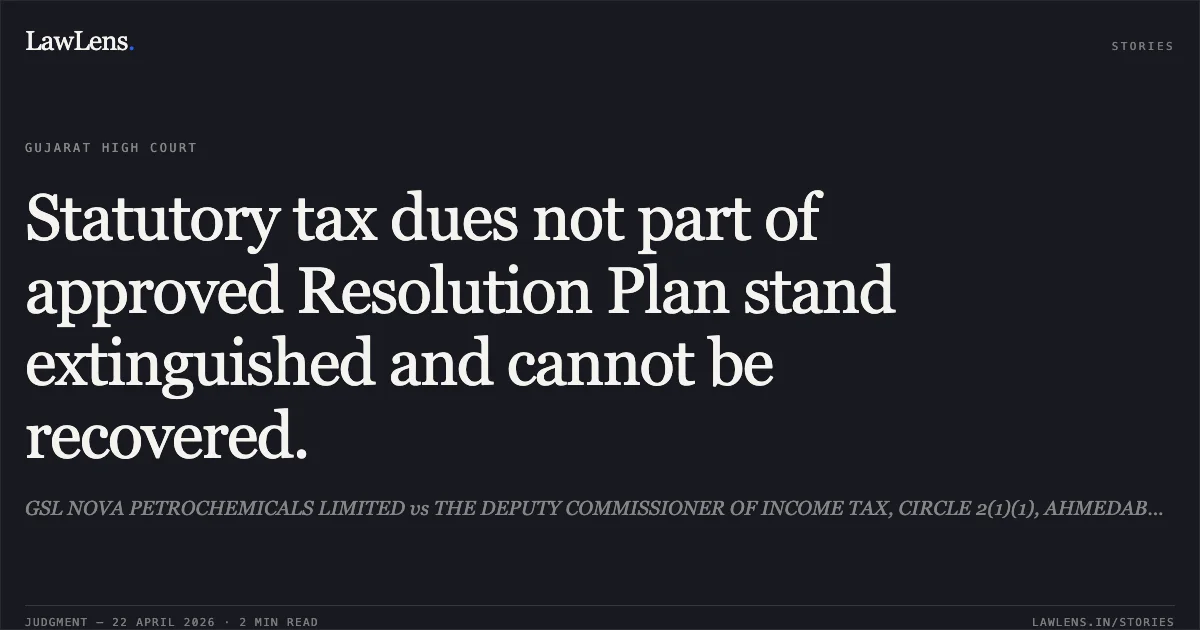
The High Court held that upon the approval of the Resolution Plan under Section 31 of the IBC, all prior tax liabilities (assessed or unassessed) stand extinguished
Consequently, the Respondent had no authority to initiate reassessment proceedings for the period covered by the plan. The court quashed and set aside the notice under Section 148 and the order under Section 148A(d) dated 30.03.2022. Rule was made absolute in favor of the petitioner
Source reference: para 10, 11Acts & Sections Cited
6 provisions across 1 statute referred to in this judgment. Each provision opens on LawLens.
Insolvency and Bankruptcy Code, 2016.6
Original Court PDF
GSL NOVA PETROCHEMICALS LIMITEDvsTHE DEPUTY COMMISSIONER OF INCOME TAX, CIRCLE 2(1)(1), AHMEDABAD
Click to open original judgment
Original judgment, available to read, download and summarize on LawLens.in


