Facts
The parties were married on 05.12.2007 and have one daughter.
Source reference: p. 1-2Due to irreconcilable differences, they have lived separately since October 2022 without cohabitation.
Source reference: p. 2On 26.02.2026, the parties executed a comprehensive Deed of Settlement to resolve all matrimonial disputes.
Source reference: p. 2The Family Court allowed the First Motion Petition under Section 13-B(1) of the Hindu Marriage Act (HMA) on 18.03.2026.
Source reference: p. 2On 15.04.2026, the parties moved the Second Motion Petition under Section 13-B(2) along with an application to waive the statutory six-month cooling period.
Source reference: p. 2The Family Court dismissed the waiver application and the Second Motion on 24.04.2026, leading to this appeal.
Source reference: p. 2Issues
1. Whether the six-month statutory waiting period prescribed under Section 13-B(2) of the Hindu Marriage Act, 1955, is mandatory or directory.
Source reference: p. 2-32. Whether the appellants established sufficient grounds for the waiver of the said cooling period based on the irretrievable breakdown of marriage and prior settlement.
Source reference: p. 4Law Applied
Section 13-B(2) of the Hindu Marriage Act, 1955, concerning the waiting period for a decree of divorce by mutual consent.
Source reference: p. 2The Supreme Court in Amardeep Singh v. Harveen Kaur (2017) 8 SCC 746 held that the six-month cooling period is directory, not mandatory, and can be waived if: (i) the parties have been separated for more than 18 months; (ii) efforts for mediation/conciliation have failed; (iii) alimony and custody issues are settled; and (iv) the waiting period would only prolong agony.
Source reference: p. 3Reasoning
The High Court observed that the parties had been living separately for over three years (since October 2022), satisfying the requirement that the total period of separation exceeded the statutory minimum before the second motion.
Source reference: p. 4The Court noted that all attempts at reconciliation by well-wishers and relatives had failed, and the marriage had broken down irretrievably.
Source reference: p. 2, 4The parties had recorded a genuine settlement regarding alimony and child custody via a Deed of Settlement.
Source reference: p. 4Following the Amardeep Singh guidelines, the Court reasoned that insisting on the cooling period would only perpetuate mental agony and prolong litigation without any possibility of resuming cohabitation.
Source reference: p. 2-4Holding
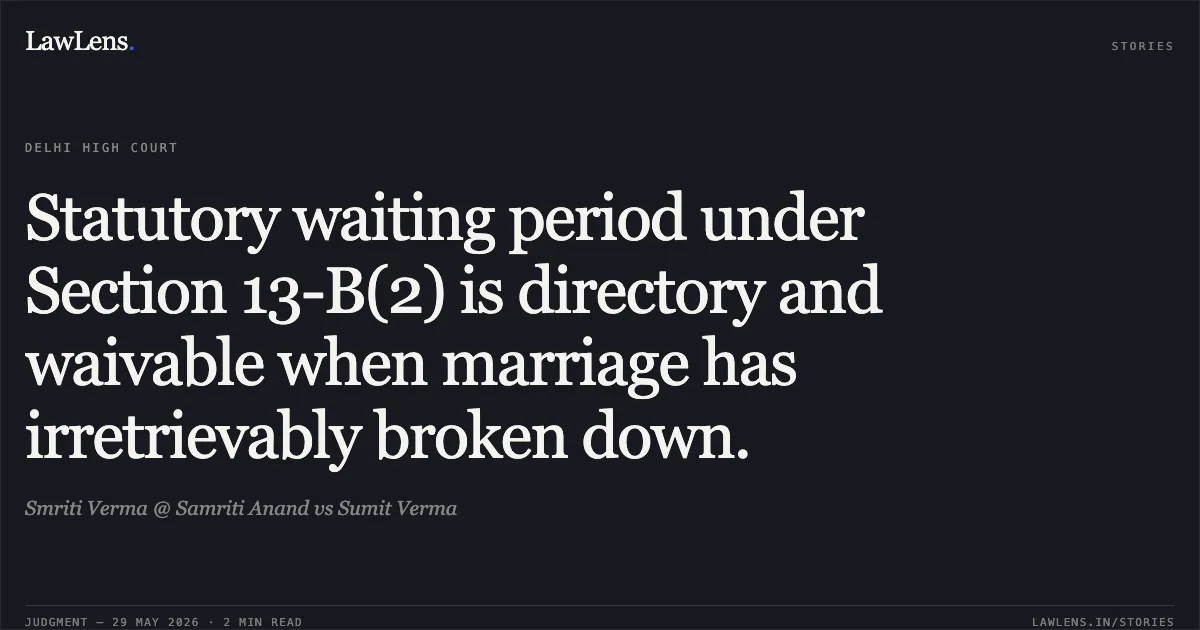
The Court held that Section 13-B(2) is directory and that the facts of the case warranted the exercise of judicial discretion to expedite the divorce.
The High Court set aside the Family Court's order dated 24.04.2026 and allowed the waiver of the six-month cooling period; the Second Motion Petition was revived and remanded to the Family Court for an expeditious decision in accordance with the law.
Source reference: p. 4Acts & Sections Cited
2 provisions across 2 statutes referred to in this judgment. Each provision opens on LawLens.
Hindu Marriage Act, 19551
Family Courts Act, 19841
Original Court PDF
Smriti Verma @ Samriti AnandvsSumit Verma
Click to open original judgment
Original judgment, available to read, download and summarize on LawLens.in