Facts
Revisionist No. 1, Rapti, married Respondent No. 2 in 2013, with Respondent No. 2 having full knowledge that she had a son, Revisionist No. 2, from her previous marriage. The son resided with the parties as a member of the matrimonial household, and Revisionist No. 3 was their minor daughter.
Source reference: para. 2The Family Court, Haridwar, partly allowed the application under Section 125 CrPC by order dated 24 January 2022, awarding ₹8,000 per month to the wife and ₹6,000 per month to the minor daughter, but rejected the son’s claim on the ground that Respondent No. 2 was not his biological father.
Source reference: para. 2The revisionists challenged the rejection of the son’s claim and contended that the maintenance awarded to the wife and daughter was inadequate in view of Respondent No. 2’s income. His November 2025 salary slip disclosed gross salary of ₹2,01,843 and net salary of ₹1,06,654.
Source reference: para. 4Respondent No. 2 contended that the wife was independently earning approximately ₹55,000–₹58,000 per month and that the wife and children were residing in a flat owned by him.
Source reference: para. 5Issues
1. Whether a husband who knowingly marries a woman having a child from a previous marriage and accepts that child as a member of the matrimonial household can subsequently avoid responsibility for the child’s maintenance solely because he is not the child’s biological father.
Source reference: paras. 3, 6, 102. Whether the maintenance awarded to the wife and minor daughter required enhancement in light of the husband’s income, liabilities, and the parties’ respective financial circumstances.
Source reference: paras. 4, 9, 113. Whether the settlement amount received by the wife from her former husband absolved Respondent No. 2 of his maintenance responsibility towards the wife and children.
Source reference: paras. 7–8Law Applied
The Court applied Section 125 of the Code of Criminal Procedure, 1973, concerning the obligation to provide maintenance to a wife and minor children unable to maintain themselves.
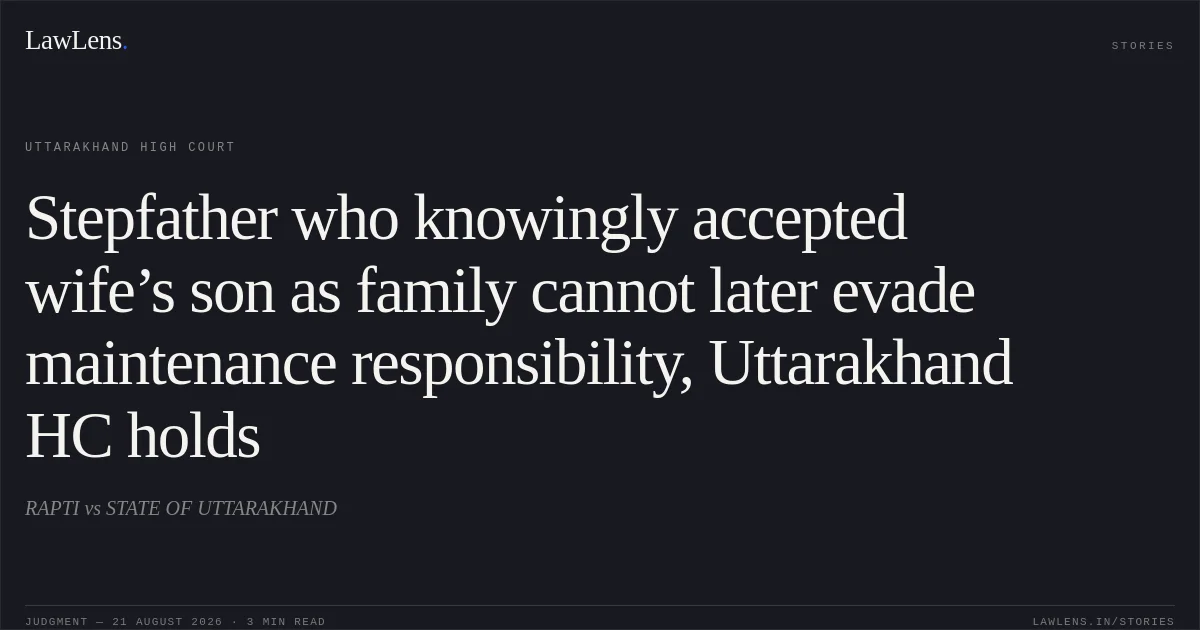
Source reference: paras. 6, 10It held that a person who, with full knowledge of a child’s non-biological status, voluntarily enters into a matrimonial relationship and accepts the child as part of the family cannot subsequently disown the responsibility assumed towards the child merely because no biological relationship exists.
Source reference: paras. 6, 10Relying on Deepa Joshi v. Gaurav Joshi, 2026 SCC OnLine SC 597, the Court reiterated that the husband’s obligation to maintain his spouse is primary and continuing, and that repayments or liabilities creating or enhancing assets cannot substantially reduce assessable income for maintenance purposes.
Source reference: para. 9The Court also considered the financial disclosures filed pursuant to Rajnesh v. Neha, (2021) 2 SCC 324, for assessing income, assets, liabilities, and the parties’ respective needs.
Source reference: para. 11Reasoning
The Court found that Respondent No. 2 knowingly married Revisionist No. 1 despite being aware of her son and permitted the son to live with the parties as a member of the family. Applying the principle of voluntarily assumed familial responsibility, it held that the absence of biological paternity alone could not justify denying the son maintenance.
Source reference: paras. 6, 10The alleged settlement between the wife and her former husband also did not extinguish obligations arising from the subsequent marriage or absolve Respondent No. 2 of responsibilities he had undertaken.
Source reference: para. 8On the quantum of maintenance, the Court considered Respondent No. 2’s disclosed salary, the absence of substantial independent liabilities, the wife’s income, and the needs of the children. It concluded that the amounts awarded by the Family Court were inadequate, while also taking the wife’s independent income into account.
Source reference: para. 11Holding
The Criminal Revision was allowed and the Family Court’s order dated 24 January 2022 was modified.
Maintenance payable to Revisionist No. 1 (wife) was enhanced from ₹8,000 to ₹10,000 per month. Maintenance payable to Revisionist No. 3 (minor daughter) was enhanced from ₹6,000 to ₹30,000 per month.
Source reference: para. 12Revisionist No. 2 (son) was held entitled to ₹10,000 per month from the date of filing of the maintenance application until attaining majority, notwithstanding that Respondent No. 2 was not his biological father.
Source reference: para. 12Acts & Sections Cited
1 provisions across 1 statute referred to in this judgment. Each provision opens on LawLens.
Code of Criminal Procedure, 19731
Original Court PDF
RAPTIvsSTATE OF UTTARAKHAND
Click to open original judgment
Original judgment, available to read, download and summarize on LawLens.in