Facts
The complainant alleged that, following her 2007 marriage to Ramkrishna Sarkar, she was subjected to dowry-related cruelty.
Source reference: paras. 2–4, 20She alleged that on 2 May 2017 her husband assaulted her and another relative poured kerosene on her; the complaint named the petitioners, the husband’s brother and sister-in-law, in general allegations of participation.
Source reference: paras. 2–4, 20The police registered a case under Sections 341, 325, 498A, 307 and 34 IPC and Sections 3 and 4 of the Dowry Prohibition Act, and filed a charge-sheet against seven accused.
Source reference: paras. 4–5The Magistrate committed the case to the Sessions Court because Section 307 IPC was alleged.
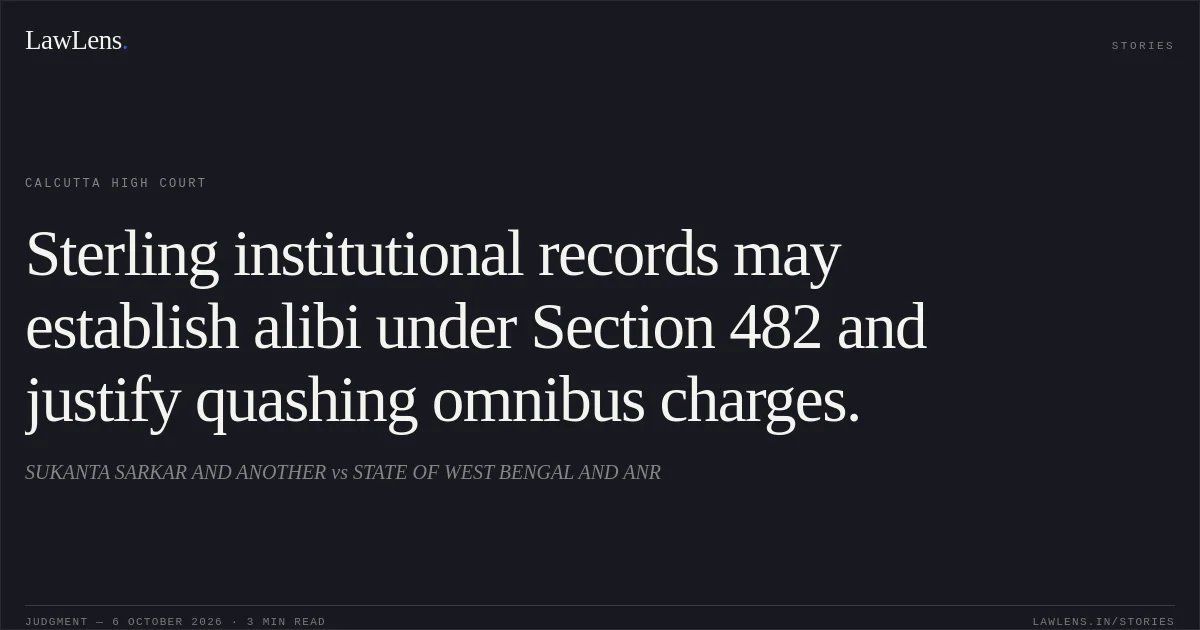
Source reference: paras. 4–5The petitioners sought quashing under Section 482 CrPC, relying on the absence of specific allegations and on records said to show that they lived in Kolkata and that Petitioner No. 1 was employed there at the time of the alleged incident.
Source reference: paras. 6–10Issues
1. Whether the FIR and charge-sheet disclosed specific acts or the essential ingredients of offences under Sections 498A or 307 IPC against the petitioners, or contained only vague and omnibus allegations.
Source reference: para. 18(I)2. Whether the employment and residence records established an unimpeachable plea of separate residence and geographical impossibility that could be considered under Section 482 CrPC at the post-commitment stage.
Source reference: para. 18(II)3. Whether continuing the proceedings against the petitioners would constitute an abuse of the process of the court warranting quashing.
Source reference: para. 18(III)Law Applied
Section 482 CrPC empowers the High Court to quash proceedings to prevent abuse of process or secure the ends of justice; under State of Haryana v. Bhajan Lal, proceedings may be quashed where allegations are inherently improbable or do not justify prosecution.
Source reference: para. 34Geeta Mehrotra v. State of U.P. and Kahkashan Kausar v. State of Bihar caution against prosecuting relatives in matrimonial cases on casual, general or omnibus allegations without specific attribution of acts.
Source reference: para. 23Under Rajiv Thapar v. Madan Lal Kapoor, the High Court may consider defence material at the quashing stage where it is of unimpeachable and sterling quality and its genuineness is not in doubt.
Source reference: para. 29The court also referred to State of M.P. v. Awadh Kishore Gupta for the exceptional nature of the quashing power and the need not to stifle a legitimate prosecution.
Source reference: para. 16Section 498A IPC concerns specified forms of cruelty, while Section 307 IPC requires an act accompanied by the requisite intention or knowledge to constitute an attempt to murder.
Source reference: para. 22Reasoning
The court found that the allegations of assault and pouring kerosene were directed principally at the husband and another relative, while the petitioners were implicated only through a general allegation of joint dowry-related cruelty; the charge-sheet, in the court’s view, added no specific material linking them to the alleged acts.
Source reference: paras. 20–24It also accepted the petitioners’ bank employment and Kolkata residence records as unimpeachable, concluding that they supported separate residence and made Petitioner No. 1’s presence at the alleged incident in Malda physically impossible.
Source reference: paras. 27–31Applying the cited authorities, the court held that requiring the petitioners to face trial on those allegations and materials would constitute an abuse of process, notwithstanding that the case had been committed to the Sessions Court.
Source reference: paras. 32–35Holding
The court answered all three issues in favour of the petitioners and allowed the application.
It quashed, as against Sukanta Sarkar and Ruma Sarkar, the proceedings arising from Harishchandrapur P.S. Case No. 417 of 2017, the charge-sheet and the consequential commitment order.
Source reference: para. 39The proceedings against the remaining accused were left undisturbed and were to continue according to law.
Source reference: para. 40Acts & Sections Cited
11 provisions across 3 statutes referred to in this judgment. Each provision opens on LawLens.
Code of Criminal Procedure, 19735
Indian Penal Code, 18604
Original Court PDF
SUKANTA SARKAR AND ANOTHERvsSTATE OF WEST BENGAL AND ANR
Click to open original judgment
Original judgment, available to read, download and summarize on LawLens.in