01Facts
The petitioner was appointed as a Computer Operator on a contractual basis for three months from 22 February 2008, with subsequent extensions.
¶ 2, 3On 1 April 2010, he sought leave from 3 April to 20 May 2010 for family marriages and proceeded on leave. His services were terminated by order dated 1 June 2010.
¶ 2.1–5The respondents alleged that he had left without waiting for leave to be sanctioned, failed to complete scholarship-related work, and locked his computer system. The petitioner maintained that he had not received the alleged show-cause notice and that one allegation in the termination order had not been put to him beforehand. He challenged the termination by writ petition.
¶ 2.1–502Issues
i.Whether the termination, though expressed as an order of termination simpliciter, was stigmatic and therefore required compliance with the principles of natural justice.
¶ 10ii.Whether the respondents established that the petitioner had been served with the show-cause notice and had been given an opportunity to respond to the allegations relied upon for termination.
¶ 8–9iii.Whether the petitioner was entitled to back wages following the quashing of the termination order.
¶ 1203Law Applied
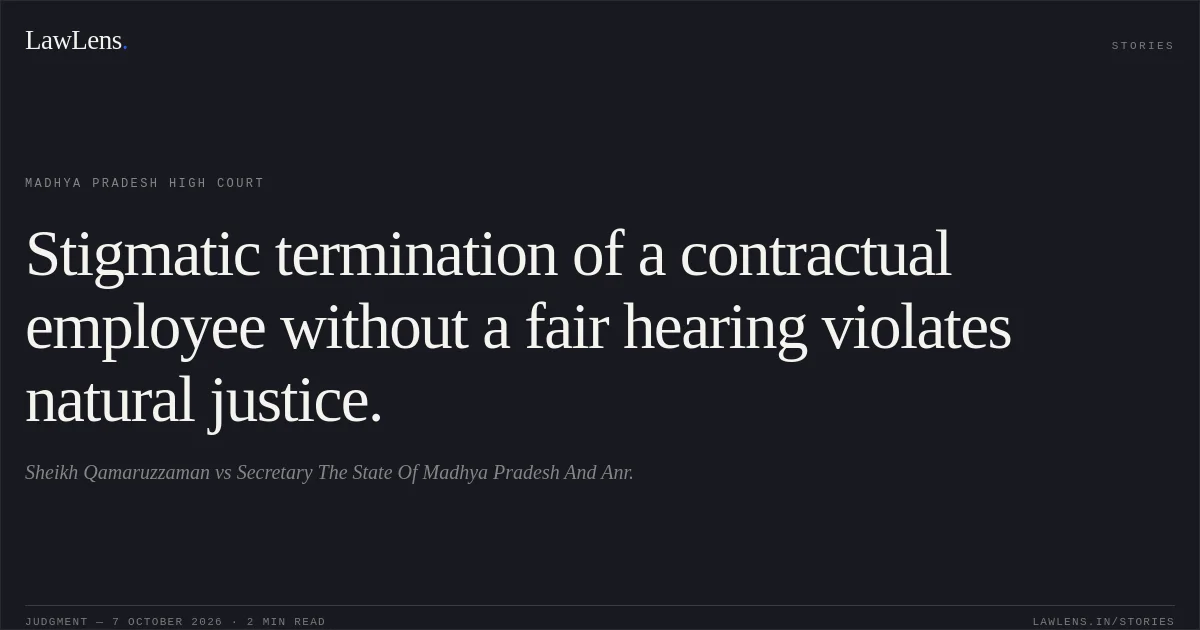
The Court applied the principles of natural justice, holding that where a termination order is founded on allegations and is stigmatic in substance, the affected employee must be given a fair opportunity to answer those allegations before the order is passed.
¶ 8–10The notice must be shown to have been served, and the employee must be informed of the material allegations relied upon. The judgment cites no statute or precedent; its reasoning rests on these principles.
¶ 8–1004Reasoning
The respondents did not place any receipt or other proof on record to establish service of the notice dated 10 May 2010. Further, the termination order relied on an allegation concerning the petitioner’s signatures on the cash book of the autonomous society, but that allegation was not included in the notice.
¶ 8–10The Court therefore found that the petitioner had not been given a proper opportunity to respond and that, despite its form, the termination was based on allegations and was stigmatic. The principles of natural justice had not been followed.
¶ 8–1005Holding
The Court quashed the termination order dated 1 June 2010 for breach of the principles of natural justice.
¶ 10–13It left the respondents at liberty to issue a fresh show-cause notice and pass a fresh order after following due process.
¶ 10–13The question of back wages was left to the competent authority to decide after completion of the directed proceedings. The petition was disposed of.
¶ 10–13Original Court PDF
Sheikh QamaruzzamanvsSecretary The State Of Madhya Pradesh And Anr.
Click to open original judgment
Original judgment, available to read, download and summarize on LawLens.in