Facts
The petitioner was appointed as a Gram Rojgar Sahayak in 2011.
Source reference: p. 2Following complaints from villagers, Respondent No. 3 conducted a preliminary fact-finding enquiry without the petitioner’s participation.
Source reference: p. 2Based on this report, a show-cause notice was issued, and the petitioner’s services were terminated via order dated 21.05.2019 issued by the CEO, Janpad Panchayat, Pichhore.
Source reference: p. 2The termination order alleged negligence in duty, including failure to complete houses under the Pradhan Mantri Awas Yojana and poor performance in resolving CM Helpline complaints.
Source reference: p. 2-3The petitioner’s appeal was subsequently rejected by the CEO, Zila Panchayat, Shivpuri, on 24.12.2019.
Source reference: p. 2The petitioner challenged these orders under Article 226 of the Constitution, contending the termination was stigmatic and lacked a regular departmental inquiry.
Source reference: p. 2Issues
1. Whether a termination order for a contractual employee that contains allegations of misconduct and dereliction of duty is "stigmatic" in nature.
Source reference: p. 3-42. Whether the services of a contractual employee can be terminated through a stigmatic order without conducting a regular departmental enquiry and providing a reasonable opportunity for defense.
Source reference: p. 4-5Law Applied
The court relied on the principles of natural justice and the concept of "reasonable opportunity" as summarized by the Supreme Court in Khem Chand v. The Union of India, which requires an opportunity to deny guilt, cross-examine witnesses, and represent against proposed punishments.
Source reference: p. 3-4It applied the precedents of Rahul Tripathi v. Rajeev Gandhi Shiksha Mission and Malkhan Singh Malviya v. State of M.P., which establish that if a termination order casts a stigma affecting future prospects, it cannot be passed without a full inquiry.
Source reference: p. 3The court referred to the MGNREGA Guidelines (Clause 15 & 16) and Devkaran Patidar v. State of M.P., affirming that termination for negligence requires charges to be proved through a formal process.
Source reference: p. 6-8Reasoning
The court examined the language of the impugned order dated 21.05.2019, which explicitly accused the petitioner of negligence and failing to rectify his work conduct.
Source reference: p. 2-3The court determined that such findings transform a simple termination into a "stigmatic" one because they carry serious consequences for the employee's future employment prospects.
Source reference: p. 4Since the respondents admitted that no charge-sheet was issued and no regular departmental inquiry was conducted before passing the order—relying instead solely on a preliminary fact-finding report—the court found the procedure to be a violation of the principles of natural justice.
Source reference: p. 4, 7The court noted that even for contractual or contingency workers, an order founded on acts of commission or omission amounting to misconduct requires an inquiry and a hearing.
Source reference: p. 5-6Holding
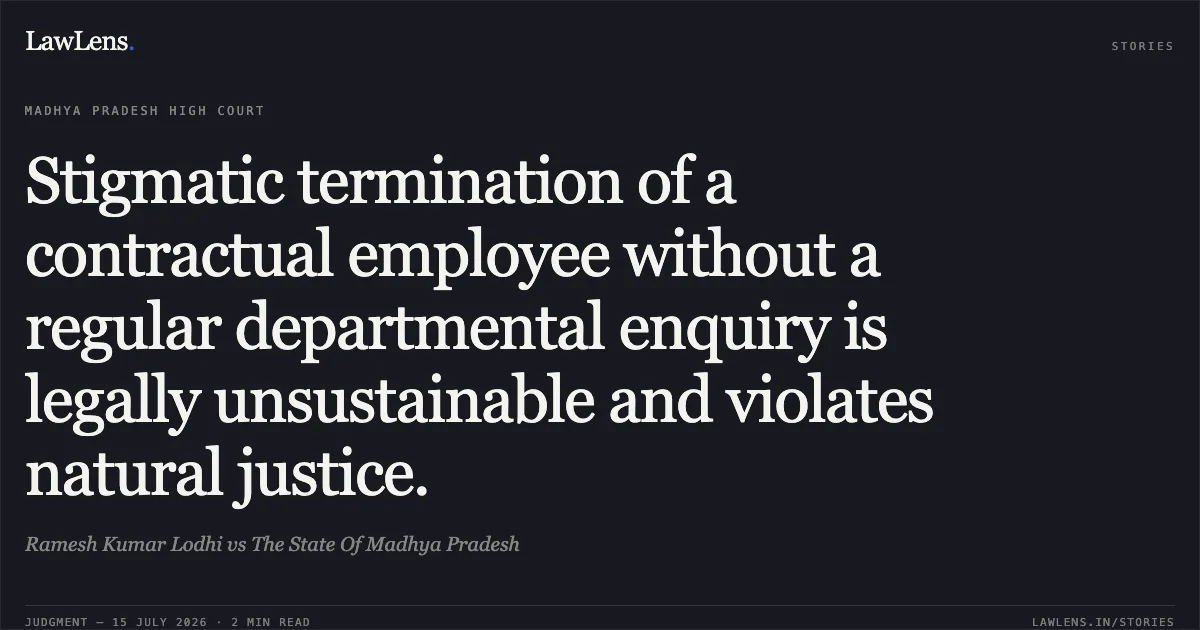
The court answered that a stigmatic termination order passed without a regular departmental enquiry is unsustainable in law.
The High Court allowed the writ petition, quashing the termination order dated 21.05.2019 and the appellate order dated 24.12.2019.
Source reference: p. 9The respondents were directed to reinstate the petitioner forthwith with all consequential benefits, except back wages based on the principle of "no work no pay". However, the court granted the respondents liberty to initiate fresh action against the petitioner in accordance with the law.
Source reference: p. 10Original Court PDF
Ramesh Kumar LodhivsThe State Of Madhya Pradesh
Click to open original judgment
Original judgment, available to read, download and summarize on LawLens.in


