Facts
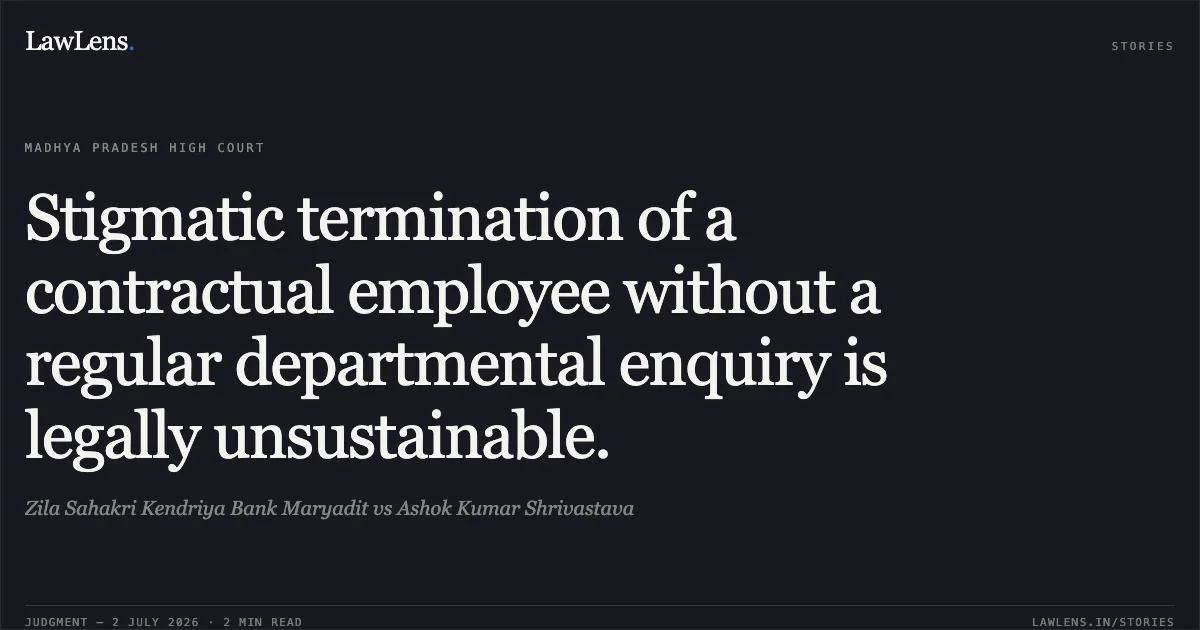
The applicant bank filed this review petition seeking to recall/modify the order dated 07.01.2026 passed in W.P. No. 323/2017
Source reference: para. 1In the original writ petition, the Court quashed the termination order dated 23.11.2016 issued against the respondent, a contractual employee
Source reference: para. 2The respondent’s services were terminated following a Lokayukta raid and allegations of acquiring illegal assets, after a notice was issued and a hearing was held before the Staff Up-Samiti
Source reference: para. 2 & 4The applicant contended that since the respondent was a contractual employee, no formal departmental inquiry was required, whereas the respondent argued that the termination was "stigmatic" and thus required a full inquiry
Source reference: para. 2–3Issues
1. Whether the termination order dated 23.11.2013 was stigmatic in nature, thereby necessitating a regular departmental inquiry despite the contractual nature of the service.
Source reference: para. 5–72. Whether there exists any error apparent on the face of the record to justify the exercise of review jurisdiction.
Source reference: para. 15–17Law Applied
if a termination order is "stigmatic"—meaning it casts a blemish on the employee's character or future prospects—it cannot be passed without a regular departmental inquiry, regardless of whether the employee is temporary, on probation, or contractual
Source reference: para. 6 & 9The Court relied on Rahul Tripathi v. Rajeev Gandhi Shiksha Mission (2001) and Malkhan Singh Malviya v. State of M.P. (2018) to establish that "reasonable opportunity" includes the right to cross-examine witnesses and establish innocence
Source reference: para. 6The scope of review was governed by Kamlesh Verma v. Mayawati (2013) and State of West Bengal v. Kamal Sengupta (2008), which stipulate that review is only maintainable for patent errors or discovery of new evidence, and cannot be used as an "appeal in disguise"
Source reference: para. 15–16Reasoning
The Court examined the termination order and noted it explicitly mentioned "unethical means," "misuse of post," and "illegal acquisition of property" based on a Lokayukta report
Source reference: para. 4Applying the aforementioned rules, the Court determined this language was clearly stigmatic
Source reference: para. 7The Court reasoned that simply providing a hearing before a committee did not satisfy the requirement of a "regular departmental inquiry" where charges are proved through evidence and cross-examination
Source reference: para. 5–7It distinguished the applicant's cited precedents by observing that the law is now well-settled: even contractual services cannot be terminated via stigmatic orders without a formal inquiry
Source reference: para. 13Finally, the Court found that the applicant failed to demonstrate any "error apparent on the face of the record" as defined in Kamlesh Verma, noting that an erroneous view of law is not a ground for review
Source reference: para. 15–16Holding
The Court held that the termination order was stigmatic and its quashment in the original writ petition was legally sound
Finding no manifest error or miscarriage of justice in the initial judgment, the Court concluded that the review petition lacked merit. The petition was dismissed, and the previous order quashing the termination was upheld.
Source reference: para. 17Acts & Sections Cited
3 provisions across 1 statute referred to in this judgment. Linked provisions open on LawLens.
Gram Rojgar Sahayak Guidelines3
Original Court PDF
Zila Sahakri Kendriya Bank MaryaditvsAshok Kumar Shrivastava
Click to open original judgment
Original judgment, available to read, download and summarize on LawLens.in