Facts
The petitioner was appointed as an Accountant on a contractual basis on 26 February 2008 and his contractual engagement was extended periodically.
Source reference: para. 2In 2017, his designation was changed to Assistant Accounts Officer (Contractual).
Source reference: para. 2The respondents issued show-cause notices alleging, inter alia, failure to prevent or report substantial irregular and allegedly impermissible payments under MGNREGA.
Source reference: paras. 2, 6, 20The petitioner submitted replies to the notices, including his reply dated 28 January 2025.
Source reference: paras. 2, 6, 20Without issuing a charge-sheet or conducting a regular departmental inquiry, the respondents terminated his services by order dated 30 September 2025.
Source reference: para. 6The petitioner’s appeal was rejected on 5 May 2026.
Source reference: paras. 2, 21He therefore invoked Article 226 of the Constitution seeking quashing of both orders, reinstatement, consequential benefits and back wages.
Source reference: para. 1Issues
1. Whether the termination of a contractual employee, founded on allegations of serious dereliction of duty and financial irregularities, was stigmatic and could lawfully be effected without a charge-sheet and regular departmental inquiry?
Source reference: paras. 7–10, 202. Whether the termination order was legally unsustainable for being non-speaking, unreasoned and for failing to consider the petitioner’s reply to the show-cause notice?
Source reference: paras. 15–203. Whether the petitioner was entitled to reinstatement and consequential benefits, and whether the respondents could be granted liberty to initiate fresh proceedings in accordance with law?
Source reference: para. 21Law Applied
Clause 7.2 of the MGNREGA Policy requires disciplinary proceedings in serious cases and contemplates an opportunity of hearing and inquiry before disciplinary action, including termination, is taken.
Source reference: para. 5A termination order that is founded on allegations of misconduct, dereliction of duty or financial irregularity and thereby casts stigma on the employee cannot ordinarily be passed without following the principles of natural justice and conducting an appropriate inquiry; an innocuous termination simpliciter stands on a different footing.
Source reference: paras. 7–11The Court relied on Rahul Tripathi v. Rajeev Gandhi Shiksha Mission, 2001 (3) MPLJ 616; Jitendra v. State of M.P., 2008 (4) MPLJ 670; Malkhan Singh Malviya v. State of M.P., ILR (2018) MP 660; and Rajesh Kumar Rathore v. High Court of M.P., W.P. No. 18657 of 2018, for the rule that a stigmatic termination requires observance of natural justice and inquiry.
Source reference: paras. 8–11The Court further applied the principles in Khem Chand v. Union of India, AIR 1958 SC 300, requiring an effective opportunity to deny the charges, defend oneself through evidence and representation, and contest the proposed punishment.
Source reference: para. 8Administrative orders affecting rights must contain clear, cogent and self-sustaining reasons; reasons cannot be supplied for the first time in appeal, as explained in State of Punjab v. Bandeep Singh, (2016) 1 SCC 724, Kranti Associates Pvt. Ltd. v. Masood Ahmed Khan, (2010) 9 SCC 496, and Oryx Fisheries Pvt. Ltd. v. Union of India, (2010) 13 SCC 427.
Source reference: paras. 15–19Reasoning
The termination order did not merely bring the petitioner’s contractual engagement to an end in an innocuous manner; it recorded specific allegations that he had failed to discharge his official duties, had not prevented or reported impermissible works and had facilitated or failed to prevent irregular payments amounting to substantial sums.
Source reference: para. 6These findings directly attributed misconduct and dereliction of duty to the petitioner and therefore rendered the order stigmatic.
Source reference: para. 6Although the petitioner had submitted a reply to the show-cause notice, the respondents neither issued a formal charge-sheet nor conducted a regular inquiry in which the allegations could be tested and the petitioner could present his defence.
Source reference: paras. 7, 20The authority’s statement that the petitioner’s reply did not satisfactorily answer the allegations could not substitute for an inquiry or a reasoned adjudication.
Source reference: para. 20Further, the order failed to demonstrate proper consideration of the petitioner’s defence and was consequently non-speaking and unreasoned.
Source reference: para. 20Applying the cited precedents and Clause 7.2 of the MGNREGA Policy, the Court held that the impugned termination and the consequential appellate order could not be sustained.
Source reference: para. 20Holding
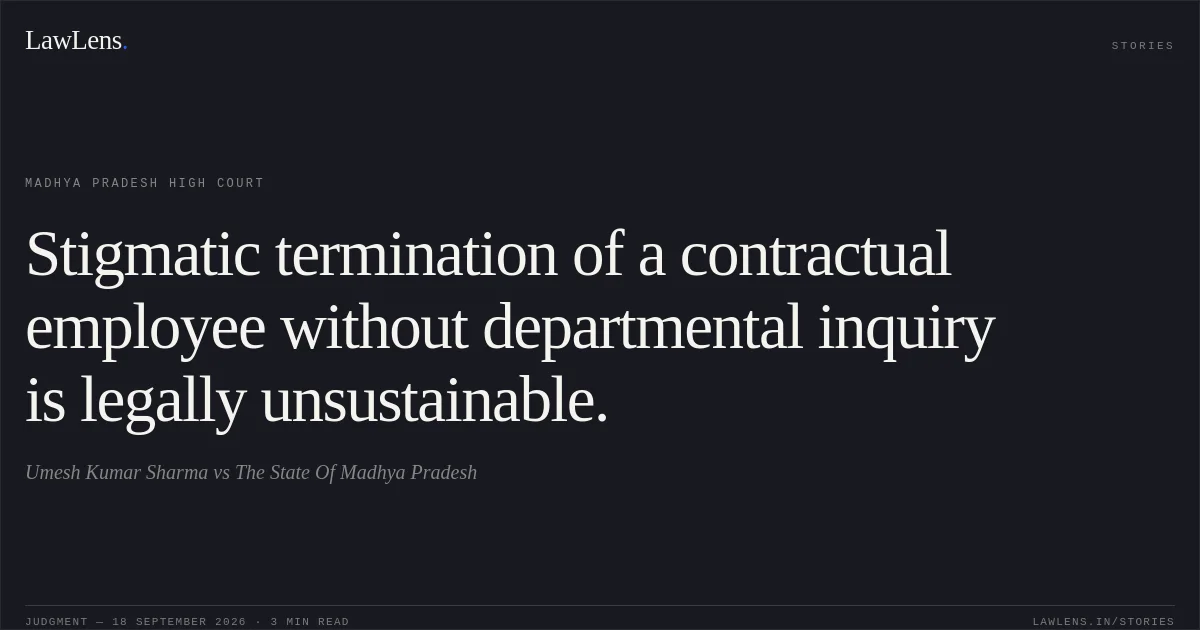
The Court held that the termination order dated 30 September 2025 was stigmatic, non-speaking and passed in breach of the principles of natural justice without a charge-sheet or regular departmental inquiry.
The termination order and the appellate rejection order dated 5 May 2026 were accordingly set aside.
Source reference: para. 21(i)The respondents were directed to reinstate the petitioner forthwith with all consequential benefits, but without back wages on the principle of “no work, no pay”.
Source reference: para. 21(ii)The respondents were granted liberty to take fresh action against the petitioner in accordance with law, if so advised.
Source reference: para. 21(iii)Original Court PDF
Umesh Kumar SharmavsThe State Of Madhya Pradesh
Click to open original judgment
Original judgment, available to read, download and summarize on LawLens.in