01Facts
The petitioner was appointed as a Gram Rojgar Sahayak in 2012.
¶ 1–2In anticipation of Panchayat elections, and because his brother was contesting the election, the petitioner was assigned charge of MGNREGA on 3 July 2022.
¶ 1–2A show-cause notice was thereafter issued alleging that a viral video showed the petitioner campaigning in violation of the Model Code of Conduct. He was directed to submit his explanation within 24 hours.
¶ 5–6The petitioner submitted a written reply, but the Collector, Guna terminated his contractual services on 4 July 2022, holding that his conduct violated the Model Code of Conduct.
¶ 5–6No charge-sheet was issued and no regular departmental inquiry was conducted. The petitioner’s appeal was rejected by order dated 27 July 2026. He therefore invoked Article 226 seeking quashing of both orders and reinstatement.
¶ 5–6, 1902Issues
i.1. Whether the termination order, which attributed election-related misconduct and violation of the Model Code of Conduct to the petitioner, was stigmatic and could lawfully be passed without a charge-sheet and regular departmental inquiry.
¶ 6–9, 19ii.2. Whether the appellate authority’s rejection order was sustainable when the original termination order was non-speaking, unreasoned, and passed in breach of principles of natural justice.
¶ 14–19iii.3. Whether the petitioner was entitled to reinstatement and consequential benefits, subject to the principle of “no work no pay”.
¶ 2003Law Applied
The Court applied Article 226 of the Constitution and the principles of natural justice, holding that termination founded on allegations of misconduct and carrying stigma cannot ordinarily be effected without a proper disciplinary inquiry.
¶ 7It relied on Khem Chand v. Union of India, which recognizes the reasonable opportunity to deny the allegations, cross-examine witnesses, lead evidence, and make a representation against the proposed punishment.
¶ 7Relying on Rahul Tripathi v. Rajeev Gandhi Shiksha Mission, Jitendra v. State of M.P., and Malkhan Singh Malviya v. State of M.P., the Court held that an order based on misconduct and affecting future employment prospects is stigmatic and requires an inquiry.
¶ 7The Court further relied on Rajesh Kumar Rathore v. High Court of M.P., Devkaran Patidar v. State of M.P., and Nilesh v. State of M.P., which establish that a Gram Rojgar Sahayak cannot be terminated for alleged misconduct or gross negligence without following the prescribed procedure and proving the charges.
¶ 10–12Under the principles stated in State of Punjab v. Bandip Singh, Kranti Associates Pvt. Ltd. v. Masood Ahmed Khan, and Oryx Fisheries Pvt. Ltd. v. Union of India, administrative and appellate orders affecting rights must contain cogent reasons; reasons in an appellate order cannot cure the absence of reasons and procedural fairness in the original order.
¶ 14–1804Reasoning
The termination order did not merely bring the petitioner’s contract to an end simpliciter; it expressly recorded that he had participated in election campaigning, distributed campaign material, and acted contrary to the Model Code of Conduct. These findings attributed misconduct and thereby cast a stigma affecting his future employment prospects.
¶ 5, 8–9Although the petitioner was given a show-cause notice and submitted a reply, he was not served with a charge-sheet, given an opportunity to test the evidence—including the alleged viral video—or afforded a regular departmental inquiry. The Court accordingly held that the preliminary show-cause process was insufficient to establish misconduct or justify stigmatic termination.
¶ 6, 8, 19Since the original order was also non-speaking and failed to properly consider the petitioner’s explanation, the subsequent appellate order could not validate it; an appellate decision cannot compensate for the absence of a fair and reasoned original proceeding.
¶ 18The case was therefore covered by the earlier decisions requiring reinstatement while preserving the employer’s liberty to proceed afresh in accordance with law.
¶ 9, 11–13, 2005Holding
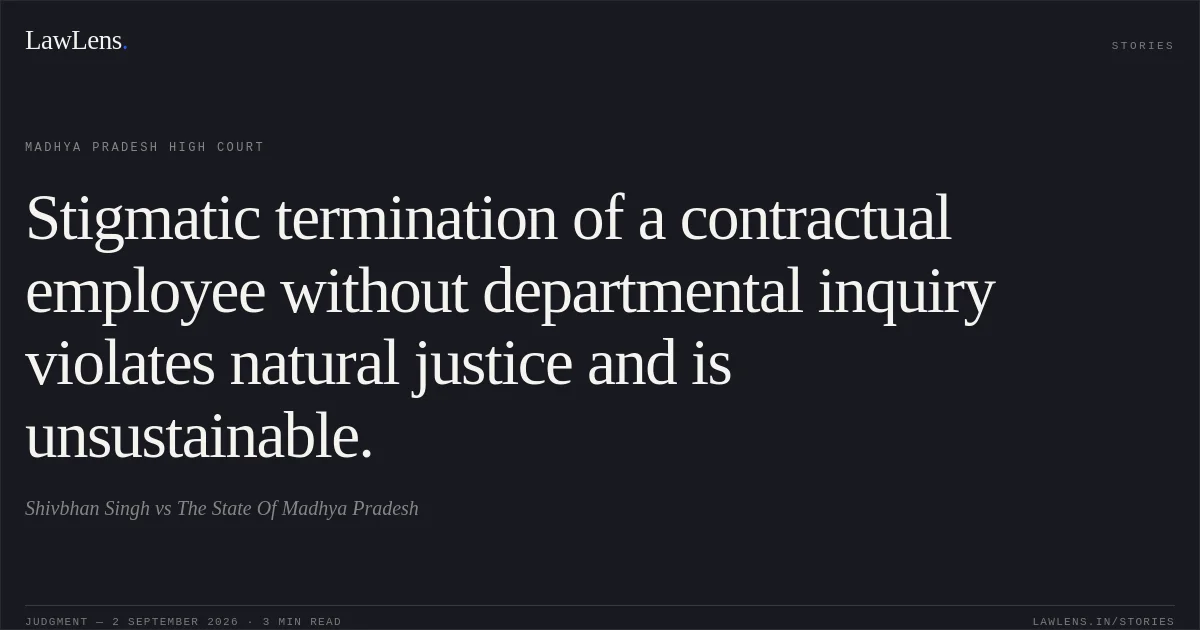
The High Court allowed the petition and set aside the termination order dated 4 July 2022 and the appellate rejection order dated 27 July 2026.
¶ 20(i)The respondents were directed to reinstate the petitioner forthwith with all consequential benefits, but without back wages on the principle of “no work no pay”.
¶ 20(ii)The respondents were granted liberty to take fresh action against the petitioner, if so advised, strictly in accordance with law.
¶ 20(iii)Original Court PDF
Shivbhan SinghvsThe State Of Madhya Pradesh
Click to open original judgment
Original judgment, available to read, download and summarize on LawLens.in