Facts
The petitioner was appointed as a Gram Rojgar Sahayak on a contractual basis in 2010 and served for approximately 12 years.
Source reference: para. 2On 06.04.2022, his services were terminated following a show-cause notice dated 23.03.2022 regarding allegations of irregularities in labor employment and incomplete housing under the "Prime Minister Aawas Yojna".
Source reference: para. 1, 2The petitioner challenged the termination and subsequent appellate orders dated 28.02.2023 and 18.12.2023, contending that the termination was punitive and stigmatic, passed without a full-fledged departmental enquiry or a proper opportunity for a hearing.
Source reference: para. 2, 3, 9The respondents maintained that as a contractual employee with unsatisfactory performance and an alleged admission of lapses, a show-cause notice was sufficient procedure.
Source reference: para. 6Issues
1. Whether the termination of a contractual employee based on allegations of misconduct and irregularities is "stigmatic" in nature, requiring a full-fledged departmental enquiry.
Source reference: para. 7, 82. Whether the issuance of a show-cause notice and consideration of a reply, without a formal inquiry or cross-examination of witnesses, satisfies the principles of natural justice for a contractual employee facing punitive action.
Source reference: para. 4, 8Law Applied
The Court primarily applied the principles of Natural Justice, which mandate that if a termination order is founded on allegations of misconduct casting a stigma, the employer must follow a fair procedure regardless of the employee's contractual status.
Source reference: para. 8It relied on the doctrine established in Malkhan Singh Malviya v. State of M.P. (W.A. No. 1166/2017), which holds that even for contractual staff, a fair hearing—including the supply of material evidence and the right to cross-examine witnesses—is mandatory if the dismissal is punitive.
Source reference: para. 8The Court further referenced Tufan Singh Narban v. Panchayat and Rural Development Department (WP No. 4499/2019) and Lokesh Sharma v. Panchayat and Rural Development Department (WP No. 18455/2022) to support the requirement of a formal inquiry.
Source reference: para. 5Reasoning
The Court determined that the termination was not a simple case of non-renewal of a contract but was explicitly "rooted in allegations of misconduct and gross irregularities".
Source reference: para. 7Consequently, the order was characterized as stigmatic and punitive rather than administrative.
Source reference: para. 7The Court reasoned that a mere preliminary consideration of a reply to a show-cause notice is insufficient to discharge the employer's liability to provide a proper hearing.
Source reference: para. 8By failing to issue a formal charge sheet or conduct an inquiry where the petitioner could cross-examine witnesses and challenge evidence, the respondents violated the petitioner's constitutional rights and the settled principles of law governing even contractual employment.
Source reference: para. 4, 8The Court found the lack of specific detail regarding the alleged deficiencies further evidenced the arbitrary nature of the administrative action.
Source reference: para. 5Holding
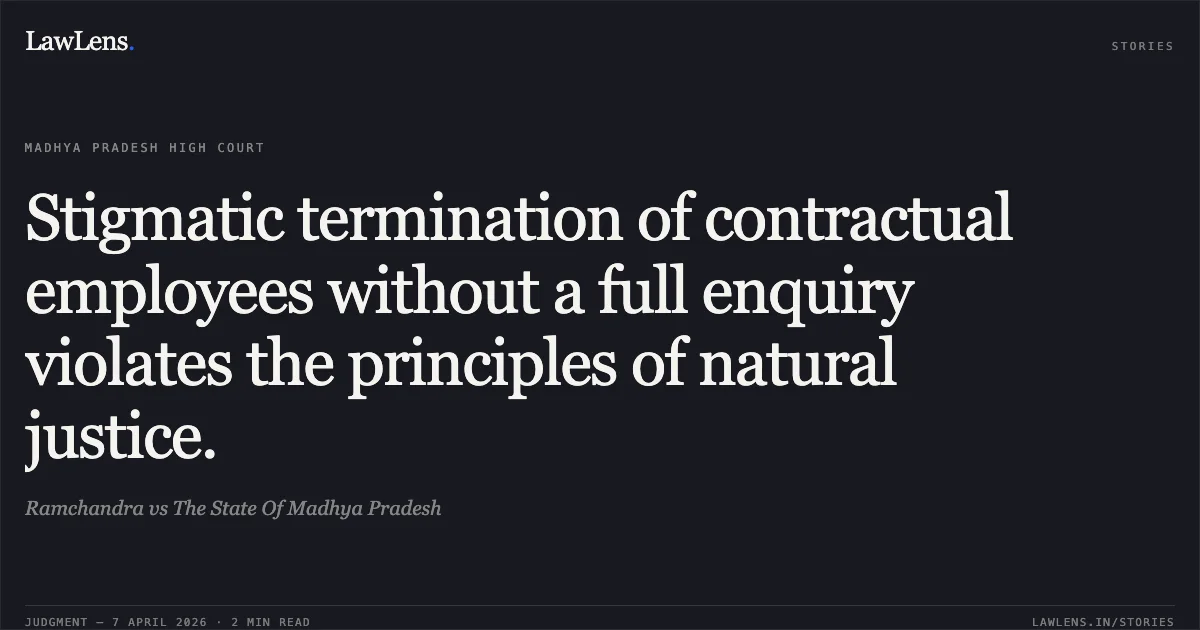
The Court answered that the termination was stigmatic and passed in gross violation of natural justice.
The High Court quashed the termination order dated 06.04.2022 and the appellate orders dated 28.02.2023 and 18.12.2023.
Source reference: para. 9, 10The respondents were directed to reinstate the petitioner as Gram Rojgar Sahayak forthwith and pay 25% back wages for the period he remained out of service, with the process to be completed within 60 days.
Source reference: para. 10, 11The Court granted the respondents liberty to conduct a full-fledged enquiry in accordance with the law.
Source reference: para. 12Original Court PDF
RamchandravsThe State Of Madhya Pradesh
Click to open original judgment
Original judgment, available to read, download and summarize on LawLens.in