01Facts
The petitioner was appointed as Gram Rojgar Sahayak at Village Panchayat Pipra on 5 April 2019.
p. 2Following a fact-finding investigation into alleged financial irregularities in payment of wages under the Pradhan Mantri Awas Yojana and verification of muster rolls, a show-cause notice was issued to him; he submitted a reply, but no charge-sheet or regular departmental enquiry was conducted.
pp. 3–5, 16–17His services were terminated on 26 May 2022 by an order attributing financial irregularities and misconduct to him.
pp. 3–4The petitioner’s first appeal was initially allowed and the matter was remanded for reconsideration after recording statements of beneficiaries.
p. 2Upon reconsideration, the Collector again confirmed the termination on 22 September 2023, and the second appellate authority dismissed the petitioner’s appeal on 1 February 2024.
pp. 2–302Issues
i.Whether termination of the petitioner’s services through an order attributing financial irregularities and misconduct, without issuing a charge-sheet or conducting a regular departmental enquiry, was legally sustainable.
¶ 5–9, 19ii.Whether the termination and appellate orders were invalid for being non-speaking, unreasoned, and violative of principles of natural justice.
¶ 14–19iii.Whether the petitioner was entitled to reinstatement and consequential benefits, and whether the respondents could be granted liberty to proceed afresh in accordance with law.
¶ 2003Law Applied
Article 226 empowers the High Court to judicially review administrative action, particularly where there is violation of natural justice.
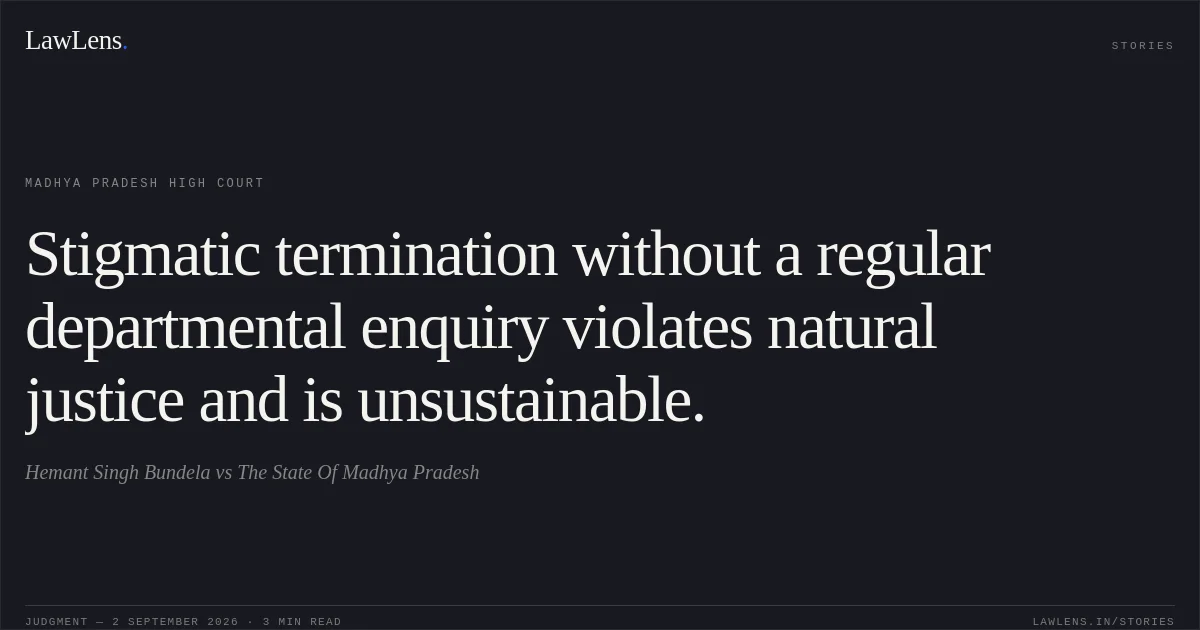
¶ 6–10A termination order founded on allegations of misconduct and casting a stigma on the employee’s conduct or character cannot ordinarily be passed without a regular departmental enquiry, including disclosure of charges and an effective opportunity to defend, cross-examine witnesses, and produce evidence.
¶ 6–10The Court relied on Khem Chand v. Union of India, which explained the components of reasonable opportunity, and on Rahul Tripathi v. Rajeev Gandhi Shiksha Mission, Jitendra v. State of M.P., and Malkhan Singh Malviya v. State of M.P., holding that stigmatic termination entails serious consequences and requires an enquiry.
¶ 7The applicable MGNREGS guidelines also contemplated termination for proved irregularities or gross negligence, including action by the competent authority under the prescribed procedure.
¶ 12–13Administrative and quasi-judicial authorities must provide cogent and self-contained reasons; appellate reasons cannot cure the absence of reasons in the original order, as recognised in State of Punjab v. Bandip Singh, Kranti Associates Pvt. Ltd. v. Masood Ahmed Khan, and Oryx Fisheries Pvt. Ltd. v. Union of India.
¶ 14–1804Reasoning
The termination order expressly recorded findings of financial irregularities and misconduct against the petitioner and therefore was stigmatic, rather than a simple or innocuous termination.
¶ 5, 8–9Although a fact-finding committee had been constituted and a show-cause notice was issued, the petitioner was never served with a formal charge-sheet, nor was an Inquiry Officer or Presenting Officer appointed; no regular enquiry was held in which he could effectively contest the evidence.
¶ 8, 19The authorities consequently treated a preliminary fact-finding exercise as a substitute for a disciplinary enquiry, contrary to the requirements of natural justice.
¶ 8, 19The Court further found that the termination order failed to properly consider the petitioner’s reply and that the subsequent orders did not cure the foundational procedural defect or adequately disclose reasons for rejecting his case.
¶ 14–19Since the original stigmatic termination was procedurally invalid, the appellate orders confirming it could not stand.
¶ 14–1905Holding
The Court held that the termination dated 26 May 2022, the order dated 22 September 2023 confirming termination, and the second appellate order dated 1 February 2024 were unsustainable and accordingly set them aside.
¶ 20(i)The respondents were directed to reinstate the petitioner forthwith with all consequential benefits, except back wages, on the principle of “no work, no pay”.
¶ 20(ii)The respondents were granted liberty to initiate fresh proceedings against the petitioner in accordance with law, if so advised.
¶ 20(iii)Original Court PDF
Hemant Singh BundelavsThe State Of Madhya Pradesh
Click to open original judgment
Original judgment, available to read, download and summarize on LawLens.in