Facts
The appellant (husband) was convicted under Sections 302 and 498A of the IPC for the death of his wife.
Source reference: para. 1On June 6, 2013, the appellant informed his father-in-law (PW 1) that the victim had committed suicide by hanging.
Source reference: para. 5PW 1 alleged that the appellant tortured the victim over dowry demands and his extra-marital affairs.
Source reference: para. 4, 16-17The post-mortem report indicated death by violent asphyxia due to strangulation rather than hanging.
Source reference: para. 10, 43The appellant was at home with the victim and their minor children on the night of the incident, and a quarrel was reported.
Source reference: para. 39, 77The Trial Court sentenced the appellant to life imprisonment for murder.
Source reference: para 2The appellant challenged the conviction, citing lack of direct evidence and inconsistencies in witness testimonies.
Source reference: para. 56, 61Issues
1. Whether the non-examination of the complainant during the investigation and the scribe during trial is fatal to the prosecution's case.
Source reference: para. 572. Whether the medical evidence establishes the death as homicidal strangulation rather than suicidal hanging.
Source reference: para. 89, 953. Whether the circumstantial evidence, including the "last seen" theory, is sufficient to sustain a conviction under Section 302.
Source reference: para. 87, 111Law Applied
The court applied Section 302 (Murder) and Section 498A (Cruelty) of the IPC.
Source reference: para. 1It relied on Section 106 of the Indian Evidence Act regarding the "last seen" doctrine, which places the burden of proof on the accused to explain facts within their special knowledge.
Source reference: para. 87It cited Javed Abdul Rajjaq Shaikh v. State of Maharashtra regarding the medical distinctions between hanging and strangulation (e.g., saliva dribbling, ligature mark shape, and neck elongation).
Source reference: para. 96It further applied Ravirala Laxmaiah v. State of A.P., establishing that the absence of a hyoid bone fracture does not exclude a finding of strangulation.
Source reference: para. 97-99Reasoning
The Court found that while several neighbors turned hostile, their prior statements to police regarding the victim’s complaints of torture and the appellant's illicit affairs provided a corroborated motive.
Source reference: para. 66-73The Court invoked the "last seen" theory, noting the appellant was admittedly at the PO with the victim on the fateful night and failed to provide a plausible explanation for her death.
Source reference: para. 86-87Crucially, the Court adopted a detailed medical analysis: the absence of saliva dribbling, the horizontal and continuous nature of the ligature mark, the lack of neck elongation, and the presence of undigested food in the stomach collectively pointed to homicidal strangulation shortly after dinner.
Source reference: para. 103-110The Court dismissed the appellant’s argument regarding the intact hyoid bone, noting that in victims under 40, such bones often remain unbroken during strangulation.
Source reference: para. 100Holding
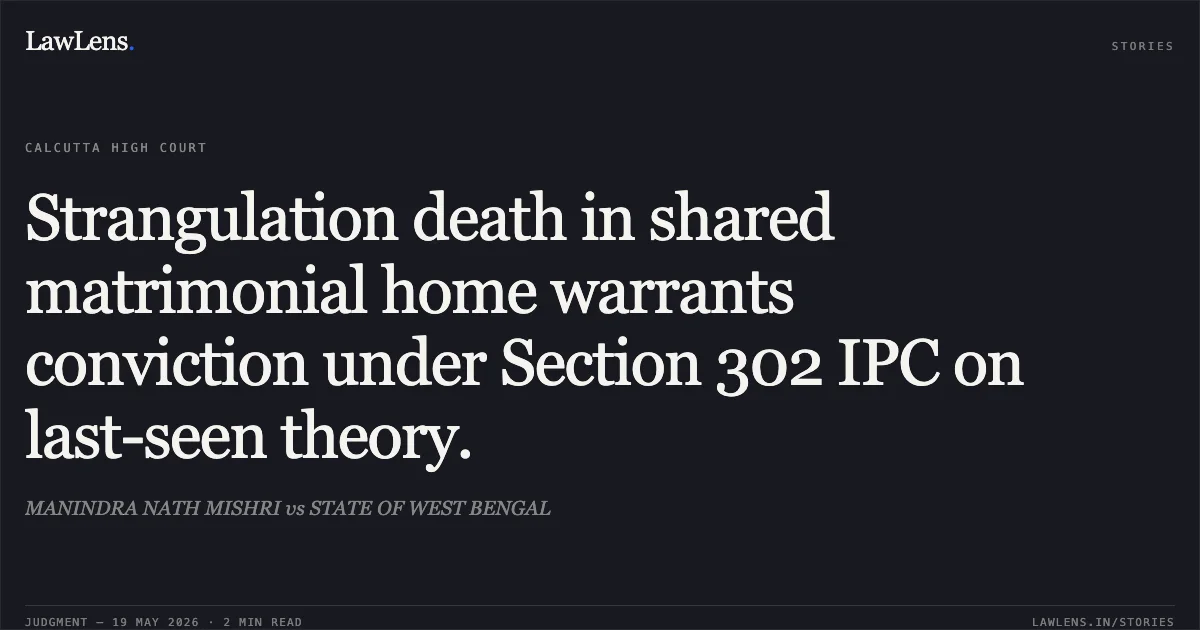
The Court answered all issues in the negative for the appellant, holding that the chain of circumstantial evidence—motive, presence at the scene, and medical findings—was complete.
The High Court upheld the judgment of conviction dated December 5, 2016, and the order of sentence for life imprisonment under Section 302 and two years under Section 498A; the appeal (CRA 719 of 2016) was dismissed.
Source reference: para. 114Acts & Sections Cited
4 provisions across 2 statutes referred to in this judgment. Each provision opens on LawLens.
Indian Penal Code, 18601
Code of Criminal Procedure, 19733
Original Court PDF
MANINDRA NATH MISHRIvsSTATE OF WEST BENGAL
Click to open original judgment
Original judgment, available to read, download and summarize on LawLens.in