Facts
The applicant, a Postal Assistant, appeared for the Limited Departmental Competitive Examination (LDCE) for promotion to the post of Inspector of Posts pursuant to a notification dated 09.09.2019
Source reference: para. 2When the results were declared on 24.06.2020, the applicant’s name appeared in the rejected candidates list at Sl. No. 241 with the remark "Error in OMR Sheet"
Source reference: para. 2The applicant admitted that while he wrote his Roll Number correctly in the boxes, he accidentally darkened the wrong bubble for a single digit in Paper-I
Source reference: para. 3He alleged that the Invigilator assured him it would not be a problem as the machine would read the barcode
Source reference: para. 3The respondents contended that the instructions on the Admit Card, Question Booklet, and OMR sheet explicitly stated that failure to correctly fill particulars would result in non-evaluation
Source reference: para. 4A total of 390 candidates were rejected nationwide for similar OMR errors
Source reference: para. 5Issues
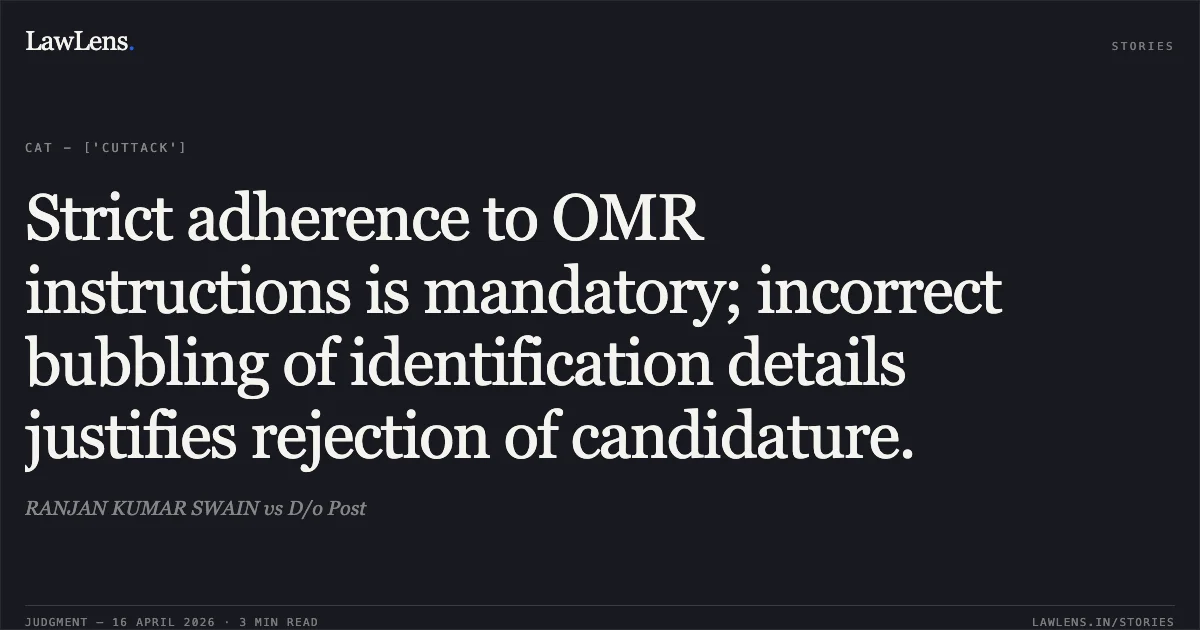
1. Whether the rejection of the applicant’s candidature due to incorrect bubbling of the Roll Number on the OMR sheet was legally sustainable.
Source reference: para. 1, 72. Whether the applicant is entitled to the evaluation of his OMR sheet on grounds of lack of malafide intent and alleged verbal assurance by the Invigilator.
Source reference: para. 3, 7Law Applied
Part-II of Appendix-37 of the Postal Manual Vol.-IV, which mandates strict adherence to instructions for filling answer books and OMR sheets
Source reference: para. 4The principle that recruitment actions must be regulated strictly by the rules, as established in T. Kannan & Ors v. S.K. Nayyar (1991) 1 SCC 544, A.N. Sehgal and Ors v. Raje Ram Sheoran (1992) (1) Supp 1 SCC 304, and State of Kerala v. N.M. Thomas (1976) 2 SCC 310
Source reference: para. 8Poonam Dwivedi v. State of UP (Civil Appeal of 2026), which held that in large-scale public recruitments processed via computer software, any error in the application/OMR is bound to result in rejection to ensure the integrity and expeditious completion of the process
Source reference: para. 9Reasoning
The Tribunal reasoned that the instructions provided to the candidates were clear, multiple, and unambiguous, appearing on the Admit Card, Question Booklet, and the OMR sheet itself
Source reference: para. 4The applicant’s failure to correctly darken the bubbles was a breach of these mandatory instructions
Source reference: para. 7The Tribunal noted that OMR evaluation is an automated electronic process; therefore, any inconsistency in filling the bubbles naturally leads to rejection by the scanning machine
Source reference: para. 5, 7The court dismissed the applicant's argument regarding the Invigilator's assurance, noting that Invigilators are present for conduct and discipline, not to provide legal clarifications or waive examination rules
Source reference: para. 5Significantly, the Tribunal held that granting relief to the applicant would constitute unfair discrimination against the 389 other candidates rejected for similar errors
Source reference: para. 7, 9The court emphasized that sympathy and sentiment have no place in judicial review when rules are clear
Source reference: para. 8Holding
The Tribunal held that the rejection of the applicant's candidature was valid and in accordance with the prescribed rules and the automated nature of the evaluation process
the direct answer to the issues is that a candidate bears the sole responsibility for correctly filling the OMR sheet, and failure to do so justifies non-evaluation
Source reference: para. 7The Original Application (OA) was dismissed, and no relief was granted to the applicant
Source reference: para. 10Acts & Sections Cited
1 provisions across 1 statute referred to in this judgment. Each provision opens on LawLens.
Administrative Tribunals Act, 19851
Original Court PDF
RANJAN KUMAR SWAINvsD/o Post
Click to open original judgment
Original judgment, available to read, download and summarize on LawLens.in