Facts
The Petitioners are various street vendors whose applications for vending licenses were rejected by the Town Vending Committee (TVC) of the Delhi Cantonment Board.
Source reference: p. 3On 15th January 2026, the TVC passed a resolution (Resolution No. 3) establishing a policy that only vendors who could produce at least three challans issued by the Board prior to 27th October 2023 (the survey commencement date) would be eligible for inclusion in the list of authorized vendors.
Source reference: p. 4, 7The Petitioners challenged these rejections, arguing that despite having fewer than three challans (one or two), they had been vending continuously and should be included.
Source reference: p. 8Issues
1. Whether the TVC's policy requiring a minimum of three challans issued prior to 27th October 2023 for vendor certification is legally valid.
Source reference: p. 82. Whether vendors who fail to meet the "three-challan" threshold can be considered for inclusion in the current list of authorized vendors.
Source reference: p. 9Law Applied
The Court applied the principles of administrative policy-making by statutory bodies under the Street Vendors (Protection of Livelihood and Regulation of Street Vending) Act/Scheme framework.
Source reference: no citationTVC’s Resolution No. 3 dated 27th January 2026 (based on minutes dated 15th January 2026), which dictates that eligibility for street vending is contingent upon proof of prior vending (challans) and the holding capacity of the designated zones.
Source reference: p. 4, 7The court also followed its own precedents in Gyan Chand v. Delhi Cantonment Board and Danveer Yadav v. Delhi Cantonment Board, which upheld the TVC's authority to set verification criteria.
Source reference: p. 4, 5Reasoning
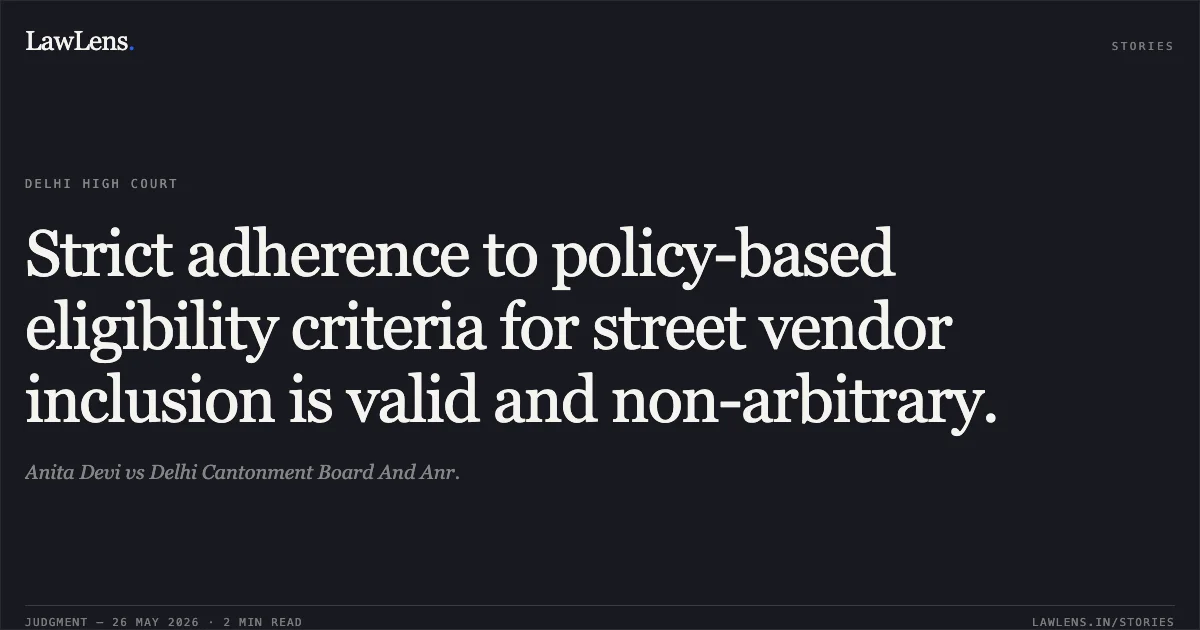
The Court reasoned that determining criteria for the final list of vendors is a policy decision within the exclusive domain of the Delhi Cantonment Board, necessitated by the need to balance vendor livelihoods with pedestrians’ rights and vehicular traffic movement.
Source reference: p. 8The Court observed that the TVC had conducted a "fair scrutiny" of documents and that the requirement of three challans served as a reasonable evidentiary threshold for verifying long-term vending activity prior to the 2023 survey.
Source reference: p. 8Since the Petitioners could not meet this specific policy requirement, the Court found no procedural or substantive fault in the rejection of their candidatures.
Source reference: p. 9The Court emphasized that while one or two challans might show some prior activity, they do not fulfill the three-challan policy mandate currently in force.
Source reference: p. 9Holding
The Court dismissed the petitions, holding that the rejection orders for vendors who failed to produce three challans prior to 27th October 2023 cannot be faulted.
If the TVC finalizes its vending plan and finds excess holding capacity, these Petitioners may be considered during the next survey cycle.
Source reference: p. 9The Delhi Cantonment Board was granted liberty to take action against any unauthorized vendors in accordance with the law.
Source reference: p. 9Acts & Sections Cited
3 provisions across 1 statute referred to in this judgment. Each provision opens on LawLens.
Street Vendors (Protection of Livelihood and Regulation of Street Vending) Act, 20143
Original Court PDF
Anita DevivsDelhi Cantonment Board And Anr.
Click to open original judgment
Original judgment, available to read, download and summarize on LawLens.in