Facts
The applicant, Smt. Anita Bai, filed for maintenance under Section 125 Cr.P.C., asserting she is the legally wedded wife of the respondent following a temple marriage and the execution of an agreement/affidavit acknowledging the marital bond
Source reference: para. 2She alleged cruelty and desertion by the respondent, leaving her destitute
Source reference: para. 3The Judicial Magistrate First Class (JMFC), Sehore, granted maintenance of ₹5,000 per month on 19.07.2014
Source reference: para. 4However, on 03.09.2015, the 2nd Additional Sessions Judge, Sehore, set aside this order in revision, holding that an affidavit/agreement was insufficient to prove a legally valid marriage
Source reference: para. 5The applicant challenged this revisional order before the High Court under Section 482 Cr.P.C.
Source reference: para. 1Issues
1. Whether the revisional court erred in requiring strict proof of marriage for the purposes of a summary proceeding under Section 125 Cr.P.C.
Source reference: para. 7, 122. Whether the revisional court exceeded its jurisdiction by re-appreciating evidence and substituting the trial court’s findings without establishing perversity
Source reference: para. 15, 17Law Applied
The court primarily applied Section 125 of the Code of Criminal Procedure (Cr.P.C.), 1973, which serves a social-justice purpose to prevent destitution
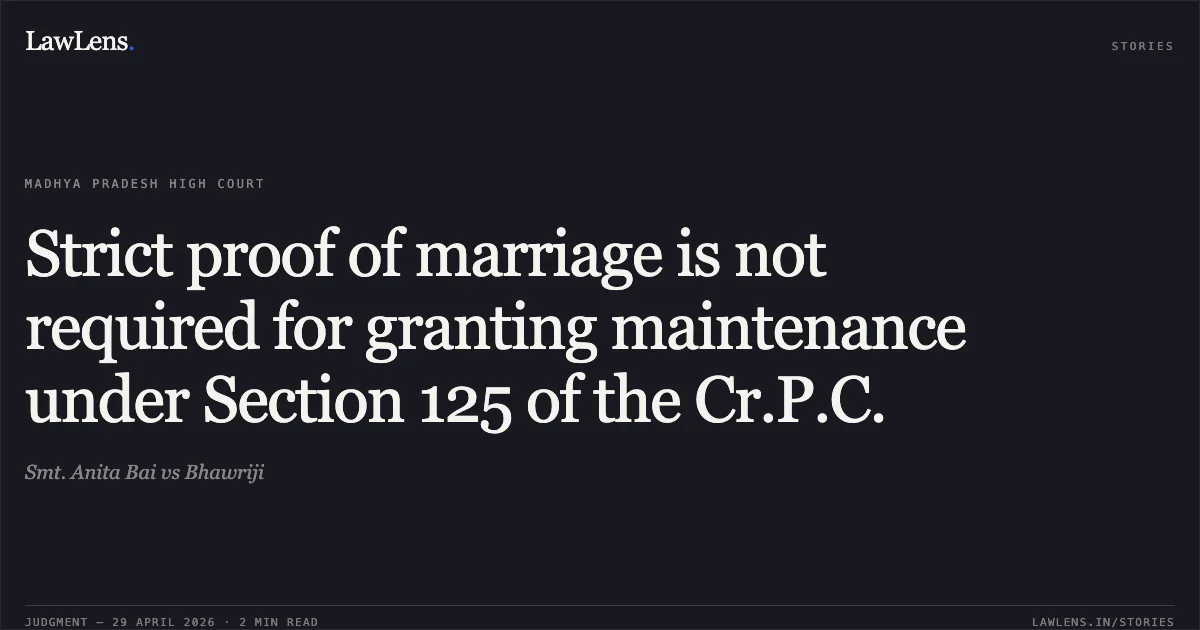
Source reference: para. 12It relied on the principle that proceedings under Section 125 are summary in nature, and "strict proof of marriage" as required in civil or matrimonial disputes is not necessary; rather, a prima facie standard applies where parties cohabiting as husband and wife creates a presumption of marriage
Source reference: para. 12, 13The court further applied the settled principle of revisional jurisdiction, which limits interference to cases of patent illegality or perversity and prohibits the mere substitution of views through re-appreciation of evidence
Source reference: para. 15Reasoning
The High Court observed that the JMFC had recorded a categorical finding based on evidence that the parties lived as husband and wife and that the applicant was deserted without cause
Source reference: para. 11The court reasoned that the revisional court adopted a "hyper-technical approach" by demanding evidence of essential ceremonies and discarding the marriage solely because it was evidenced by an affidavit/agreement
Source reference: para. 12, 14The court noted that for Section 125, the focus is on preventing vagrancy, not determining the technical validity of a marriage
Source reference: para. 13Furthermore, the High Court found that the revisional court improperly performed a de novo appreciation of evidence without demonstrating any material irregularity in the trial court's original order, thereby exceeding its limited revisional jurisdiction
Source reference: para. 15, 17Holding
The High Court answered both issues in the affirmative, holding that the revisional court's order suffered from patent illegality
The petition under Section 482 Cr.P.C. was allowed, the revisional order dated 03.09.2015 was quashed, and the trial court's order dated 19.07.2014 was restored
Source reference: para. 18The respondent was directed to pay maintenance of ₹5,000 per month from the date of the original application
Source reference: para. 19Acts & Sections Cited
2 provisions across 1 statute referred to in this judgment. Each provision opens on LawLens.
Code of Criminal Procedure, 19732
Original Court PDF
Smt. Anita BaivsBhawriji
Click to open original judgment
Original judgment, available to read, download and summarize on LawLens.in


