Facts
The Central Bureau of Investigation (CBI) registered an FIR against Respondent No. 2 (Raman Gautam) and others for the transmission and storage of Child Sexual Exploitation Material (CSEM) under the IT Act and IPC
Source reference: para 4Searches conducted at the residence of Respondent No. 2 led to the seizure of a hard disk and mobile phone containing 48 pornographic videos depicting children
Source reference: para 5-6Further investigation revealed that Respondent No. 3 (Sandeep Singh) had transmitted this material to Respondent No. 2 and was in possession of 25 similar videos
Source reference: para 5-6Both were chargesheeted under Section 15(2) of the POCSO Act, Section 67B of the IT Act, and Section 120B of the IPC
Source reference: para 7The Special POCSO Court discharged the respondents of the offence under Section 15(2) of the POCSO Act, reasoning that in the absence of identified victims, documentary proof, or scientific age-determination tests (e.g., ossification), the mandatory criteria for establishing the subjects as "children" were not met
Source reference: para 9The High Court initiated this suo motu revision to examine the legality of the discharge
Source reference: para 3Issues
1. Whether the physical identification or documentary proof of age of a victim is mandatory to invoke Section 15(2) of the POCSO Act in cases involving child pornographic material.
Source reference: para 10, 282. Whether the "test of subjective satisfaction" applies to the determination of "child" status under Section 2(1)(da) of the POCSO Act.
Source reference: para 33, 36Law Applied
The Court primarily applied Section 15(2) of the POCSO Act, which penalizes the storage or possession of pornographic material involving a child for transmission or distribution
Source reference: para 16It interpreted the definition of "child" under Section 2(1)(d) alongside the definition of "child pornography" under Section 2(1)(da), the latter of which includes images that "appear to depict a child"
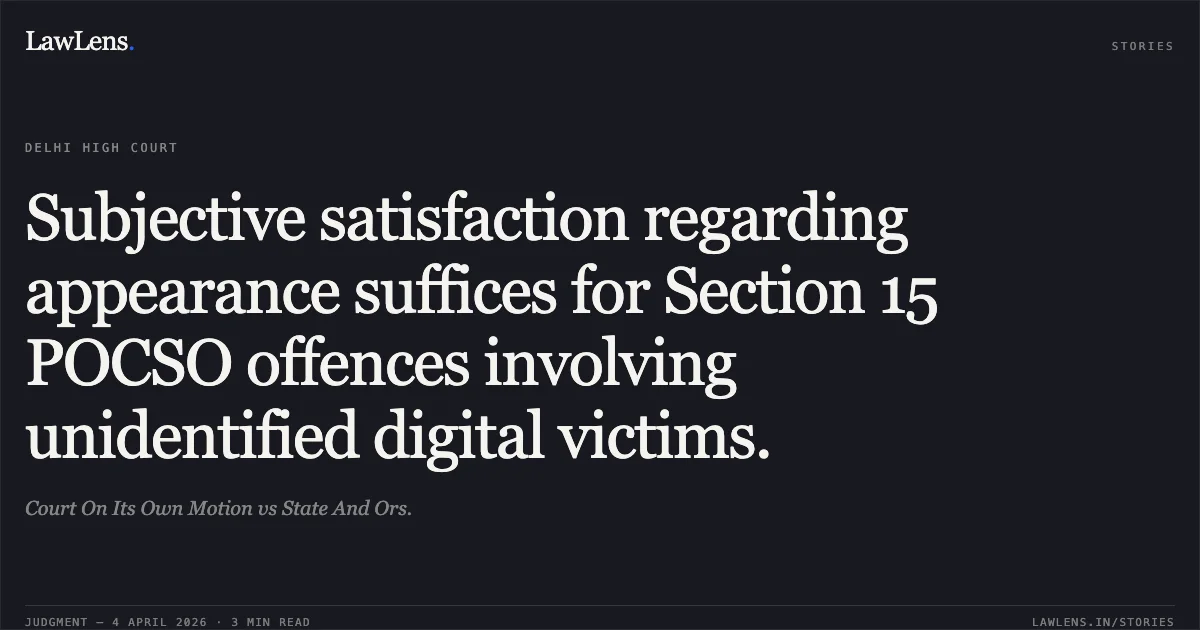
Source reference: para 23, 30The Court relied on the precedent of Just Rights for Children Alliance v. S. Harish (2024), which established that for offences relating to child pornography, courts must form a prima facie "subjective satisfaction" based on the perspective of an ordinary prudent person rather than relying solely on objective age-determination procedures under Section 34 of the POCSO Act or Section 94 of the JJ Act
Source reference: para 33, 36Reasoning
The Court observed that while Section 34 of the POCSO Act and Section 94 of the JJ Act provide objective criteria for age determination, these are applicable when the victim is identifiable and physically available
Source reference: para 27-28In cases of CSEM involving unidentified victims, the Court held that a rigid application of these sections would frustrate the legislative intent and render Section 15(2) unworkable
Source reference: para 34-35The Court emphasized that Section 2(1)(da) was specifically amended to include material that "appears to depict a child," signifying a legislative departure from strict objective age-testing in pornography cases
Source reference: para 34, 36Applying this to the facts, the Court noted that two medical experts (PW-9 and PW-9(1)) had opined, based on secondary sexual characteristics, that the individuals in the videos appeared to be under 18 years of age
Source reference: para 37Furthermore, statements from Delhi Commission for Women officials and forensic reports from the CFSL prima facie established the storage and transmission of CSEM by the respondents
Source reference: para 38-41Consequently, the Court found that the "subjective satisfaction" test was met
Source reference: para 40Holding
The High Court set aside the impugned order dated 01.09.2023 to the extent that it discharged the respondents under Section 15(2) of the POCSO Act
It held that conclusive objective age determination is not a prerequisite for framing charges in child pornography cases if the material, to an ordinary prudent mind, appears to involve a child
Source reference: para 33, 36The Court directed the Sessions Court to frame charges against Respondent Nos. 2 and 3 under Section 15(2) of the POCSO Act and proceed with the trial in accordance with law
Source reference: para 44Acts & Sections Cited
7 provisions across 3 statutes referred to in this judgment. Each provision opens on LawLens.
Protection of Children from Sexual Offences Act, 20124
Code of Criminal Procedure, 19732
Juvenile Justice (Care and Protection of Children) Act, 2015.1
Original Court PDF
Court On Its Own MotionvsState And Ors.
Click to open original judgment
Original judgment, available to read, download and summarize on LawLens.in