Facts
The Applicant challenged a decree of eviction passed by the Trial Court and confirmed by the Appellate Bench of the Small Causes Court on the grounds of unlawful subletting and default in payment of rent
Source reference: para. 1Respondent No. 1 (Plaintiff) acquired ownership of the building "Kadri Mansion" in 2006 and found the Applicant in possession of the suit premises, originally tenanted by one late Ballaram Hullaji
Source reference: para. 2The Applicant claimed that tenancy rights were assigned to him in 1995 with the consent of previous owners
Source reference: para. 2During the appeal, the Applicant filed five applications, including for additional evidence (Exhibits 22, 23, 71, 72) and for framing an issue on limitation (Exhibit 67)
Source reference: para. 4The Appellate Court rejected the ground of default but upheld eviction based on unlawful subletting
Source reference: para. 4Issues
1. Whether the Appellate Court’s failure to decide two specific applications for additional evidence (Exs. 22 and 23) necessitates a remand of the case
Source reference: para. 5/162. Whether the Appellate Court erred in deciding the issue of limitation without referring it to the Trial Court for additional evidence under Order XLI Rule 25 of the CPC
Source reference: para. 6/283. Whether the suit for eviction based on unlawful subletting was barred by limitation under Article 66 of the Limitation Act
Source reference: para. 7/304. Whether the Applicant attained the status of a tenant due to his name appearing in a list appended to the Plaintiff's Deed of Conveyance
Source reference: para. 8/37Law Applied
The court applied Order XLI Rule 27 of the CPC, which prohibits additional evidence at the appellate stage except under specific exhaustive conditions to prevent filling lacunae
Source reference: para. 20-21It relied on Order XLI Rules 24 and 25 of the CPC regarding the Appellate Court's power to determine a case finally if the evidence is sufficient
Source reference: para. 28-29Regarding limitation, it applied Section 22 of the Limitation Act, 1963, and the principle from Balakrishna Savalram Pujari Waghmare v. Shree Dnyaneshwar Maharaj Sansthan, establishing that a continuous wrong creates a fresh period of limitation
Source reference: para. 31It further applied the precedent in Shree Durga Trading Co. v. Ateeq Anwar Agboatwal, which held that unlawful subletting is a continuing breach
Source reference: para. 30-32Reasoning
The Court found the Applicant’s multiple applications (Exs. 22, 23, 71, 72) to be an abuse of process aimed at delaying the 18-year-old litigation; since the documents were within the Applicant's knowledge during the trial, they did not meet the criteria of Order XLI Rule 27
Source reference: para. 17-24The Court rejected the demand for remand under Rule 25, noting that the issue of limitation was a pure question of law based on admitted facts (the 1995 induction), making additional evidence unnecessary
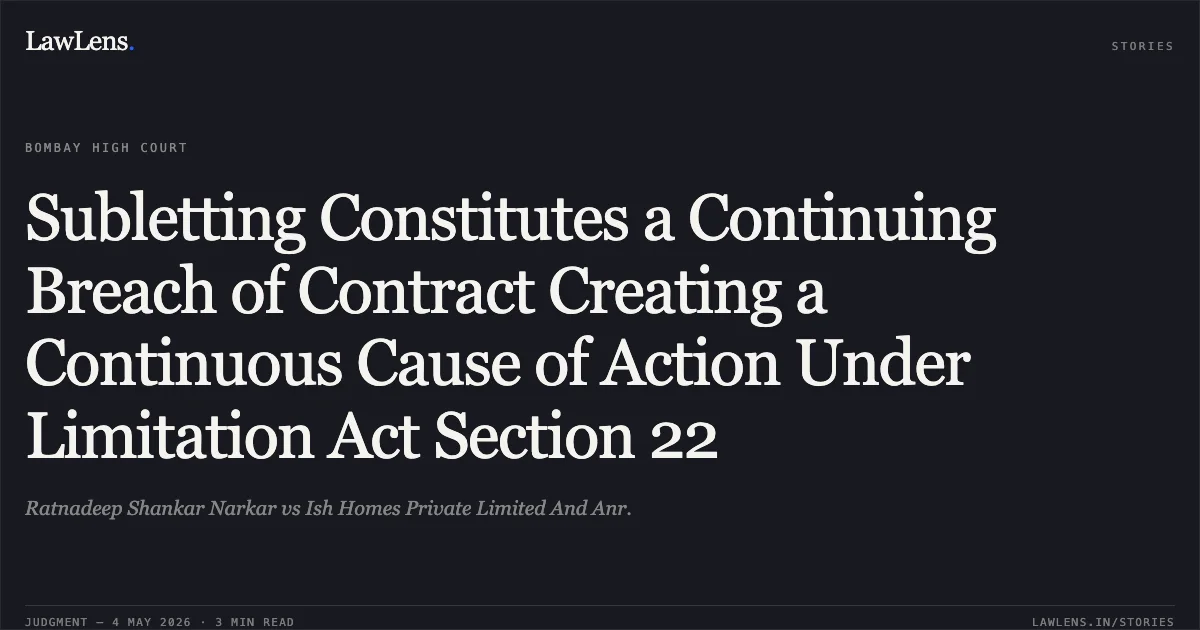
Source reference: para. 29Regarding limitation, the Court distinguished Bakul Nandlal Gandhi and held that under Section 22, subletting constitutes a "continuous cause of action" that persists as long as the sub-tenant remains in possession, thus the suit was within time
Source reference: para. 32-34The Court held that the Conveyance Deed list referred to both "tenants and occupants," and mere inclusion did not prove a tenancy relationship, following Ambavi Raghu Patel v. M/s. Ish Homes Pvt. Ltd.
Source reference: para. 37Holding
The Court answered all issues in the negative. It held that the Appellate Court's failure to expressly reject Exs. 22 and 23 was not fatal given the Applicant's conduct and the lack of merit in those applications
The suit was found to be within the limitation period as subletting is a continuing breach, the Applicant was confirmed as an unlawful sub-tenant and the decree of eviction was upheld. The Civil Revision Application was dismissed.
Source reference: para. 35, 38Acts & Sections Cited
4 provisions across 3 statutes referred to in this judgment. Each provision opens on LawLens.
Code of Civil Procedure, 19081
Limitation Act, 19631
Maharashtra Rent Control Act, 19992
Original Court PDF
Ratnadeep Shankar NarkarvsIsh Homes Private Limited And Anr.
Click to open original judgment
Original judgment, available to read, download and summarize on LawLens.in