Facts
The appellant, a constable in the CISF posted at ONGC, Nazira, was assigned watch-tower duty on 28 January 2008.
Source reference: p.2–3It was alleged that, while on duty, he fired a round from his service SLR rifle, sustaining a bullet injury to his own body, with an intention to commit suicide.
Source reference: p.2–3A departmental enquiry was conducted on the basis of fourteen documents and seven witnesses.
Source reference: p.3–4The witnesses stated that the appellant had appeared confused, depressed and withdrawn, was present at the watch tower, and that the firing occurred from his service rifle.
Source reference: p.3–4The rifle contained one fired round, with the remaining rounds found in the magazine and chamber.
Source reference: p.3–4The appellant admitted that the firing occurred and that he sustained the injury, but contended that the rifle had accidentally discharged when it fell while he was unwell and attempting to retrieve it.
Source reference: p.4–5The Enquiry Officer found the charges proved, and the Disciplinary Authority imposed the punishment of removal from service, while directing that the removal would not disqualify him from future government employment.
Source reference: p.5–6His appeal, revision and review were rejected.
Source reference: p.5–6The learned Single Judge dismissed the appellant’s writ petition, holding that the departmental findings were supported by evidence and that the police final report in the criminal case did not automatically exonerate him in the departmental proceeding.
Source reference: p.6–7The appellant preferred the present intra-court appeal.
Source reference: p.6–7Issues
Whether the police final report submitted in the criminal case required the appellant to be exonerated in the departmental proceeding?
Source reference: p.8–10Whether the Enquiry Officer’s finding that the firing was a deliberate act, rather than an accident, was unsupported, perverse or otherwise liable to judicial interference?
Source reference: p.10–12Whether the appellant was denied a reasonable opportunity to cross-examine the departmental witnesses?
Source reference: p.10–11Whether the punishment of removal from service was disproportionate, warranting interference by the appellate or writ court?
Source reference: p.12–13Law Applied
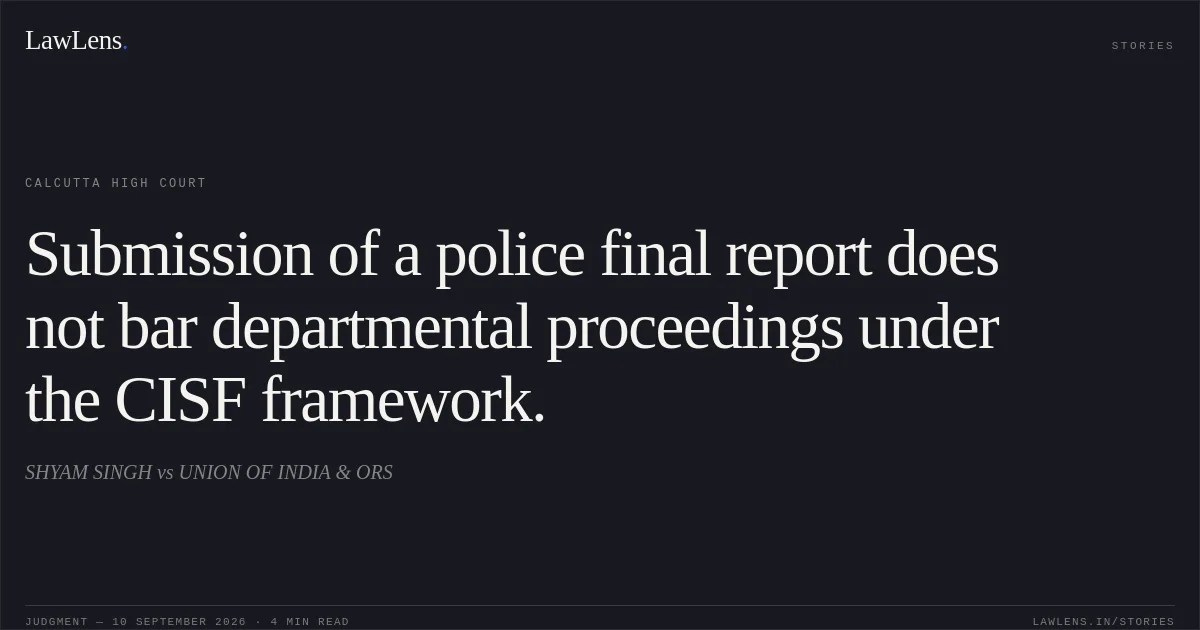
Departmental proceedings and criminal proceedings operate independently and ordinarily apply different standards of proof; therefore, an acquittal or police final report does not, by itself, invalidate disciplinary action.
Source reference: p.8–10The Court distinguished Ex. Sqn. Ldr. R. Sood v. Union of India & Ors., 2026 SCC OnLine SC 590, where statutory provisions under the Air Force Act, pari materia with the Army Act, excluded independent disciplinary action following a criminal acquittal or discharge; no equivalent provision under the CISF Act or Rules was shown to exist.
Source reference: p.8–10Judicial review of departmental findings is limited and does not permit reappreciation of evidence where the conclusion is supported by some material and is neither perverse nor manifestly arbitrary.
Source reference: p.10–12A plea of denial of cross-examination raised belatedly, despite the delinquent having participated in the enquiry and not raising the objection before the Enquiry Officer, may be rejected as an afterthought.
Source reference: p.10–11In assessing proportionality, the Court may consider the heightened requirements of integrity, discipline and devotion to duty applicable to members of a disciplined armed force; Surekha Domaji Bele v. Executive Engineer, Testing Division, MSEDCL, 2026 SCC OnLine SC 1109, concerning a lower-division clerk, was distinguished on facts.
Source reference: p.12–13Reasoning
The Court held that the police final report did not confer any automatic benefit on the appellant because the CISF statutory framework contained no provision comparable to those considered in R. Sood.
Source reference: p.8–10The departmental evidence established that the appellant was posted at the watch tower, was in a confused and withdrawn mental state, and that a round had been fired from his SLR, causing the injury.
Source reference: p.10–12Although no witness had directly seen him fire at himself, the Enquiry Officer relied on the cumulative circumstances, including the weapon used, the bullet trajectory and the appellant’s conduct, to reject the explanation of accidental firing.
Source reference: p.10–12The Court found this conclusion supported by the record and neither perverse nor manifestly arbitrary.
Source reference: p.10–12The objection regarding cross-examination was rejected because the appellant had participated in the enquiry, made a statement, and did not complain before the Enquiry Officer or in his reply to the Presenting Officer’s brief.
Source reference: p.10–11The objection was raised for the first time in the statutory appeal and was therefore treated as an afterthought.
Source reference: p.10–11Finally, given that the appellant was a constable in a disciplined armed force and that firing a service rifle while on guard duty constituted gross misconduct capable of undermining discipline and safety, the punishment of removal was not disproportionate.
Source reference: p.12–13The fact that the removal did not disqualify him from future government employment was regarded as sufficient leniency.
Source reference: p.12–13Holding
The Court answered all issues against the appellant.
The police final report did not invalidate the departmental proceeding; the Enquiry Officer’s findings were supported by evidence and were not amenable to judicial interference; no denial of cross-examination was established; and the punishment of removal from service was not disproportionate in the case of a CISF constable.
Source reference: p.8–13The intra-court appeal was dismissed, the order of the learned Single Judge was affirmed, and any pending application was disposed of accordingly.
Source reference: para. 22–24Original Court PDF
SHYAM SINGHvsUNION OF INDIA & ORS
Click to open original judgment
Original judgment, available to read, download and summarize on LawLens.in