Facts
The respondent filed a criminal complaint against the petitioner in July 2016.
Source reference: p. 1After numerous adjournments, notice under Section 251 CrPC was framed on 19.07.2017.
Source reference: p. 2The petitioner repeatedly failed to cross-examine the complainant, leading the trial court to close the right of cross-examination on 13.12.2018; the petitioner was subsequently declared an absconder on 27.02.2020.
Source reference: p. 2Although the High Court later set aside these orders in 2022, the petitioner continued to seek adjournments and failed to pay costs of Rs. 10,000/- imposed by the Court of Sessions for a fresh opportunity to cross-examine.
Source reference: p. 3Consequently, the trial court again closed the opportunity on 17.02.2024.
Source reference: p. 3The petitioner challenged this via a revision petition along with a Section 5 Limitation Act application, claiming he was delayed by the death of his daughter and uncle.
Source reference: p. 4The Court of Sessions dismissed the revision, finding the petitioner’s explanations regarding his presence at the hospital and the timeline of his daughter's death to be demonstrably false.
Source reference: p. 4Issues
1. Whether the petitioner’s repeated failure to cross-examine the complainant and his reliance on false statements constituted an abuse of the process of law.
Source reference: p. 1, 52. Whether there were sufficient grounds under Section 5 of the Limitation Act to condone the delay in filing the revision petition.
Source reference: p. 4Law Applied
The Court applied the principles governing the inherent powers of the High Court under Section 482 CrPC (now relevant under the procedural framework of the CRL.M.C.) to prevent the abuse of the process of any Court.
Source reference: p. 1, 5Section 5 of the Limitation Act, 1963, which requires the applicant to show "sufficient cause" for delay.
Source reference: p. 4The principle that the procedural law cannot be used as a tool for tactical protraction of trial proceedings or to mislead the court through complete falsehoods.
Source reference: p. 1, 5Reasoning
The Court observed that this was a "classic case of abuse of the procedural law" spanning nearly a decade.
Source reference: p. 1The Court found that the petitioner had been granted multiple indulgences by both the Sessions and High Court, yet consistently opted not to avail them, choosing instead to stall the trial.
Source reference: p. 1, 3Upon analyzing the medical records provided by the petitioner, the Court noted that his excuse for missing the trial (needing to hospitalize his uncle because the uncle's son was away) was "patently false," as the records explicitly noted the son's presence.
Source reference: p. 4Furthermore, the Court noted that the petitioner attempted to mislead the Court regarding the timeline of his daughter’s death to justify a time-barred revision petition, whereas the death had actually occurred a year prior to the claimed period of "mental pain" that allegedly prevented filing.
Source reference: p. 4The Court concluded that the litigation was a "mischievous attempt" to frustrate the respondent into giving up the legal battle.
Source reference: p. 5Holding
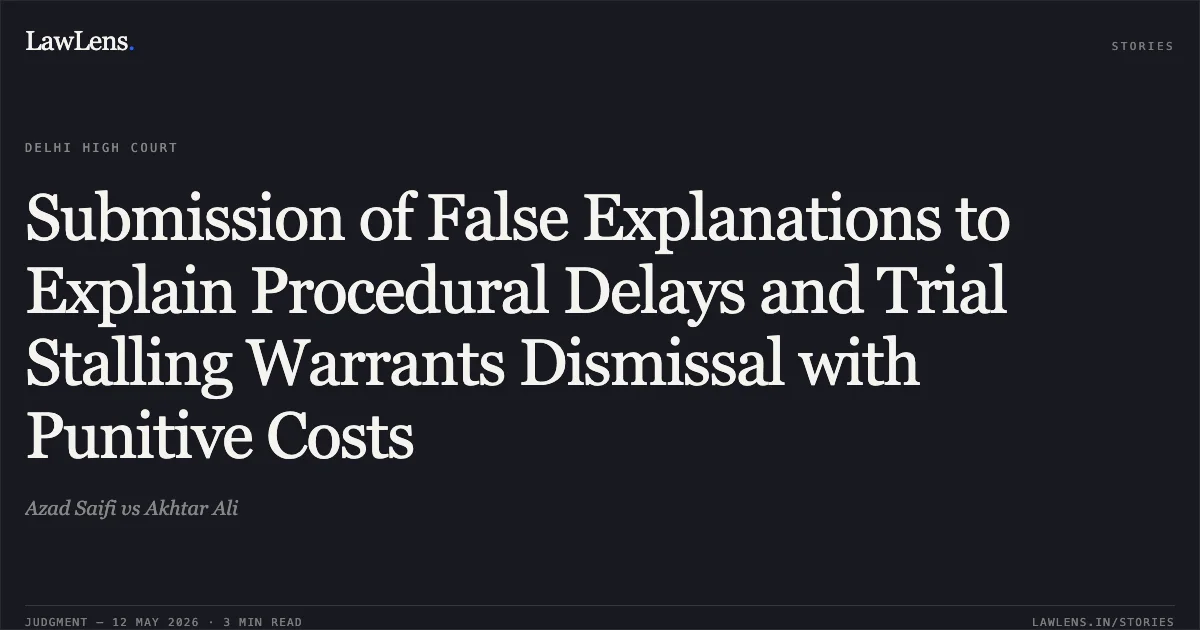
The High Court found no infirmity in the impugned order of the Court of Sessions and upheld the dismissal of the revision petition.
The Court held that the petition was devoid of merit and was filed to endlessly protract the trial.
Source reference: p. 5The petition was dismissed with exemplary costs of Rs. 50,000/- to be deposited with the Delhi High Court Legal Services Committee (DHCLSC) within one week.
Source reference: p. 5The trial court and the Secretary, DHCLSC, were directed to file compliance reports regarding the payment of costs.
Source reference: p. 5Acts & Sections Cited
1 provisions across 1 statute referred to in this judgment. Each provision opens on LawLens.
Limitation Act, 19631
Original Court PDF
Azad SaifivsAkhtar Ali
Click to open original judgment
Original judgment, available to read, download and summarize on LawLens.in