Facts
The petitioner, a Junior Assistant with N.W.K.R.T.C., was charged with unauthorised absence from 27 January to 6 October 2008 and was dismissed after a departmental inquiry.
Source reference: pp. 2–3He challenged the dismissal under Section 10(4-A) of the Industrial Disputes (Karnataka Amendment) Act, 1987. The Labour Court set aside the dismissal, directed reinstatement and substituted stoppage of two increments with cumulative effect. By the time the writ petition was heard, the petitioner had retired.
Source reference: pp. 2–3Before the High Court, he relied on leave applications and medical records relating to back pain, while the Corporation contended that leave had not been sanctioned and that the applications covered a period extending from January to August 2008.
Source reference: pp. 3–5Issues
Whether the Labour Court’s modified punishment for the petitioner’s unauthorised absence warranted interference under Articles 226 and 227 of the Constitution.
Source reference: pp. 5–7Whether the petitioner’s leave applications and medical records established a sufficient basis to treat his absence as authorised or to displace the Labour Court’s decision.
Source reference: pp. 5–6Law Applied
Section 10(4-A) of the Industrial Disputes (Karnataka Amendment) Act, 1987 provided the route by which the petitioner challenged the dismissal before the Labour Court.
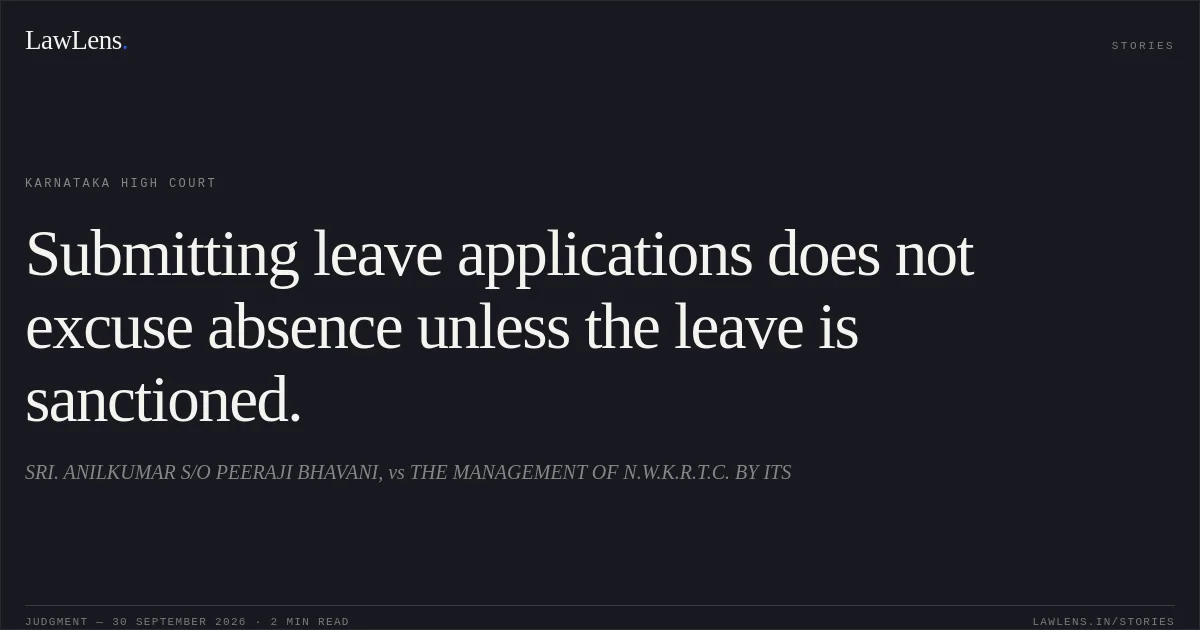
Source reference: p. 2Submitting a leave application does not, by itself, authorise absence; leave must be sanctioned.
Source reference: p. 6It considered Krushnakant B. Parmar v. Union of India, (2012) 3 SCC 178, which the petitioner invoked for the proposition that unauthorised absence must be shown to be wilful, but held that the precedent did not assist him on these facts.
Source reference: pp. 3–4, 6Reasoning
The Court noted that the petitioner had submitted multiple leave applications over several months, undermining his contention that he had been absent for only a short continuous period.
Source reference: pp. 5–7The medical records did not explain the nature or severity of the back pain, establish that he was unable to attend work, or show that leave had been sought from the employer with relevant treatment details. His outpatient treatment and the absence of evidence that leave was sanctioned therefore did not establish that the absence was authorised.
Source reference: pp. 5–7In those circumstances, the Court found no basis to disturb the Labour Court’s decision to substitute a lesser punishment for dismissal.
Source reference: pp. 5–7Holding
The Labour Court’s order setting aside dismissal and imposing stoppage of two increments with cumulative effect did not warrant interference.
The High Court dismissed the writ petition.
Source reference: p. 7Acts & Sections Cited
1 provisions across 1 statute referred to in this judgment. Linked provisions open on LawLens.
Industrial Disputes (Karnataka Amendment) Act, 19871
Original Court PDF
SRI. ANILKUMAR S/O PEERAJI BHAVANI,vsTHE MANAGEMENT OF N.W.K.R.T.C. BY ITS
Click to open original judgment
Original judgment, available to read, download and summarize on LawLens.in